Beyond the Marketing: A Locksmith’s Take on Green Security
I teach my apprentices that if you have to force the key, you’ve already lost. That same logic applies to the hardware we install on residential doors. For 25 years, I’ve sat at a bench surrounded by brass shavings and the smell of tri-flow, and if there’s one thing I’ve learned, it’s that true sustainability isn’t a sticker on a box—it’s longevity. A lock made of cheap zinc or pot metal that ends up in a landfill after three years isn’t green, no matter what the marketing says. When we talk about best residential door locks for safety and durability, we are talking about material science and precision engineering that survives the elements and the burglars alike. A sustainable home in 2026 requires hardware that won’t require an emergency lock change after a break-in because it was too flimsy to resist a simple kick-in.
“Security is always a trade-off between convenience and protection.” – Industry Axiom
The Physics of a Sustainable Deadbolt
To understand what makes a lock eco-friendly, we have to look at the internal physics. Most big-box store locks use a Grade 3 residential standard. Inside, you’ll find thin springs and hollow brass pins. Over time, these pins wear down, creating ‘slop’ in the cylinder. This leads to the key sticking, which leads to the homeowner forcing it, which leads to a snapped blade. In 2026, we are seeing a shift toward high-tolerance machining. When you look at the broken key extraction tools 2026 reviews, you’ll notice that most failures happen in low-grade hardware. A sustainable lock uses solid 360 brass or stainless steel components. These materials are infinitely recyclable, but more importantly, they are durable. We are looking for tight tolerances in the shear line—that microscopic gap where the top pins and bottom pins separate. If that gap is too wide, the lock is vulnerable to bumping; if it’s too tight with poor materials, it jams. Sustainable security means finding the sweet spot where the mechanism operates smoothly for decades.
1. The Modular High-Security Cylinder
The greenest lock is the one you never throw away. Modular cylinders allow a locksmith to change the internal ‘guts’ without replacing the entire housing. For locksmith services for vacation homes, this is a game-changer. Instead of replacing the whole handle set when a tenant loses a key, we simply swap the core. This reduces waste and keeps high-quality steel out of the scrap heap. These systems often utilize lock shield installation for doors to prevent physical tampering, ensuring the heavy-duty housing remains intact for the life of the building.
2. Solar-Augmented Keyless Entry Systems
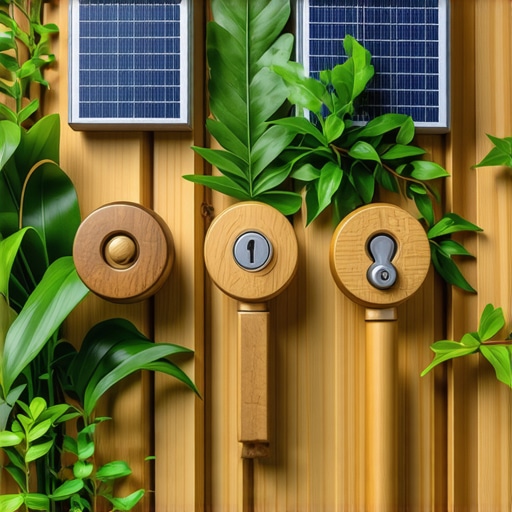
We need to talk about keyless entry systems pros and cons when it comes to the environment. The ‘con’ has always been batteries. Millions of lithium and alkaline batteries end up in the trash every year because of smart locks. The 2026 generation of eco-friendly locks integrates small, high-efficiency solar films or kinetic energy harvesters. Every time you turn the thumbturn or the sun hits the keypad, the capacitor charges. This eliminates the chemical waste of traditional batteries while providing the modern convenience homeowners crave. However, from a security standpoint, I always remind my customers that these must have a mechanical override. Electronics fail; physics is forever.
3. Recycled Alloy Grade 1 Deadbolts
ANSI Grade 1 is the highest level of residential security. In the past, manufacturing these required massive energy expenditure. Now, we are seeing 2026 models forged from 90% recycled industrial steel. These locks are designed to withstand 10 hits from a sledgehammer and 250,000 cycles. When you invest in a Grade 1 lock, you are practicing sustainability through ‘buy it once’ philosophy. The strike plate—the piece on the door frame—is equally important. A sustainable setup uses an extra-long strike plate with three-inch screws that anchor into the wall stud, not just the trim. This prevents the door from being kicked in, which is the most common way burglars enter.
4. Bio-Polymer Smart Hardware
For internal components that don’t require the strength of steel, manufacturers are moving toward plant-based bio-polymers. These aren’t the brittle plastics of the past. These are high-density materials used in the gear trains of keyless ignition repair services and automotive applications. They are self-lubricating, meaning you don’t need to spray them with petroleum-based lubricants every six months. If you do need a lubricant, I always tell my customers to skip the WD-40—which is a solvent, not a true lubricant—and go for a dry film graphite or a synthetic PTFE that doesn’t attract grit and grime that eventually destroys the lock’s internal pin stacks.
5. The Low-Impact ‘Vintage’ Restoration
Sometimes the most eco-friendly option is what’s already there. I often get calls for a locksmith for vintage car keys or historic home hardware. Restoring a 1920s mortise lock is a masterclass in sustainability. These old units were built with massive cast iron cases and thick brass bolts. A lost key replacement for hybrids 2026 might require complex automotive key programming near me, but a 100-year-old skeleton key can be hand-filed from a blank. By repairing instead of replacing, we honor the craft and reduce the carbon footprint of manufacturing new hardware.
“Standard for Residential Deadbolts (ANSI/BHMA A156.36) establishes requirements for bolt impact, cycle tests, and finish resistance.” – ANSI/BHMA Standards
The Verdict: Security and the Environment
Whether you are looking for locksmith services for vacation homes or upgrading your primary residence, stop looking at the price tag and start looking at the weight. If a lock feels light, it’s made of air and zinc. It will fail. If it feels heavy, it’s made of the stuff that lasts. Security isn’t just about keeping people out; it’s about building things that endure. In 2026, a green home is a safe home, and a safe home starts with a lock that doesn’t need a landfill to call home in five years. Don’t let a ‘trunk slammer’ sell you a shiny piece of junk; find a locksmith who knows the difference between a spool pin and a serrated pin, and invest in hardware that will be there for your grandkids.