The Apprentice’s Lesson and the Biometric Mirage
I teach my apprentices that if you have to force the key, you’ve already lost. In my twenty-five years behind the bench, I have seen every iteration of the ‘unpickable’ lock fail because the person behind it forgot that physics doesn’t care about marketing. As we stand in 2026, the automotive industry is pushing biometric keyless entry as the ultimate solution to car theft. They want you to believe that your fingerprint or retina is a more secure bitting than a piece of precision-milled brass. But here in my shop, surrounded by the smell of graphite and the sound of key cutters, I see the reality. Biometrics are not an upgrade in security; they are a shift in the failure point. When a customer walks in asking about transponder chip key cloning 2026 trends, they are usually worried about hackers. They should be worried about the sensor. If the capacitive surface of your car’s handle can’t read your print because of a smear of grease or a drop of rain, you are just as stuck as if you’d snapped a key in the ignition. In 2026, the hardware is getting smaller, but the physics of a bypass remain the same.
“Security is always a trade-off between convenience and protection.” – Industry Axiom
Mechanism Zooming: The Silicon vs. The Solenoid
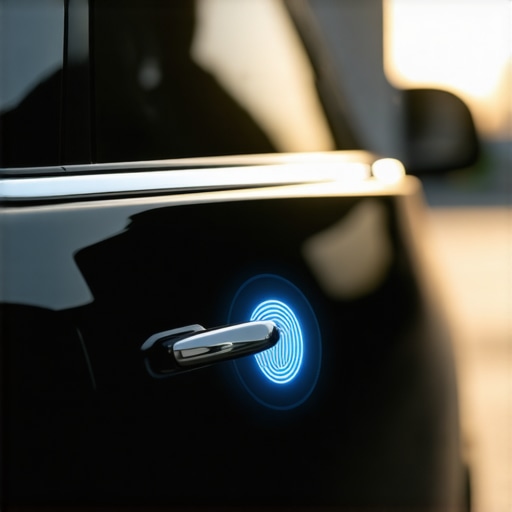
Let’s look at the internal physics of a 2026 biometric automotive handle. You have a capacitive sensor shielded by a thin layer of chemically strengthened glass. When you touch it, the sensor measures the minute electrical charge differences between the ridges and valleys of your skin. This data is converted into a hash and sent to the ECU (Engine Control Unit). The ECU then performs a ‘handshake’ with the door actuator. Here is where the locksmith sees the flaw: the actuator is still a mechanical solenoid. It relies on a spring-loaded plunger to retract the latch. If a thief bypasses the sensor and applies a direct voltage to that solenoid via a harvested CAN-bus injection point, your fingerprint meant nothing. We are seeing a rise in ‘relay-biometric’ spoofing where the signal is intercepted between the handle and the ECU. This is why commercial smart access control 2026 trends are moving toward multi-factor authentication even for vehicle fleets. A single point of failure is a gift to a thief who knows his way around a multimeter.
The Vulnerability of Transponder Chip Key Cloning in 2026
While biometrics get the headlines, transponder chip key cloning 2026 remains the bread and butter of the sophisticated car thief. Modern chips use rolling codes that change every time the car starts, but hackers have developed ‘look-ahead’ algorithms that predict the next hundred codes in the sequence. In my shop, I use high-tier diagnostic tools to re-sync these systems. If you find yourself wondering what to do when locked out of your car because the biometric sensor has fried in the summer heat, the answer is usually found in the manual override. Every biometric car has a hidden mechanical keyway, often tucked behind a plastic cap on the handle. This is the irony of 2026: even the most advanced biometric car still relies on a physical key for emergency access. If you haven’t tested that mechanical key in three years, don’t be surprised when the tumblers are seized with road salt and oxidation.
The Forensic Reality of High-Security Hardware
When we talk about high-security locks for rental properties or locksmith services for vacation homes, we emphasize durability. Biometrics in a car face a harsh environment: vibration, extreme temperature swings, and humidity. These factors degrade the silicon sensors far faster than a standard wafer lock. For those managing fleets, commercial master key system advantages for businesses still outweigh the ‘cool factor’ of biometrics. A master key system allows for hierarchical access without relying on a server that can go down or a battery that can die. I often tell my clients that if they want real security, they should look at lock shield installation for doors and physical barriers. A biometric sensor can be ‘fooled’ by a high-resolution print or a 3D-molded prosthetic; a 1/4 inch steel plate cannot be fooled. It has to be cut, and cutting makes noise. Thieves hate noise.
“The strength of a system is defined by its weakest physical point, not its most expensive digital one.” – Security Manual Guideline
Actionable Diagnostics: Handling the Failure
If you are using biometric entry, you must maintain the mechanical backup. Use a high-quality PTFE-based lubricant—never use WD-40 or heavy oils that attract grit—and cycle the mechanical key twice a year. If you experience a failure, you need to know how to extract a broken key from a lock safely if you’ve snapped the emergency blade in a panic. This involves using a spiral extractor to grip the bitting of the key and pull it past the wafers without deforming the springs. For businesses, ensuring you have fire-rated panic hardware options that integrate with your smart access is non-negotiable. You cannot have a biometric lock that traps people inside during a power failure. The 2026 standards require a mechanical ‘fail-safe’ path. This is the core of my philosophy: electronics are a luxury, but mechanics are a necessity. Whether you are looking for locksmith services for vacation homes or upgrading a commercial complex, always ask: ‘What happens when the power is cut?’ If the answer is ‘I don’t know,’ you don’t have security; you have a fancy paperweight.


![How Access Logs for Smart Locks Catch Security Breaches [2026]](https://prolocksmithco.com/wp-content/uploads/2026/02/How-Access-Logs-for-Smart-Locks-Catch-Security-Breaches-2026-500x330.jpeg)
This article makes some compelling points about the vulnerabilities of biometric systems in cars we tend to overlook. From my experience in locksmithing, I’ve often seen how relying solely on electronic or biometric security can create a false sense of safety. A physical key or mechanical backup, though sometimes seen as outdated, remains a crucial fail-safe, especially considering environmental factors like extreme heat or moisture that degrade sensors faster than anticipated. I’ve encountered cases where biometric sensors failed due to weather or dirt accumulation, leaving owners stranded. I wonder, in your opinion, how feasible is it for manufacturers to integrate truly tamper-proof multi-factor authentication without sacrificing user convenience? It seems like a delicate balance, and I’d love to hear some practical approaches that can ensure security while maintaining ease of access for everyday users.