The Apprentice Lesson: Why Physical Logic Still Rules Digital Entry
I teach my apprentices that if you have to force the key, you’ve already lost. In my shop, we see everything from 19th-century cast-iron skeleton keys to the latest encrypted proximity fobs. This technical wisdom isn’t just about brass; it applies to the silicon and light-waves powering the newest 2026 biometric car entry systems. For years, I’ve watched trunk-slammers and big-box retailers push ‘convenience’ over actual physics, but 2026 marks a turning point where the hardware is finally catching up to the threats. When a customer walks in asking about car key duplication costs 2026, they are no longer just paying for a piece of cut metal; they are paying for a secure cryptographic handshake. We are performing a forensic autopsy on the failed biometric systems of the early 2020s to understand how these three critical flaws were finally mitigated.
“Security is always a trade-off between convenience and protection.” – Industry Axiom
Flaw 1: The Capacitive Surface Bypass and the Shift to Ultrasonic Depth Mapping
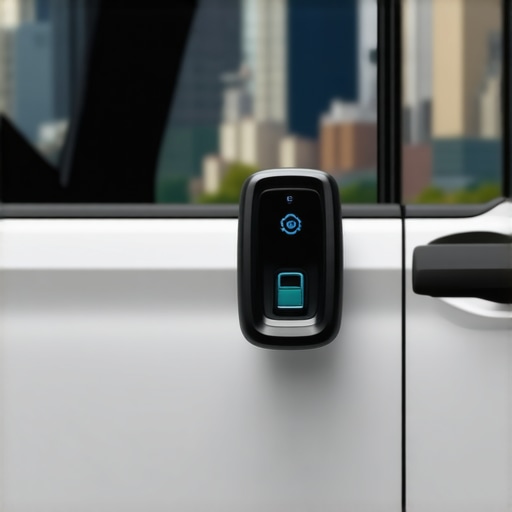
The first glaring issue we saw in early biometric scanners was their reliance on capacitive sensing. These sensors essentially took a 2D map of the ridges on your finger. In the shop, we proved how easily these could be spoofed with high-resolution latent print lifting and a bit of conductive silicone. If you’ve ever dealt with residential keypad locks reviews, you know that physical wear on the buttons gives away the code; capacitive sensors had a similar ‘residue’ problem. In 2026, manufacturers have moved to 3D ultrasonic mapping. Instead of just ‘seeing’ the print, the sensor sends out a sound wave that penetrates the outer layer of the skin to map the dermal ridges. This makes a 2D silicone mold useless. It’s the same level of precision we use in emergency safe cracking services when we’re feeling for the drop-in of a mechanical dial—it’s about depth and resistance, not just surface-level appearance. This hardware upgrade is why your 2026 EV keyless entry troubleshooting usually involves sensor calibration rather than simple cleaning.
Flaw 2: The Relay Injection and the Encrypted CAN Bus Handshake
The second flaw wasn’t in the finger scanner itself, but in the ‘conversation’ between the door handle and the car’s Engine Control Unit (ECU). Older systems used a simple ‘go/no-go’ signal. If a thief could tap into the wiring behind the wheel well, they could inject a ‘door open’ command directly into the CAN bus. It didn’t matter how secure the biometric lock was if the internal wiring was shouting the password in plain English. 2026 models have implemented ‘End-to-End Encrypted Handshakes.’ The biometric data is processed in a ‘Secure Element’ chip inside the handle itself, and the signal sent to the car is a one-time-use encrypted token. This is similar to how commercial smart access control 2026 trends are moving toward decentralized security. If you don’t have the rolling code key, the car won’t talk to you. This is why preventing bike lockouts with smart tech has become so much more complex; the security is no longer in the physical bolt, but in the mathematical wall surrounding the command signal.
“A lock is only as strong as its weakest protocol, whether that’s made of brass or binary.” – Master Locksmith Axiom
Flaw 3: Liveness Detection and Pulse Oximetry Integration
The most grizzly flaw—and yes, we think about this in the security world—was the ‘static’ biometric problem. Early sensors couldn’t tell the difference between a living finger and… well, something else. In 2026, the sensors now include liveness detection through pulse oximetry and infrared light. The sensor checks for blood flow and oxygen levels before it even looks at the fingerprint. This eliminates the risk of spoofing with dead tissue or sophisticated synthetic overlays. We see this same logic applied to app-controlled door locks security risks; if the system can’t verify that a conscious, living human is making the request, the door stays shut. This is a massive leap forward for electronic gate lock systems and solar-powered smart locks 2026, where environmental factors used to make high-security sensors too power-hungry. The new low-power IR arrays have changed the game for remote perimeter security.
The Practical Reality: Rekeying vs Replacing in the Digital Age
When people ask about rekeying vs replacing locks which is better, I tell them it depends on the architecture. With these 2026 biometric car systems, you aren’t ‘rekeying’ a cylinder; you are reflashing a Secure Element. If your biometric data is compromised, replacing the sensor module is the only way to ensure the old ‘digital key’ is physically gone. It’s not like an old Schlage where I can just swap the pins and give you a new brass key. The material science has shifted from brass and zinc to high-impact polymers and shielded copper. If you are looking at residential keypad locks reviews or thinking about upgrading your vehicle, you have to look at the ‘Force to Fail’ rating of the housing itself. No biometric sensor matters if a thief can just pry the handle off and jump the solenoid. Always ensure your 2026 hardware has a physical ‘hard-point’ that prevents mechanical bypass. Security is a physics problem, and no amount of fancy 2026 tech changes the fact that a door is only as strong as its strike plate and its hinges.