
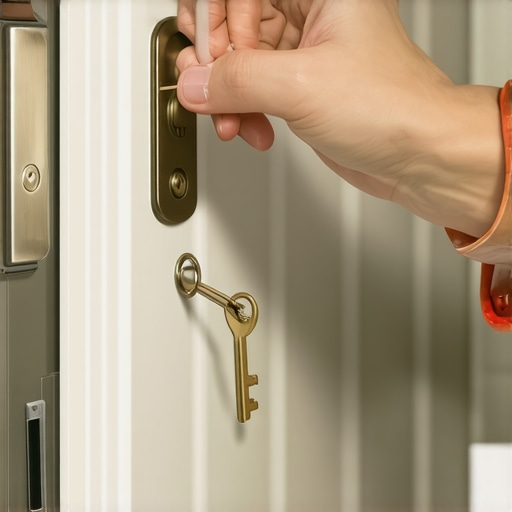
The Sound of Failure: Why Keys Snap in the First Place
I have spent over twenty five years behind a workbench, and if there is one sound that defines a bad day for a homeowner, it is that sickening metallic ‘tink’ of a key snapping off inside a cylinder. It usually happens when you are in a rush, late for work or trying to get the groceries inside. You feel the resistance, you give it that extra nudge of torque, and suddenly you are holding half a bow while the blade is buried deep in the keyway. This is a physics problem, plain and simple. Most residential keys are made of C46400 Naval Brass or, even worse, cheap zinc alloys. Over years of use, the metal undergoes work hardening. Every time you turn that key against a sticky bolt, micro fractures develop at the deepest cut of the bitting. Eventually, the material reaches its fatigue limit and shears right at the shear line.
“Security is a process, not a product. It is a series of decisions made to mitigate risk through physical and electronic barriers.” – Security Industry Axiom
I teach my apprentices that if you have to force the key, you have already lost the battle. If a lock requires more than two fingers of pressure to turn, the problem isn’t the key; it’s the timing of the bolt or the alignment of the strike plate. When you force it, you are asking a thin piece of brass to overcome the friction of a misaligned door. In my shop, I see the results of this daily. People come in with the ‘tail’ of the key and look at me like I’m a magician. But before you call a pro and pay a service fee, there are ways to handle this using what you have in your junk drawer, provided you understand the mechanics of the pinning chamber.
The Forensic Autopsy: Identifying the State of the Lock
Before you stick a single tool into that keyway, you must diagnose the situation. Is the plug turned? If the key snapped while you were mid-turn, the pins are currently trapped in a state of ‘binding.’ This means the driver pins are resting on the side of the plug, and the shear line is not aligned. You cannot extract a key fragment if the plug is turned even a few degrees. Use a flathead screwdriver to gently rotate the plug back to its neutral, vertical position. You should feel a slight click when the pins align with their chambers. This is the only way the fragment will slide out. If the fragment is pushed too deep, beyond the first pin, the driver pins will drop down into the space where the key should be, effectively locking the fragment in place. This requires ‘pin lifting’ while extracting, a technique that separates the real techs from the trunk slammers who just reach for a drill.
The Tweezers Method: Precision Over Force
Most people reach for eyebrow tweezers. This is usually a mistake because the tips are too thick to enter the warding of the keyway. You need precision needle nose tweezers or surgical forceps. The goal is to grab the ‘spine’ of the key, not the ‘bitting.’ The warding, those little zig-zag grooves in the lock face, are designed to prevent foreign objects from entering. You must navigate these grooves. If you can see even a millimeter of the key sticking out, do not push it. Many homeowners try to grab it, slip, and push the fragment deeper into the back of the cylinder, past the last pin stack. Once it is behind the fifth pin, you are looking at a full cylinder teardown. Use a magnifying glass. Steady your hand against the door. Pull straight back with constant, light pressure.
The Safety Pin and Paperclip: The Poor Man’s Extractor
If the key is flush with the face of the plug, tweezers won’t work. You need to create a ‘hook.’ Take a heavy duty safety pin or a small paperclip. Use a pair of pliers to create a tiny, microscopic hook at the very tip, maybe a 45 degree angle no longer than a millimeter. Slide this thin wire along the top of the keyway, above the bitting of the broken fragment. You are trying to get the hook behind one of the ‘teeth’ or cuts of the key. Once you feel it catch, apply outward pressure. It is a game of millimeters. You might only move it a fraction of an inch at a time. This requires patience that most people don’t have at 6 PM on a Tuesday.
“Standard Grade 3 deadbolts are often little more than a visual deterrent against a determined physical attack, failing to address the structural integrity of the strike plate and door frame.” – BHMA Security Standards Overview
While you are fishing for that key, think about why it happened. Was the lock weather-worn? In high humidity environments, the zinc housing of cheap locks can corrode, causing ‘galling’ where the plug binds to the shell. This is why I always advocate for high security locks vs standard locks comparison. A high security cylinder, like a Medeco or a Mul-T-Lock, uses thicker keys with side-biting that are significantly harder to snap. They also use hardened steel inserts that prevent the kind of drilling a scammer will try to sell you the moment they arrive on site.
The Super Glue Trap: A Warning from the Bench
You will see videos online telling you to put a drop of super glue on the end of a matchstick and press it against the broken key. As a master locksmith, I am telling you: do not do this. The tolerances inside a lock cylinder are measured in thousandths of an inch. If even a microscopic amount of cyanoacrylate leaks off the key and onto the plug or the pins, you have effectively welded the lock shut. I have replaced hundreds of cylinders because a ‘handyman’ tried the glue trick and ruined the entire assembly. It is a high-risk, low-reward move that usually ends in a higher bill from me.
Lubrication Science: Graphite vs. Liquid
If the key is stuck, you need to reduce the coefficient of friction. Do not use WD-40. It is a solvent, not a long-term lubricant. It will eventually dry into a sticky film that attracts dust and creates a ‘sludge’ inside the pinning chambers, leading to more snapped keys in the future. Use a dry film lubricant like PTFE or high-grade powdered graphite. Puff a small amount into the keyway. This will help the brass fragment slide past the pins without binding. In the locksmith world, we call this ‘making it slick.’ A well-lubricated lock should feel like it’s moving through butter.
Beyond the Mechanical: The Future of Entry
As we move toward 2026, the industry is shifting. We are seeing transponder chip key cloning 2026 technology becoming more accessible, and fingerprint lock reliability tests are proving that biometric entry is finally maturing. If you are tired of snapping keys, you might look into smart locks with video integration. These systems eliminate the physical key entirely, using encrypted signals or biometric data. However, even these have failure points. EV keyless entry troubleshooting is becoming a major part of my daily work, as rolling codes can de-sync or car batteries can die, leaving you just as locked out as a snapped key would. For residential applications, garage door lock upgrades 2026 trends show a move toward secondary Bluetooth deadbolts that provide a backup if the main door fails. But for those who prefer the tactile feel of metal, high-tech lock bumping prevention and commercial smart access control 2026 trends ensure that mechanical locks remain a formidable barrier.
The Final Verdict on DIY Extraction
If you have tried the safety pin, the tweezers, and the lubrication, and the key hasn’t budged, stop. You are likely burring the brass or damaging the internal warding. A professional locksmith uses a tool called a spiral extractor, which is a thin, serrated wire that grips the side of the key. We can usually get a fragment out in under thirty seconds without damaging the lock. If you keep poking at it, you might turn a $75 service call into a $300 hardware replacement. Security involves trust in the tools and the people who use them. Keep your locks lubricated, replace your keys every few years to avoid metal fatigue, and never, ever force a lock that is fighting back. Perspective is everything in security; treat your hardware with respect, and it will protect you. If you are looking for budget home security upgrades 2026, start with longer screws in your strike plate and a well-maintained cylinder. It is cheaper than a 3 AM emergency call.