The Apprentice’s First Lesson in Metal and Guile
I teach my apprentices that if you have to force the key, you have already lost the battle against the physics of the cylinder. Last week, I had a kid trying to muscle a key into a jammed STD-4C commercial mailbox unit. He was sweating, turning the plug with enough torque to shear the brass. I stopped him. I told him what my mentor told me thirty years ago: a lock is a conversation between the key bittings and the internal wafers. If they are shouting at each other, something is fundamentally broken. We are seeing a massive spike in mail theft leading into 2026, and the culprits are not just thieves with ‘fishing’ tools, but the mechanical failure of cheap, neglected hardware. Most commercial property managers treat mailbox security as an afterthought until the Postal Inspector shows up. By then, the damage is done.
“Security is always a trade-off between convenience and protection.” – Industry Axiom
The Forensic Autopsy: Why Your Mailbox Lock is Failing
When a client calls me saying their mailbox key just spins or won’t enter the keyway, the forensic autopsy usually reveals one of three things: metal fatigue, environmental corrosion, or an attempted breach. The common 5-wafer cam lock found in many older multi-unit complexes is essentially a toy. These are often made of zinc-alloy (pot metal) that becomes brittle over time. When you insert a key, those wafers are supposed to retract flush with the plug’s diameter. In a failing lock, the springs—which are thinner than a human hair—lose their tension or become gummed up with the wrong lubricants. This leads to a ‘mushy’ feel where the shear line is never truly clear. Compare this to a residential lock cylinder replacement involving high-quality brass components; the difference in tolerances is staggering. Mailbox locks are exposed to the elements 24/7, meaning the oxidation of the zinc creates a gritty paste inside the chamber that eventually grinds the wafers down until any similar key—or even a flathead screwdriver—can bypass the security entirely.
Repair 1: The Cylinder Overhaul and Wafer Alignment
The first line of defense for 2026 is a total cylinder overhaul. This is not just a ‘squirt some oil in it’ job. We pull the plug and inspect the wafers for ‘mushrooming’ at the edges. If the wafers are worn, the lock becomes susceptible to ‘jiggling.’ For 2026, we are recommending upgrading standard 5-wafer systems to 7-wafer restricted keyway cylinders. This increases the theoretical key changes and makes the lock significantly harder to pick with standard tools. While we talk about smart locks with geofencing features for front doors, mailboxes still rely on mechanical integrity. During a repair, ensure the cam—the tailpiece that actually locks the door—is not bent. A bent cam requires more force to turn, which puts stress on the key, eventually leading to a snap. If the key does snap, utilizing broken key extraction tools 2026 reviews will show that a spiral extractor is often superior to the traditional saw-tooth design for these tight, narrow keyways.
Repair 2: Addressing the ‘Spinning Plug’ Syndrome
If your key turns but the door won’t open, the C-clip or the nut holding the cam in place has failed. This is a common point of failure in commercial ‘Cluster Box Units’ (CBU). The vibration of hundreds of daily openings rattles the mounting hardware loose. A master locksmith does not just tighten the nut; we use a medium-strength thread locker to ensure the repair lasts another decade. We also look at the strike plate of the mailbox frame. If the frame is bent from a previous pry-bar attempt, the cam won’t seat properly. This mechanical misalignment is exactly why people think they need a new lock when they actually just need a frame alignment. It is a physics problem: if the bolt (the cam) cannot reach its destination without friction, the user will apply ‘compensatory torque,’ which kills the lock.
“The strength of a system is defined by its weakest point of ingress, not its most expensive lock.” – Security Manual 101
Repair 3: Integrating 2026 Wireless Protocols and Smart Upgrades
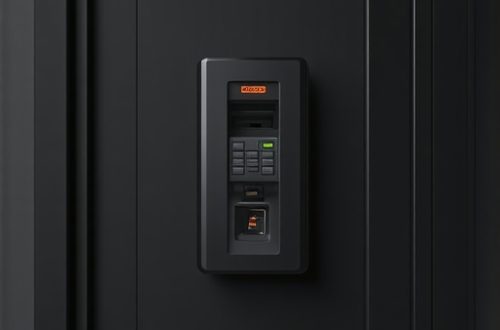
As we move into 2026, the ‘dumb’ mailbox is becoming a liability. We are now seeing the implementation of 2026 wireless lock protocols explained in commercial settings where a mailbox can alert a tenant’s smartphone via an integrated home security lock bundle when the door is opened. While the physical locking remains mechanical, the sensor array provides a digital audit trail. For high-end commercial properties, we are installing smart deadbolts with fingerprint scanners or RFID readers on the main parcel lockers. This eliminates the ‘lost key’ problem which accounts for 40% of my service calls. These units often feature smart lock hacking prevention tips built into their firmware, such as lockout timers and encrypted rolling codes, similar to automotive transponder keys 2026 updates that prevent signal boosting theft.
Repair 4: Environmental Shielding and Sustainable Materials
The fourth repair is actually a preventative upgrade. Most mailbox locks fail because of moisture. We are now sourcing sustainable eco-friendly locks for homes and commercial units that use recycled marine-grade stainless steel instead of zinc. This prevents the ‘frozen lock’ syndrome seen in northern climates. If you are in a high-humidity area, the internal components should be treated with a dry-film lubricant. Never use WD-40; it is a solvent, not a long-term lubricant, and it will attract dust, turning into a sticky mess that traps the wafers in the ‘up’ position. This creates a ‘dead lock’ situation where even the correct key will not work. Instead, we use PTFE-based sprays that bond to the metal at a molecular level.
The Verdict: Trust Metal, Not Just Luck
Security is not a product you buy; it is a state of maintenance you manage. Whether you are dealing with residential lock cylinder replacement or securing a massive commercial mail facility, the principles remain the same. Avoid the ‘trunk slammers’ who offer a $29 service call only to drill your locks and charge you $500 for a $10 part. A real technician understands the tolerances of the shear line and the metallurgical properties of the hardware. As 2026 approaches, mail theft will only become more sophisticated. Your hardware needs to keep pace. Keep your cams tight, your wafers clean, and your keys off the ‘big box’ duplicators that produce sloppy, out-of-spec cuts.

![How to Extract a Broken Key Safely and Avoid a $200 Repair [2026]](https://prolocksmithco.com/wp-content/uploads/2026/02/How-to-Extract-a-Broken-Key-Safely-and-Avoid-a-200-Repair-2026-75x75.jpeg)

![5 Modern Access Control Fixes for Co-Working Spaces [2026]](https://prolocksmithco.com/wp-content/uploads/2026/02/5-Modern-Access-Control-Fixes-for-Co-Working-Spaces-2026-500x330.jpeg)