
The Ghost in the Machine: Diagnosing Modern EV Entry Failures
I teach my apprentices that if you have to force the key, you have already lost the battle against physics. In my twenty-five years at the bench, I have seen the transition from simple iron skeletons to the complex rolling code encrypted transponders found in the latest electric vehicles. When a customer rolls into my shop complaining that their EV keyless entry is acting like a stubborn mule, they usually expect a mechanical fix. But with an EV, we are dealing with a microscopic dance of electrons and radio frequencies. The crunch you hear in a digital system isn’t metal grinding; it is the sound of a synchronization packet failing to handshake with the Electronic Control Unit (ECU). If your proximity sensor is ignoring you or your doors stay locked while you are standing in the rain, you are likely experiencing a failure in the rolling code counter or a shielding issue within the door handle assembly itself.
“The most dangerous weakness in any digital lock system is the assumption that the battery is infinite.” – Security Manual 101
The Forensic Autopsy of a Glitching Fob
The first symptom of a failing system is usually a decrease in effective range. You used to be able to chirp the car from fifty feet; now you have to press the fob against your chin to get a response. This is often the result of a CMOS battery that has dipped below 2.9 volts. Even if the battery is new, cheap zinc-carbon cells from a gas station do not provide the stable current required for the high-peak bursts of a 2026 hybrid key replacement. When we look at car remote programming tutorials, they often skip the material science. I only use silver-oxide batteries in my shop because they maintain a flat discharge curve, ensuring the internal oscillator stays at the exact 315MHz or 433MHz frequency required. If the frequency drifts even a fraction, the car sees it as background noise, not a valid command.
The internal physics of a modern fob involve an Integrated Circuit (IC) that runs a proprietary algorithm. Every time you press that button, the fob and the car both move to the next number in a sequence of billions. If the fob is pressed too many times out of range, it can fall out of the synchronization window. This is what we call a desync. In urban areas, where locksmith costs in 2026 are often driven up by the sheer complexity of these diagnostic tools, a simple resync procedure can save you hundreds. However, if the rolling code counter has rolled over or corrupted, you are looking at a full ECU re-pairing, which requires an authenticated dealer-level scan tool.
The Interference War: Urban Locksmithing Challenges
In the city, the air is thick with radio frequency interference (RFI). High-security locks for rental properties and access control for co-working spaces often operate on similar bands as your car remote. I have seen cases where a powerful Wi-Fi router inside a nearby building created a dead zone on the sidewalk, preventing an EV from detecting its owner. This is not a hardware failure; it is a physics collision. The door handles on many EVs use capacitive touch sensors. These sensors work by measuring a change in electrical charge when your hand nears the handle. In high-humidity environments, or when road salt builds up on the handle, the sensor cannot distinguish between a finger and the environment. This is why keeping your sensors clean is just as important as keeping your deadbolt lubricated.
“Security is always a trade-off between convenience and protection.” – Industry Axiom
Fixing the Glitch: From Key Extraction to Digital Re-pairing
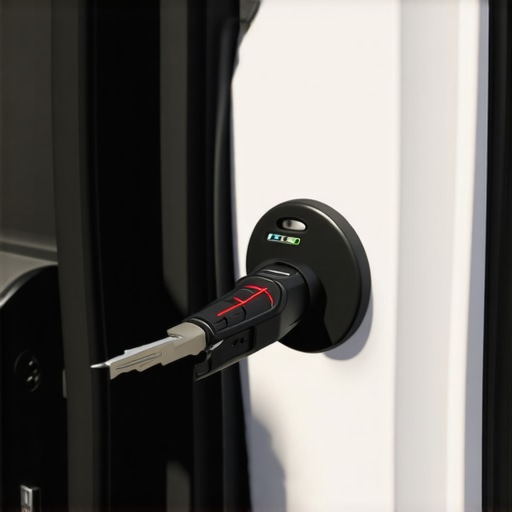
If the digital side is healthy but the door still won’t budge, we have to look at the physical override. Every EV has a hidden mechanical key blade. Most owners do not even know it exists until they are stranded. Because these blades are rarely used, the wafers inside the lock cylinder can seize due to oxidation. I have performed more key extractions for deadbolts and car cylinders than I can count because people try to force a key into a lock that hasn’t seen a drop of lubricant in five years. Do not use WD-40. It attracts grit and turns into a sticky paste that ruins high-precision tolerances. Use a dry PTFE-based spray or high-grade graphite to keep the mechanical backup operational. This is the difference between a quick entry and a drilling job that costs you a fortune.
For those looking at car remote programming tutorials, understand that the 2026 hybrids use an encrypted CAN-bus architecture. You cannot simply jump two wires or use a generic OBD-II dongle from a discount site. These vehicles require a secure handshake with the manufacturer’s server. If you are managing access control for co-working spaces or looking for the best residential door locks for safety and durability, you’ll find that the same logic applies: cheap hardware is the most expensive thing you will ever buy. A trunk-slammer might charge you $50 to try and ‘fix’ it with a hammer and a drill, but a real technician understands the rolling code logic and the importance of signal integrity.
The Final Verdict on Maintenance and Security
To prevent bike lockouts with smart tech or EV glitches, the solution is proactive maintenance. Check your fob battery voltage annually. Clean your door handle sensors. And most importantly, test your mechanical override key every six months to ensure the wafers haven’t fused. If you find yourself needing a lost key replacement for hybrids 2026 models, be prepared for a technical process, not a simple metal cutting job. Security is about the integrity of the entire system, from the physical strike plate on your home’s deadbolt to the encrypted packets flying through the air between your pocket and your car. When you treat your security as a physics problem, you stop being a victim of ‘glitches’ and start being the master of your own hardware.
Comments are closed.