
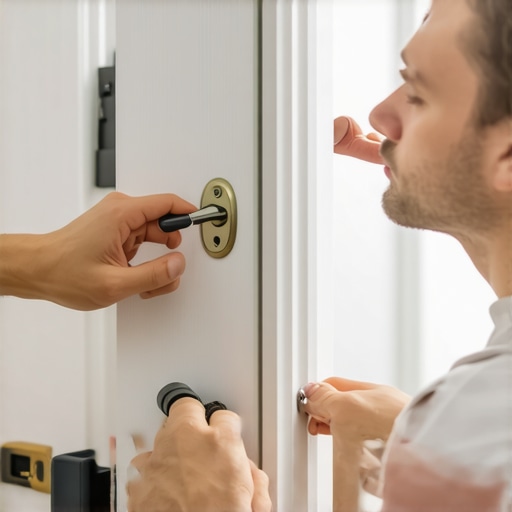
The Forensic Autopsy of a Binding Cylinder
You hear it before you feel it. That specific, gritty crunching sound inside the lock cylinder that signals a mechanical failure is imminent. To the untrained homeowner, it is an annoyance. To a master locksmith with twenty five years at the bench, it is a forensic symptom of internal friction, spring fatigue, or the inevitable decay of pot metal components. I teach my apprentices that if you have to force the key, you have already lost. The moment you apply more than three pounds of torque to a resisting plug, you are no longer operating a security device, you are performing a stress test on a piece of nickel silver or brass that was never designed to act as a lever. When a lock jams, it is a physics problem. The pins are not reaching the shear line, the driver pins are hung up on a burr, or the plug itself has developed enough slop to tilt within the housing.
“Security is always a trade-off between convenience and protection.” – Industry Axiom
Fix 1: The Lubrication Myth and Chemical Reality
The first thing people reach for is WD-40. Stop. Just stop. As a locksmith who has cleaned the gummy, dirt-attracting residue of a thousand spray cans out of cylinders, I am telling you that WD-40 is a solvent, not a lubricant for fine tolerances. For a jammed lock in 2026, you need a dry film lubricant or a high grade synthetic silicone. When the key feels sticky, it is often because the pin stacks are hindered by oxidized metal dust. You want to spray a tiny amount of PTFE-based lubricant into the keyway. The goal is to reduce the coefficient of friction between the bottom pins and the key blade. As you slide the key in and out, you are clearing the path. This is a budget home security upgrade 2026 tactic that keeps a Grade 2 deadbolt functioning for decades instead of years. If the lock is in a high humidity urban area, the internal springs can develop micro-corrosion, making the return force sluggish. A proper lubricant frees the driver pins so they can snap back into the plug when the key is withdrawn.
Fix 2: Clearing the Debris and Key Extraction Physics
Sometimes the jam is not mechanical wear but a foreign object. I have seen everything from broken toothpick tips to intentional vandalism with superglue. If you are wondering how to extract a broken key from a lock safely, the answer is never a pair of tweezers. Tweezers are too thick and usually push the fragment deeper into the pin stacks. You need a spiral extractor or a thin piece of spring steel with a hooked tip. The physics of extraction requires you to bypass the pins, hook the bitting of the broken key fragment, and pull with a steady, linear force. If the key has snapped because of a jam, the remaining piece is likely being pinched by a binding pin. You must use a small pick to lift the pins off the fragment while you pull. This is a delicate operation that separates the professionals from the trunk slammers who will immediately tell you the entire lock needs to be drilled and replaced for four hundred dollars.
Fix 3: Strike Plate Realignment and the Sagging Door
A lock that feels jammed from the outside is often just a door that has moved. In the locksmith trade, we look at the reveal, the gap between the door and the frame. If the house has settled or the hinges have worn down, the deadbolt or latch is no longer hitting the center of the strike plate. This creates lateral pressure on the bolt. When you turn the key, you are fighting the friction of the bolt against the steel strike plate. The quick fix here is to tighten the top hinge screws. If the screws are spinning, replace them with three inch wood screws that bite into the wall stud. This pulls the door back into alignment and allows the bolt to move freely into the mortise. For those managing commercial properties, ensure that your hardware meets panic bar code compliance 2026 standards, as any misalignment in a fire exit can lead to massive liability during an inspection.
“A lock is only as strong as the frame it is mounted in.” – Security Manual 101
Fix 4: Addressing the 2026 Tech Gap
We are seeing more solar-powered smart locks 2026 models hitting the market, and they suffer from jams just like the old mechanical ones, but with the added complexity of a small motor. If your best smart locks compatible with Alexa 2026 start to beep or struggle, it is usually because the motorized bolt is hitting the strike plate. The motor does not have the torque of a human hand, so it fails faster. Furthermore, as we see automotive transponder keys 2026 updates, people are becoming more reliant on electronics. If you find yourself wondering what to do when locked out of your car, remember that even electric vehicles in 2026 still have a mechanical override hidden in the fob. Locksmith services for electric vehicles 2026 often involve dealing with these mechanical backups that have seized from lack of use. The same logic applies to commercial restricted keyways, where the tolerances are so tight that even a microscopic bit of pocket lint can cause a total jam. Always keep your keys clean and your cylinders lubricated with the right stuff.
Final Verdict on Professional Maintenance
Locksmith costs in urban areas 2026 are largely driven by emergency calls that could have been avoided with five minutes of maintenance. If these four fixes do not resolve the issue, the problem is likely a broken tailpiece or a collapsed spring within the internal timing of the lock. At that point, you need a bench tech who understands the metallurgy of the specific brand. Do not let a scammer drill your lock. A real locksmith can usually pick or bypass a jammed cylinder without destroying the hardware. We live in an era of smart tech, but the physical interaction of brass pins and steel springs remains the foundation of your security. Keep it clean, keep it aligned, and never force the turn.
Comments are closed.