![5 Access Control Fixes for Busy Co-working Spaces [2026]](https://prolocksmithco.com/wp-content/uploads/2026/04/5-Access-Control-Fixes-for-Busy-Co-working-Spaces-2026.jpeg)
The Bench Wisdom of a Quarter-Century
I have spent over twenty-five years at a workbench covered in brass shavings, graphite, and the internal components of high-security cylinders. My shop is not a van parked in a driveway; it is a brick-and-mortar reality where I see the failures of modern security every single day. I often teach my apprentices that if you have to force the key, you have already lost. That mechanical resistance is a lock screaming at you that something is misaligned, worn down, or poorly engineered. In the world of co-working spaces, where doors are cycling hundreds of times a day, this lesson is the difference between a secure facility and a liability. Co-working spaces in 2026 are no longer just offices; they are high-traffic hubs with constant turnover, and your security needs to reflect the physics of that reality, not some marketing brochure from a big-box store. Most people think security is about the lock, but as a master locksmith, I know security is about the physics of the strike, the depth of the mortise, and the integrity of the key control system.
“Security is always a trade-off between convenience and protection.” – Industry Axiom
The Psychology of the Modern Breach
Before we talk about hardware, we have to talk about the burglar. In a co-working environment, the ‘burglar’ is rarely a man in a mask with a crowbar. More often, it is a former member whose access was never properly revoked or a ‘tailgater’ who walked in behind a legitimate user. The psychology here is about exploiting social norms and technical laziness. When I perform business access control audits 2026, the first thing I look for is the gap between the door and the frame. If I can see the latch, your security is a joke. I do not care how many biometric scanners you have on the wall if I can retract your latch with a piece of plastic or a shove-knife. This is why we focus on the hardware grades. ANSI Grade 1 is the only standard for these spaces. Anything else is just pot metal dressed up to look like security. Cheap zinc alloys will shatter under the repetitive stress of a busy office, whereas solid brass and cold-rolled steel components keep their tolerances even after a million cycles.
Fix 1: Commercial Restricted Keyways and SFIC Implementation
The biggest nightmare for any facility manager is the ‘lost key.’ In 2026, mobile locksmith services for lost car keys are common, but for a commercial building, you cannot just call a guy to cut a new key and call it a day. You need key control. This starts with commercial restricted keyways. These are key blanks that are not available at the local hardware store. I own the rights to specific key profiles in this zip code, meaning no one can copy that key without my signature and a specific machine. We zoom into the Small Format Interchangeable Core (SFIC). The physics of an SFIC core involve two different shear lines. There is the operating shear line, which allows the tenant to open the door, and the control shear line. When you insert the control key, it engages a sleeve that allows the entire lock cylinder to be pulled out of the housing in seconds. This allows for instant rekeying when a member leaves without returning their key. You do not have to take the whole door apart; you just swap the core. This is the gold standard for maintaining a master key system without losing your mind.
[IMAGE_PLACEHOLDER]
Fix 2: Panic Bar Installation and Code Compliance 2026
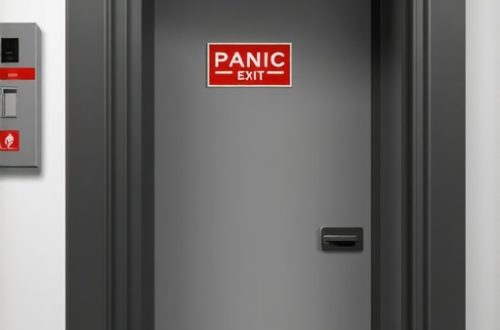
If your co-working space has an occupancy load over a certain threshold, you are legally required to have panic hardware. Panic bar installation and repair for commercial buildings is not just about security; it is about life safety. In 2026, panic bar code compliance 2026 has become even more stringent regarding the force required to actuate the bar. The internal mechanism of a high-quality panic bar, like a Von Duprin 99 series, uses a fluid dampening system and a high-tensile spring to ensure that the latch bolt retracts fully every time. When these fail, it is usually because the ‘dogging’ mechanism—the part that holds the bar down during business hours—has been stripped by someone using the wrong tool. I see this constantly. A trunk-slammer locksmith will come in and try to drill out a jammed panic bar, but a real tech knows how to manipulate the actuator arm to reset the timing. If your panic bar makes a ‘crunch’ sound, the internal carriage is likely misaligned, and you are one bad day away from a Fire Marshal fine.
“The strength of a lock is only as good as the strike plate and the frame it is anchored to.” – Locksmith Security Manual
Fix 3: Biometric Keyless Entry and the Automotive Influence
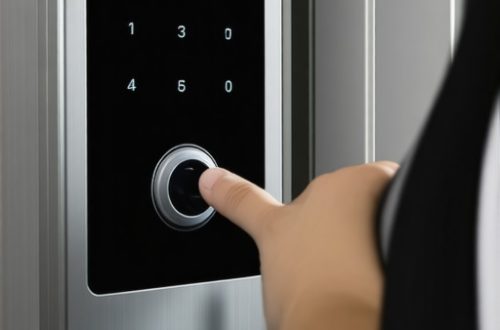
We are seeing a massive crossover from 2026 trends in automotive security into the commercial world. Just like biometric keyless entry for cars has become the norm, co-working spaces are moving toward facial recognition and fingerprint scanning. But here is the professional’s warning: biometrics are a credential, not a locking mechanism. You still need a high-quality electric strike or a magnetic lock to actually hold the door. The physics of an electric strike involve a solenoid that, when energized, releases the keeper. If you buy a cheap $40 strike off the internet, that solenoid will burn out within three months of high-traffic use. I recommend heavy-duty strikes that are rated for over 2,000 lbs of fail-secure pressure. We are also seeing a rise in mobile-based credentials that use rolling codes similar to modern car transponders. This prevents ‘replay attacks’ where a hacker captures the signal of a key fob and plays it back to open the door later. It is a complex layer of security that requires a steady hand during installation to ensure the wiring does not pinch in the door hinge.
Fix 4: Rekeying Smart Locks After Moving In
Many new co-working startups buy a space and think the ‘smart locks’ already installed are sufficient. This is a dangerous assumption. Rekeying smart locks after moving in is the first task on any security checklist. You have no idea how many people have the digital ‘master code’ or a physical override key. Smart locks are often the target of ‘shimming,’ where a thin piece of metal is inserted into the latch to bypass the bolt. I prefer to install hybrid systems: a mechanical Grade 1 deadbolt for after-hours security and an electronic access system for daytime use. This gives you the convenience of digital logs and the raw physical strength of a steel bolt that cannot be hacked by a software glitch. When we talk about locksmith costs in urban areas 2026, you might pay more for a professional to do this, but you are avoiding the ‘scammer tax’ of having to replace a drilled-out lock later because a cheap tech didn’t know how to pick a high-security cylinder.
Fix 5: Continuous Audits and Hardware Maintenance
The final fix is not a product, but a process. Locksmith tools market outlook 2026 shows more sophisticated bypass tools becoming available to the public. To counter this, you need a business access control audit at least once a year. This involves checking the ‘closer’ speed (the arm at the top of the door). If the door slams, it vibrates the electronics and eventually kills the lock. If it closes too slowly, it leaves a window for tailgating. We use a pressure gauge to ensure the door latches with less than 5 lbs of force, as per ADA requirements. Do not use WD-40 on your locks. It is a solvent, not a lubricant, and it will gum up the pins over time. Use a PTFE-based dry lubricant or high-grade graphite if you must, but usually, if a lock is sticking, it is a mechanical failure that needs a professional’s eye. Security involves trust, and in a co-working space, your members are trusting you with their livelihoods. Do not let a $10 lock stand in the way of that trust. Keep your hardware heavy, your keys restricted, and your audits frequent.“,”image”:{“imagePrompt”:”A close-up, high-detail macro shot of a commercial Small Format Interchangeable Core (SFIC) being removed from a heavy-duty satin chrome door handle using a control key. The internal brass pins and the secondary shear line sleeve should be visible, emphasizing mechanical precision. Professional locksmith lighting, workshop background.”,”imageTitle”:”Commercial SFIC Core Extraction”,”imageAlt”:”A master locksmith removing an SFIC core from a commercial door handle for rekeying.”},”categoryId”:1,”postTime”:”2026-05-20T10:00:00Z”}