
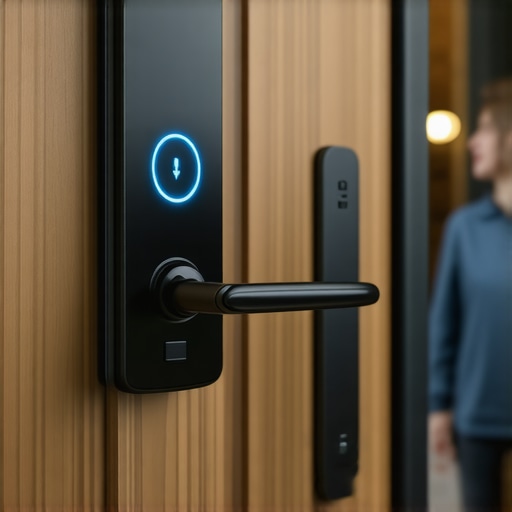
The Reality of Smart Home Security
I once had a customer call me at 3 AM because she was standing in a torrential downpour, yelling at her front door. She had just installed a voice-activated lock she bought from a big-box retailer, and after a night out, her voice was raspy. The software didn’t recognize her, the Wi-Fi bridge had flickered during a power surge, and she was effectively locked out of her own fortress. As I stood there with my pick set, I reminded her that while voice commands are fancy, the internal physics of the bolt don’t care about your tone of voice. This is the starting point for anyone looking at a biometric locks installation guide 2026 or setting up voice-activated hardware. If you do not understand the mechanical failure points, you are just installing an expensive paperweight on your door.
“Security is always a trade-off between convenience and protection.” – Industry Axiom
The Physics of the Modern Deadbolt
When you look at a voice-activated lock, you are looking at two distinct worlds forced into a single housing. First, there is the mechanical assembly. This includes the tailpiece, the bolt, and the strike plate. Second, there is the electronic actuator, usually a small DC motor or solenoid. In the best residential door locks for safety and durability, the motor has enough torque to overcome slight door misalignments, but most consumer-grade smart locks are weak. If your door has even a millimeter of friction against the strike plate, that tiny motor will burn out or fail to fully extend the bolt. This is why I tell people that rekeying smart locks after moving in is only half the battle; you must also ensure the door is hung perfectly. If you have to push or pull on the handle to get the deadbolt to throw, your voice-activated setup will fail within six months.
The Setup Blueprint: More Than Just an App
Setting up voice activation involves more than just a smartphone. You are creating a mesh network. Most of these units use Zigbee, Z-Wave, or Bluetooth to talk to a hub, which then talks to your router. When you give a voice command, that signal travels to a cloud server, back to your router, through the bridge, and finally to the lock. If any link in that chain breaks, you are stuck. This is why commercial mailbox lock repairs often focus on simplicity over electronics; complexity is the enemy of reliability. When performing a biometric locks installation guide 2026 style setup, focus on the local bridge placement. It should be within fifteen feet of the door, unobstructed by metal studs or heavy masonry.
“A lock is only as strong as the frame it is mounted in.” – Security Manual
Mechanism Zooming: The Actuator and the Gear Train
Inside the casing of a voice-activated lock, a gear train translates the high-speed rotation of the motor into the slow, powerful movement of the deadbolt. Cheap locks use nylon gears that strip the moment they encounter resistance. High-end units use sintered metal or solid brass gears. When the motor receives the “open” command via your voice assistant, it draws current from the battery pack, usually four AA alkaline cells. This is a critical failure point. In our region, the humidity can cause battery terminals to oxidize, increasing resistance and dropping the voltage. If the voltage drops below a certain threshold, the motor cannot pull the bolt, even if the electronics say it is unlocked. This is a common issue with electronic gate lock systems as well, where environmental exposure is constant.
Step-by-Step Voice Integration
To set up voice activation, first install the physical hardware. Ensure the bolt moves freely with a manual turn. Next, pair the lock with its proprietary app. Once the app can see the lock, you must link that account to your voice assistant (Alexa, Google, or Siri). You must enable a secure PIN for voice unlocking. Never set a lock to open via voice without a secondary PIN code; otherwise, a burglar could simply yell through your window to let themselves in. This is part of how to prevent future house lockouts: always have a physical key backup hidden in a secure, non-obvious location. Even Tesla owners, who use car lockout services for Tesla models when their phone keys fail, know that redundancy is the only path to true security.
Commercial Applications and Hardware Grades
In a commercial setting, voice activation is less common than panic hardware for office buildings 2026 or commercial panic exit devices 2026, but the principles of electronic access control remain. In those environments, we use heavy-duty strikes and magnetic locks because the cycle count is much higher. If you are trying to secure a home office with sensitive data, don’t rely on a $99 smart lock. Look for hardware that meets ANSI Grade 1 standards. This means the lock can withstand 250,000 cycles and ten strikes of 75 foot-pounds of force. Most voice-activated locks are Grade 2 or 3, prioritizing the shiny app over the actual metal. For those also managing vehicle fleets, remember that transponder chip key cloning 2026 is becoming more integrated with home systems, but each remains a separate security silo that needs its own maintenance schedule.
Maintenance: The Locksmith’s Secret
Don’t use WD-40. I see people spray it into their smart locks and it turns the internal electronics into a gummy mess. Use a dry PTFE lubricant or a high-quality graphite specifically designed for lock cylinders. Check your strike plate alignment every season. As the house settles or the wood swells, the hole for the bolt might shift. If you hear the motor straining, it’s time to get a chisel and adjust the plate. This is the difference between a secure home and a lockout waiting to happen. Security is a living system, not a set-it-and-forget-it gadget. Your voice might be the key, but the metal is what keeps the bad guys out.