
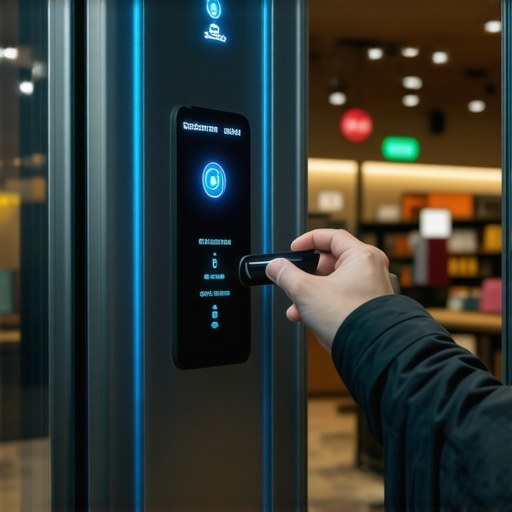
Technical Foundation of Modern Retail Security
I teach my apprentices that if you have to force the key, you have already lost the battle against physics. When the plug refuses to rotate, it isn’t being stubborn; it is communicating a specific misalignment of the driver pins or a shear line obstructed by microscopic brass shavings. In the 2026 retail landscape, this lesson evolves from physical keys to digital handshakes. Whether we are talking about a traditional Schlage C keyway or a high-end biometric scanner, the fundamental physics of entry remain constant: you are either clearing an obstruction or you are forcing a failure. Modern retail managers often fall for the glitz of silicon valley marketing, but as a locksmith with 25 years at the bench, I see the hardware for what it is: metal and logic gates. If the metal is soft zinc and the logic is poorly encrypted, your store is wide open regardless of the price tag.
“Security is always a trade-off between convenience and protection.” – Industry Axiom
When analyzing 2026 smart lock trends for homes and businesses, we must look at the duty cycle of the hardware. Commercial environments require Grade 1 hardware capable of withstanding 1,000,000 cycles. A standard deadbolt from a big box store will fail within months under the high traffic of a retail entrance. The internal physics of a commercial smart lock involve heavy-duty solenoids that actuate the locking pawl. These solenoids must be rated for continuous duty to prevent overheating. When a retailer asks about app-controlled door locks security risks, I point them toward the encryption layer. If the lock uses outdated Bluetooth protocols without rolling codes, a sophisticated thief can sniff the handshake and replicate it. This is why Strategic Commercial Smart Access Control 2026 Trends for Retailers emphasize Ultra-Wideband (UWB) technology, which allows for centimeter-level accuracy in geofencing, ensuring the door only unlocks when the authorized device is inches away, not across the street.
The Physics of Weatherproof Outdoor Locks
Retailers often read weatherproof outdoor locks reviews and assume a plastic gasket is enough protection. It is not. In our shop, we see what salt air and humidity do to pot metal. A true weatherproof commercial lock requires an IP65 or higher rating, meaning it is dust-tight and protected against water jets. The internal circuit boards must be conformal coated to prevent oxidation. If you are looking at biometric locks installation guide 2026 updates, you will see that capacitive sensors are being replaced by thermal or ultrasound scanners. This is because capacitive sensors fail when a user has wet hands or when the temperature drops below freezing. A retail storefront in a harsh climate needs a lock that accounts for the thermal expansion of the door frame. If the strike plate is not aligned to within 0.003 inches, the motor in a smart lock will burn out trying to overcome the friction of the bolt against the plate.
App-Controlled Risks and Geofencing Reality
Smart locks with geofencing features are a double-edged sword for retail managers. While it is convenient for the door to unlock as the manager approaches with a morning shipment, it introduces a perimeter vulnerability. If the geofence is too wide, the door may stay unlocked while the manager is in the back office. The 2026 trends suggest multi-factor authentication where the geofence only primes the lock, but a biometric or PIN is still required for physical entry. This prevents the ‘accidental unlock’ scenario that has plagued early smart home adopters. We also have to consider the ‘rolling code’ issue. Much like modern automotive transponders, 2026 commercial systems use a rotating cryptographic key. If the app and the lock get out of sync, you are looking at a hard lockout that usually requires a master override key. This brings us to the core of the matter: never install an electronic lock that does not have a physical high-security override cylinder, preferably an Interchangeable Core (IC) system that allows for rapid rekeying if a physical key is lost.
“The strength of any system is defined by its weakest point of failure, usually found at the strike plate or the human interface.” – Security Manual 101
Hardened Hardware: Beyond the Software
Let’s talk about the physical strike plate. In a deadbolt installation DIY vs pro scenario, the amateur usually uses the half-inch screws that come in the box. A master locksmith replaces those with 3-inch hardened steel screws that bite deep into the building’s framing. For a retail store, we use reinforced strike boxes. The logic is simple: if a burglar uses a pry bar, the smart features mean nothing if the wood frame splinters. Keyless entry systems pros and cons often focus on the software, but the physical bolt material matters more. We look for hardened steel inserts that spin when a hacksaw blade touches them, preventing the ‘saw-through’ attack. This is a common failure in cheap residential-grade hardware being marketed to small retailers.
The 2026 Biometric Revolution
Smart locks with video integration are becoming the standard for 2026. This allows for ‘visual auditing,’ where every access event is tied to a timestamped video clip. From a locksmith’s perspective, the challenge is power delivery. Video streaming kills batteries. For retail, we recommend hard-wired Power over Ethernet (PoE) solutions rather than battery-operated units. Biometric locks installation guide 2026 mandates now often include facial recognition with liveness detection to prevent the ‘photo at the camera’ trick. When we install these in commercial settings, we ensure the database is stored locally on a secure controller rather than in a vulnerable cloud server. This reduces latency and protects employee privacy. Preventing bike lockouts with smart tech has even influenced commercial design, leading to smaller, more ruggedized form factors for exterior gates and storage areas. These units must be built with the same precision as a safe dial, where the tolerances are so tight that a shim cannot be inserted between the housing and the bolt.
Final Professional Verdict on 2026 Systems
Commercial security in 2026 is about the integration of physical metallurgy and digital encryption. If you ignore one, the other will fail you. A retailer should look for systems that offer ‘Dual-Credential’ entry and ‘Audit Trails’ that cannot be edited. When we perform a forensic autopsy on a failed lock, it is almost always due to cheap materials or poor alignment. If you want peace of mind, stop buying your security from the same place you buy your paper towels. Invest in Grade 1 hardware, ensure your firmware is updated to mitigate app-controlled door locks security risks, and always, always keep a physical master key in a secure off-site location. Trust the metal, verify the code, and never force the hardware.