
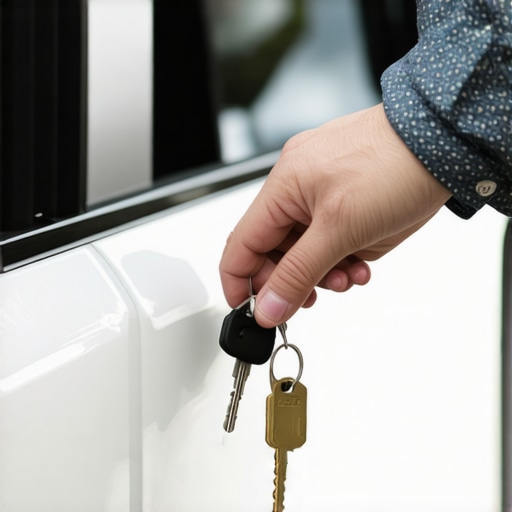
The 3 AM Reality Check: A Master Locksmith Perspective
I once had a customer call me at 3 AM because they were stranded at a desolate rest stop three towns over. It was raining sideways, the kind of weather that makes you question every life choice that led to standing outside a locked 2022 Ford F-150. A previous ‘locksmith’ they called from a search engine ad had quoted them $29 over the phone, showed up in an unmarked sedan, and immediately told them the lock was ‘high security’ and needed to be drilled for $400. That is the moment I stepped in. I have spent 25 years at the bench, and I can tell you right now: if a technician reaches for a drill before a Lishi tool or a wedge, you are being taken for a ride. Automotive security is a physics problem involving wafer tumblers and electromagnetic handshakes, not a demolition project. When you are looking for quick fixes for what to do when locked out of your car today, the first step is staying calm so you do not fall prey to the trunk-slammers who dominate the emergency search results.
“Security is always a trade-off between convenience and protection.” – Industry Axiom
Understanding the 24/7 Emergency Locksmith Services Explained
When we talk about 24/7 emergency locksmith services explained, we are talking about more than just a guy with a slim jim. Modern vehicles utilize complex wafer systems. Inside your car door lock cylinder, there are typically 8 to 10 wafers of varying heights. These wafers are spring-loaded components that must be moved to a specific ‘shear line’ to allow the plug to rotate. A professional uses a Lishi 2-in-1 pick/decoder, which allows us to feel the resistance of each individual wafer. We are looking for the ‘binding’ wafer—the one that is being pinched by the plug’s rotational tension due to manufacturing tolerances. By manipulating these wafers one by one, we decode the lock without a single scratch on your paint or a shattered window. This is the gold standard for emergency automotive entry. If you are stuck today, your quick fix is identifying a technician who actually owns these tools and knows how to use them. The scammer will try to use an air wedge and a long reach tool on every single car, which can often damage the weather stripping or even the side-curtain airbags buried in the A-pillar.
Automotive Transponder Keys 2026 Updates
As we move toward the automotive transponder keys 2026 updates, the technology is shifting from simple RFID chips to more advanced Ultra-Wideband (UWB) and Digital Key 3.0 protocols. A transponder key is not just a piece of plastic; it contains an induction coil and a microchip. When you turn the key or press the start button, the car’s immobilizer sends a burst of energy via the antenna ring around the ignition. This powers the chip in your key, which then broadcasts a unique, encrypted rolling code back to the Engine Control Unit (ECU). If the codes do not match, the fuel injectors stay shut. The 2026 updates are introducing ‘distance bounding,’ which prevents relay attacks where thieves use boosters to steal your signal from inside your house. If you lose your keys today, a real locksmith has to interface with your car’s OBD-II port to delete the old keys and ‘introduce’ the new ones to the ECU’s EEPROM. This requires expensive diagnostic hardware that ‘Big Box’ stores simply do not have.
Signs of Tampered Locks and Home Security Integration
While I am out there opening a car, I often notice the keys on the customer’s ring. Many are still using old, worn-down builder-grade SC1 or KW1 house keys. This brings us to the benefits of installing smart locks for home security. If you are already dealing with a car lockout, it is the perfect time to audit your home. Look for signs of tampered locks detection, such as fine scratches around the keyway (signs of picking attempts) or ’rounding’ of the cylinder face (signs of a drill bit). A budget smart lock starter kit can be a decent entry point, but for real protection, you want something with geofencing features. Smart locks with geofencing features use your phone’s GPS to automatically bolt the door when you leave a 100-foot radius and unlock it when you return. This eliminates the ‘did I lock the door?’ anxiety that leads to many of my emergency calls.
“A lock is only as good as the technician who services it.” – BHMA Field Guide
Electronic Access Control and Commercial Maintenance
For the small business owners I help, I always suggest electronic access control systems for small businesses. Relying on a physical master key system is risky; if one employee loses a ‘Grand Master,’ you have to rekey the entire building. With electronic systems, you just delete their digital credential. This level of key control is vital for commercial mailbox lock repairs and ensuring panic bar code compliance 2026. Panic bars, or exit devices, are governed by strict NFPA 101 Life Safety Codes. By 2026, many jurisdictions are requiring more rigorous testing of the dogging mechanisms and latch retraction to ensure they do not fail during a fire. If your business’s panic bar is sticking or making a grinding sound, the internal springs are likely fatigued and need immediate professional service. We often see solar-powered smart locks 2026 entering the commercial market, which are great for remote gates or storage areas where wiring is impossible. These units use high-efficiency photovoltaic cells to maintain a charge on a lithium-ion buffer, ensuring the lock remains operational even in low-light environments.
The Physics of Lubrication: Graphite vs. Reality
If your key is sticky today, do not reach for the WD-40. I see this mistake constantly. WD-40 is a solvent, not a long-term lubricant; it will eventually gum up with dust and turn into a sticky paste that traps the pins in the ‘up’ position, causing a lockout. Instead, use a dry PTFE-based spray or a high-quality graphite. However, if the lock is already crunching, lubrication is just a bandage. The ‘crunch’ usually means the brass pins have developed ‘shoulders’ or the springs have become tangled. In those cases, you need a professional to pull the cylinder, dump the pins, and rebuild the stack. This is the difference between a ‘quick fix’ and a permanent solution. Security is about the integrity of the shear line, and once that is compromised by wear or poor hardware, the only way forward is a proper bench service or a replacement with ANSI Grade 1 hardware.