
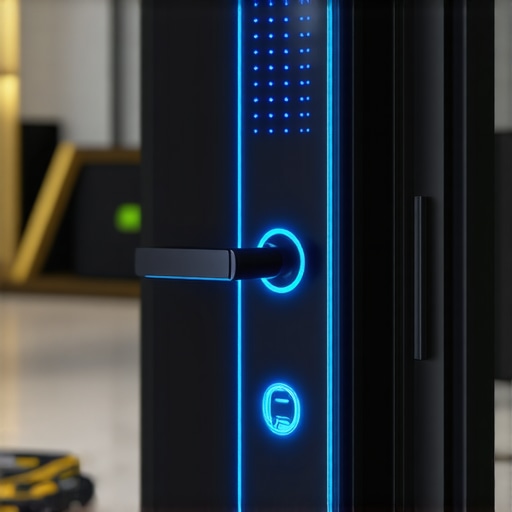
A lady came into my shop crying last Tuesday because a scammer drilled her high-security deadbolt during a lockout and charged her six hundred dollars for a piece of zinc pot-metal hardware he bought at a big-box store. It breaks my heart because that lock could have been opened in ninety seconds with a Lishi tool and a bit of patience. This is why I am writing this guide. We are moving into 2026 and the market is flooded with affordable biometric door hardware that promises the world but often delivers a false sense of security. If you are looking at voice-activated locks setup tutorial videos or considering budget smart lock starter kits, you need to understand the physics of what is actually holding your door shut. Security is not a gadget; it is a system of resistance against physical force.
“Security is always a trade-off between convenience and protection.” – Industry Axiom
The Psychology of the Entry Point: Why Your Frame Fails First
Most people think a burglar is going to sit on your porch and pick your lock like they are in a spy movie. They are not. They are going to kick the door. When you install a new biometric deadbolt, the bolt itself is rarely the failure point. The failure point is the wood of the door jamb. A standard strike plate is held in by half-inch screws that barely bite into the soft pine of the frame. In my shop, I tell every customer that door reinforcement for security is more important than the brand of the lock. You need three-inch hardened steel screws that anchor the strike plate directly into the wall studs. Without that, your fancy 2026 voice-activated lock is just a shiny handle on a broken door. When selecting hardware, look for ANSI Grade 1 ratings. Most budget smart lock starter kits are Grade 3, which is fine for a bathroom door but a joke for an exterior entry. A Grade 1 deadbolt is tested to withstand ten strikes of 150 foot-pounds of force. That is the difference between a loud noise and a wide-open house.
[image_placeholder_1]
Mechanism Zooming: The Physics of Biometric Reliability
Let us talk about the internal physics of the 2026 biometric sensors. We have moved past the old optical scanners that could be fooled by a high-resolution photo. Modern affordable biometric door hardware uses capacitive sensing. This works by measuring the electrical current between the ridges of your fingerprint. When you place your finger on the scanner, the sensor uses a complex array of tiny capacitors to map the variations in voltage. If your skin is too dry or too oily, the capacitance changes, which is why your lock fails to recognize you after a long day of yard work. Furthermore, we need to look at the motorized actuator. In a traditional deadbolt, your hand provides the torque to throw the bolt. In a smart lock, a tiny DC motor powered by AA batteries has to do that work. If your door is not perfectly aligned, that motor has to overcome the friction of the bolt rubbing against the strike plate. This leads to “motor stall” and rapid battery drain. I always recommend a sensory check: if you have to pull or push on your door handle to get the deadbolt to turn smoothly, your biometric lock will fail within six months. You must plane the door or adjust the hinges until that bolt slides in like a hot knife through butter.
“The strength of a lock is only as great as the door and frame to which it is attached.” – Locksmiths Manual of 1954
The 2026 Shift: Voice-Activated Locks and Automotive Integration
We are seeing a massive convergence between residential security and automotive tech. Many homeowners are asking for automotive transponder keys 2026 updates because they want their car and house to talk to each other. If you are looking for automotive key programming near me, you are likely dealing with rolling code technology. Your car key and your car’s ECU perform a digital handshake every time you press a button. Modern biometric locks are now adopting this. A voice-activated locks setup tutorial will usually involve setting up a secure gateway. This gateway uses 128-bit AES encryption to ensure that a recording of your voice cannot be used to unlock the door. However, as an old-school bench tech, I have a warning: always have a physical override. Whether it is a lost wallet key replacement fast service or a hidden mechanical cylinder, never rely 100% on a circuit board. If the motherboard fries during a lightning storm, you do not want to be the person calling me at 2 AM for an emergency drill-out because you bought a lock with no keyway.
Rekeying After Burglary: Best Practices for 2026
If you have been the victim of a break-in, do not just buy a new lock. You need to perform a full security audit. Rekeying after burglary best practices involve more than just changing the pins. I look for tool marks on the door edge. If they used a pry bar, your door’s structural integrity is compromised. This is the time to upgrade to a high-security cylinder with spool pins or mushroom pins. These are “security pins” designed to catch on the shear line if someone tries to pick or bump the lock. While you are at it, consider the automotive locksmith vs dealership for car key replacement debate if your car keys were also stolen. A dealership will charge you a king’s ransom for a new transponder, but a legitimate locksmith can often de-authorize the stolen keys from your car’s computer right in your driveway, ensuring the thief cannot come back for the vehicle later. Security is about layers. Your biometric lock is the first layer, your reinforced strike plate is the second, and your internal alarm or camera system is the third. Never trust a single point of failure. Keep your sensors clean with a microfiber cloth, avoid using harsh chemicals like WD-40 on the internal electronics, and always use high-quality lithium batteries to prevent leaking acid from destroying your investment.