
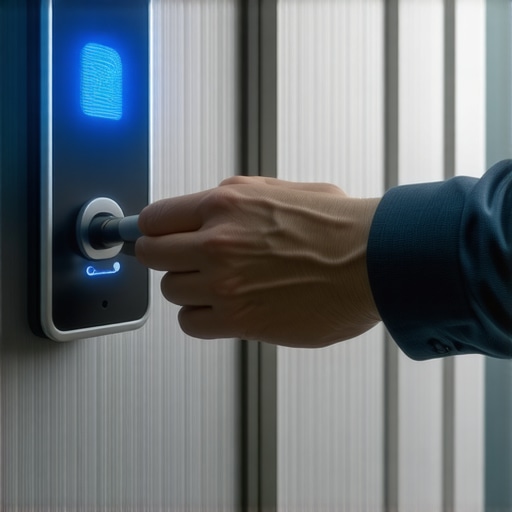
The Hard Truth About Smart Security
I teach my apprentices that if you have to force the key, you’ve already lost. That lesson is even more critical in 2026 as homeowners rush to swap their old brass cylinders for high-tech biometric systems. Most people think they are buying security, but they are often just buying an expensive gadget that is only as strong as the two-inch piece of soft pine in their door frame. In my twenty-five years behind the bench, I have seen every way a door can fail. A biometric lock is a marvel of engineering, but if the physical installation is off by even a fraction of a millimeter, the motorized bolt will bind, the PCB will overheat, and you will be calling for key extraction for deadbolts before the month is out.
“Security is always a trade-off between convenience and protection.” – Industry Axiom
The Physics of the Biometric Bolt
When you look at a pro-grade biometric lock, you are looking at a complex marriage of material science and digital authentication. The sensor itself, usually a capacitive scanner in 2026 models, maps the sub-dermal ridges of your finger. This is not the cheap optical scanning of five years ago. We are talking about liveness detection that measures blood flow and electrical conductivity. But that sensor is useless if the mechanical actuator is coupled with a zinc-alloy gear. Real pro-grade hardware uses hardened steel or solid brass internals. When that motor fires to retract the bolt, it needs to overcome the friction of the weatherstripping. In my shop, I see too many ‘big box’ specials where the motor burns out because the door wasn’t hung properly. If you are rekeying smart locks after moving in, you should really be looking at the structural integrity of the entire opening, not just the cylinder.
Why the Strike Plate is Your Weakest Link
Burglars do not pick locks. They kick doors. You can have a fingerprint scanner designed by NASA, but if your strike plate is held in by half-inch screws that barely grab the door casing, you are living in a house of cards. A proper installation requires a lock shield installation for doors and three-inch hardened steel screws that bite deep into the 2×4 framing of the house. This transfers the energy of a kick from the door jamb to the actual structure of the building. Most homeowners ignore this step, focusing instead on the flashing blue lights of their new toy. Professional locksmith response times 2026 averages show that by the time we arrive to fix a ‘broken’ smart lock, the damage is usually done by poor initial installation or a forced entry that could have been prevented with ten dollars worth of steel reinforcement.
“The strength of a lock is inversely proportional to the number of people who hold a duplicate key.” – Locksmith Manual
Step-By-Step: The Fortress Upgrade Installation
First, we start with the forensic autopsy of your current setup. Remove the old deadbolt and look at the bore hole. Is it 2-1/8 inches? Is the backset 2-3/4 or 2-3/8? If there is any ‘slop’ in the hole, the biometric scanner will shift over time, leading to alignment issues. I use a metal jig to ensure the new holes are true. Once the bore is prepped, we install the bolt. A pro-grade bolt for 2026 has a hardened steel core that spins. This is a counter-measure against hacksaws. If a thief tries to cut the bolt, the core just spins with the blade. Next comes the exterior housing. You want a flush fit against the door. Any gap is a pry point. In 2026, we are seeing more weatherproof outdoor locks reviews focusing on the IP65 rating, which is vital for the humidity and salt air that can corrode internal contacts. For those in colder climates, remember your lock maintenance tips for winter 2026: use a synthetic grease, never graphite, inside a motorized unit. Graphite can gum up the sensitive electronic sensors if it migrates. Lithium-based lubricants are the way to go to keep the mechanism moving at sub-zero temperatures when the metal contracts.
The Commercial Cross-Over and Automotive Trends
We are seeing a lot of tech trickle down from the commercial sector. For instance, the commercial master key system advantages for businesses are now being replicated in residential biometric software, allowing homeowners to give ‘digital keys’ to contractors that expire after two hours. It is similar to the 2026 trends in automotive security where your phone acts as the transponder. Speaking of cars, the EV car key fob replacement costs 2026 are skyrocketing, which is why many homeowners are opting for biometric house locks to avoid carrying a heavy keychain altogether. If you are still using a traditional transponder key programming guide for your vehicle, you know how complex rolling codes have become. Biometric locks use similar encrypted handshakes between the scanner and the deadbolt to prevent ‘replay attacks’ where a hacker tries to sniff your wireless signal.
Vetting the Tech and Avoiding the Scammer
The market is flooded with ‘trunk slammers’ who claim to be experts in smart home integration. They will show up in an unmarked car, drill your old lock unnecessarily, and then charge you five times the quoted price to install a plastic piece of junk. A real locksmith has a bench in a shop and can explain the shear line of a cylinder and the torque specs of a motor. They will use a Lishi pick to open your door if you are locked out, not a power drill. Before you buy a biometric lock, read the weatherproof outdoor locks reviews from actual security professionals, not ‘influencers.’ Look for ANSI Grade 1 certification. If it is Grade 3, it belongs on a bathroom door, not your front entry. Your home is a physics problem. Solve it with steel and smart installation, not just a fancy app. Check the battery chemistry as well; 2026 units should be using high-density lithium cells that won’t leak and destroy the PCB during a heatwave. This is the difference between being secure and just being ‘modern.’