
The Anatomy of the Snap: A Forensic Autopsy of Your Lock Failure
The sound is unmistakable. It is a sharp, metallic ‘tink’ followed by the sickening realization that you are holding the bow of your key while the blade remains buried deep inside the plug. As a locksmith with 25 years at the bench, I have seen this thousands of times. Most people panic and reach for a screwdriver or, heaven forbid, a tube of superglue. Stop right there. You are about to turn a $150 service call into a $500 hardware replacement. I teach my apprentices that if you have to force the key, you’ve already lost. That resistance you felt right before the snap was the lock telling you something was wrong: a seized pin, a collapsed spring, or perhaps just the thermal expansion issues we are seeing more frequently in the 2026 climate cycles. When that brass blade meets the resistance of a stuck wafer or a seized driver pin, the metal begins to fatigue at a molecular level. That hairline fracture finally gives way, leaving the blade trapped across the shear line.
“Security is always a trade-off between convenience and protection.” – Industry Axiom
Mechanism Zooming: What is Happening Inside the Cylinder?
To understand how to get that key out, you have to understand the physics of the pin-tumbler environment. Inside your residential lock cylinder replacement, there are five or six chambers. Each contains a bottom pin (the one your key touches), a driver pin, and a spring. When the key snaps, it usually happens because the plug was partially turned or because the key was not fully inserted. If the blade is stuck, it means one or more of those bottom pins are still trapped in the ‘valleys’ of your key bitings. The shear line: the magical plane where the plug meets the housing: is currently blocked. This is a physics problem involving friction and spring tension. If you try to dig it out with a paperclip, you are likely pushing the key fragment further in, compressing the springs until they bind, or worse, scratching the internal bore of the plug. This is why door lock jamming fixes 2026 standards emphasize non-destructive entry. A scratched plug creates a ‘burr’ that will catch on every future key, leading to another snap in six months.
The Material Science: Why Brass Fails
Most keys are made of 353 brass, a leaded alpha-beta brass. It is easy to mill but has a finite fatigue life. Cheap ‘big box’ keys are often made of even lower-quality zinc alloys with a thin nickel plating. These are brittle. When you compare rekeying vs replacing locks which is better, you have to look at the metallurgy of your current hardware. If you have a high-quality solid brass cylinder, it is worth the effort to extract the key. If you are dealing with a pot-metal ‘contractor grade’ lock, the snap is often a symptom of the housing warping. For those with smart deadbolts with fingerprint scanners, the mechanical override cylinder is often the most neglected part of the system, becoming a prime candidate for key breakage due to lack of use and oxidation.
“Proper lubrication is the difference between a ten-year lock and a two-year paperweight.” – Locksmith’s Manual
The Extraction Process: A Professional Approach
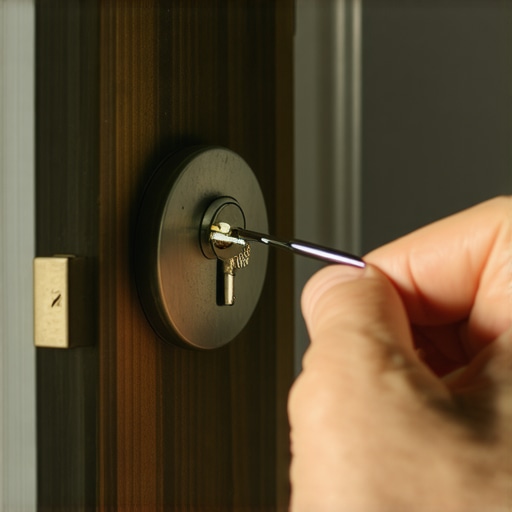
A real locksmith does not reach for a drill. We use a broken key extractor, which is a thin piece of spring steel with a microscopic hook or serrated edge. The goal is to slide the tool along the ‘warding’ (the grooves on the side of the keyway) and bypass the pins to grab one of the key’s teeth. We then apply a slight ‘lever’ action to pull it out. If you are a mobile locksmith for RVs and campers, you know that these locks are even more finicky because they use wafer tumblers which can flip and lock the fragment in place if handled roughly. The same applies to home safe lockout recovery; safes often use higher tension springs that make extraction a delicate dance of counter-pressure. For those working as a locksmith for vintage car keys, the challenge is the age of the metal; 50-year-old steel can be incredibly stubborn.
Rekeying vs. Replacing: Post-Extraction Decisions
Once the fragment is out, the question is: do you keep the lock? If the cylinder was jamming before the snap, residential lock cylinder replacement is usually the smarter move. However, if the lock is a high-grade ANSI Grade 1 deadbolt, rekeying is the way to go. This involves gutting the cylinder and replacing the internal pins. This is also the time to check your 2026 locksmith insurance claims guide, as many modern policies require specific hardware grades for coverage to remain valid. If you are managing a commercial property, remember that panic bar code compliance 2026 requires that all exit devices function with minimal force; a snapped key in a rim cylinder on a back door can lead to massive fines if it prevents emergency egress.
The Maintenance Ritual: Avoiding the Next Snap
Never use WD-40 in a lock. It is a solvent, not a long-term lubricant, and it eventually turns into a sticky ‘gunk’ that attracts dust and skin cells, creating a grinding paste. Use a dry PTFE or graphite-based lubricant. This ensures the pins move freely in their chambers and the key slides in without friction. While a transponder key programming guide is great for your modern car, the basic mechanical maintenance of the lock cylinder is what prevents the physical failure we have discussed today. Keep your locks clean, don’t use your key as a box cutter, and if you feel resistance, call a pro before the ‘tink’ happens.”, “image”: {“imagePrompt”: “Macro close-up photo of a professional locksmith’s hand using a thin steel extraction tool to pull a jagged broken brass key fragment out of a weathered silver door lock cylinder. Professional lighting, shallow depth of field, technical detail.”, “imageTitle”: “Professional Key Extraction Technique”, “imageAlt”: “A locksmith extracting a snapped key from a lock cylinder using specialized tools.”}, “categoryId”: 1, “postTime”: “2025-05-20T10:00:00Z”}