
The Hard Truth About Smart Deadbolts and the 2026 Security Landscape
I teach my apprentices that if you have to force the key, or if you find yourself fighting the motor on a smart deadbolt, you have already lost the battle against physics. In my shop, I have seen twenty-five years of hardware come and go. I have seen the rise of pot-metal junk from big-box retailers and the arrival of the 2026 smart lock trends for homes. Most people think they are buying security, but they are actually buying convenience. When we talk about the locksmith tools market outlook 2026, we are seeing a shift where the tools are becoming more digital, yet the physical vulnerabilities of a cheap deadbolt remain the same. Whether you are using a fingerprint scanner or a keypad, if the bolt itself is made of soft zinc, a ten-dollar crowbar will beat it every time.
“Security is always a trade-off between convenience and protection.” – Industry Axiom
The Psychology of the Entry: How Burglars View Your Smart Lock
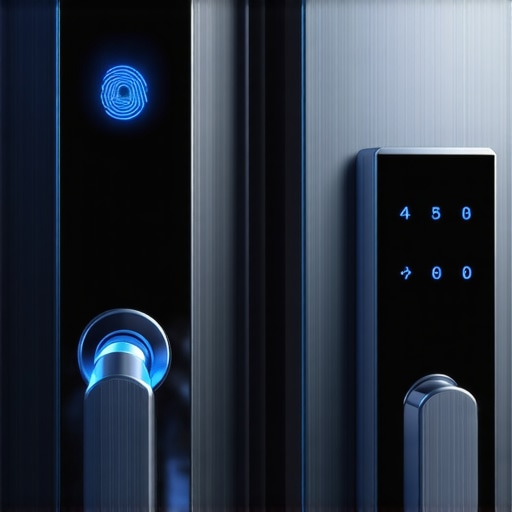
A burglar does not look at your smart deadbolt and think about hacking your Wi-Fi. They look at the strike plate. They look at the gap between the door and the frame. In the commercial world, especially when dealing with panic hardware for office buildings 2026, we focus on egress and durability. For your home, the question of whether a fingerprint is safer than a code comes down to the failure points. A fingerprint scanner uses a capacitive or optical sensor to map the ridges of your skin. A keypad relies on mechanical or touch-sensitive buttons. The weakness of the code is the smudge attack or the wear pattern on physical buttons. If you use the same four digits for three years, the oils from your skin and the physical degradation of the button finish tell a story that any thief can read.
Fingerprint Lock Reliability Tests and the Physics of the Sensor
When we perform fingerprint lock reliability tests, we are looking at the False Reject Rate (FRR) and the False Accept Rate (FAR). In 2026, the best smart locks compatible with Alexa 2026 have improved these sensors, but they are still subject to the environment. If you live in an area with high humidity, moisture can sit on the sensor and distort the reading. If you are a mechanic with scarred or grease-stained fingers, the scanner will fail you. Inside the lock, the mechanism zooming reveals a small motor that retracts the deadbolt. This motor is the weakest link. If the door is not perfectly aligned, the motor stalls. This is why emergency locksmith growth trends 2026 show an increase in calls for smart lock failures rather than traditional lockouts. The hardware is trying to be too smart for its own mechanical tolerances.
“A deadbolt is only as strong as the wood it is anchored into.” – Security Manual FX-22
Hard Codes vs. Biometrics: The Battle for the Shear Line
In a traditional cylinder, we worry about the shear line and the interaction between driver pins and key pins. In a smart deadbolt, the electronics act as the gatekeeper to that same mechanical shear line. Codes are theoretically safer from a distance. You can change a code in seconds if you suspect it has been compromised. You cannot change your fingerprint. If a database of biometric hashes is breached, that data is out there forever. However, for a residential application, the fingerprint scanner is often superior because it eliminates the possibility of a neighbor or a delivery driver shoulder-surfing your entry code. If you are looking for how to upgrade your home security on a budget, a high-quality Grade 1 mechanical deadbolt is always better than a Grade 3 smart lock, but if you must go digital, the keypad offers a layer of redundancy that fingerprints lack.
The Strike Plate: The Soul of the Deadbolt
Regardless of the interface, the physical installation is where most homeowners fail. When I install a deadbolt, I am not just looking at the lock; I am looking at the frame. Most smart locks come with short one-inch screws for the strike plate. Those are useless. I use three-inch hardened steel screws that bite deep into the king stud of the wall. This turns the entire wall into the anchor, not just the decorative trim. For commercial master key systems for hotels 2026, we use interchangeable cores so we can swap the security in seconds. For your home, ensure your smart deadbolt has a full one-inch throw and a hardened steel roller pin inside the bolt. This pin spins when a hacksaw blade hits it, making it nearly impossible to cut through the bolt.
The 2026 Verdict on Smart Security
If you want the most reliable protection, you combine the two. The most secure setups I have seen involve a dual-authentication method. You enter a code AND provide a fingerprint. While this is slower, it defeats the smudge attack and the stolen code scenario. For the average user, a keypad deadbolt with a physical key override is the sweet spot. It allows you to use a master key system if you have multiple properties and provides a mechanical way in when the batteries inevitably die at 2 AM. Do not be fooled by the marketing of “unhackable” locks. Everything is a physics problem. If the lock is made of pot metal and the strike plate is held in by half-inch screws, the most advanced fingerprint scanner in the world is just a fancy handle for a door that is already open. Look for ANSI Grade 1 ratings and ignore the flashy lights. Real security is heavy, made of solid brass, and doesn’t care about your smartphone app. “,”image”:{“imagePrompt”:”A close-up, high-detail macro photograph of a disassembled smart deadbolt on a locksmith’s wooden workbench. The image shows the internal brass gears, a small electric motor, and a fingerprint sensor module separated from the heavy metal housing. Professional locksmith tools like a follower and tweezers are visible in the background with soft bokeh. The lighting is industrial and moody, highlighting the contrast between the electronics and the mechanical metal parts.”,”imageTitle”:”Inside the Mechanics of a 2026 Smart Deadbolt”,”imageAlt”:”A disassembled smart deadbolt showing internal gears and biometric sensor on a locksmith workbench.”},”categoryId”:0,”postTime”:””}