
The Psychology of the Breach and Hardware Realities
Most homeowners look at a door and see a barrier. A burglar looks at a door and sees a series of physics calculations. They are not looking for the most complex way to bypass your security; they are looking for the path of least resistance. In my 25 years at the bench, I have seen thousands of ‘high-tech’ installations fail not because the software was hacked, but because the physical hardware was essentially a paperweight. Most people buying hardware kits for DIY smart lock installation focus on the app interface and the flashy LED lights. They ignore the fact that the actual bolt is made of pot metal or that the strike plate is held in by half-inch screws that barely grip the pine casing. When a door is kicked, it is not the lock that usually fails first; it is the wood of the door frame or the flimsy strike plate. If you are going to install your own smart lock, you must understand the physical constraints of the door assembly. This means moving beyond the marketing fluff and looking at the ANSI grades. Grade 1 is the gold standard for commercial strength, while Grade 3 is what you find in the discount bin at a big-box store. Using a Grade 3 smart lock on a main entry point is like putting a screen door on a submarine. It looks fine until the pressure is applied.
The Apprentice Lesson: Mechanics Over Muscle
I teach my apprentices that if you have to force the key, you have already lost. This technical wisdom applies double when we talk about smart locks. I remember teaching a young guy named Mike about the internal physics of a cylinder. He was trying to force a tailpiece into a smart lock adapter. I stopped him and explained that a lock is a precision instrument. If the alignment is off by even a fraction of a millimeter, the motor in that smart lock will burn out within three months. The friction created by a misaligned strike plate or a warped door creates a constant drag on the actuator. A human might not notice a slight ‘nudge’ needed to lock the door, but a small DC motor powered by four AA batteries definitely will. We spent three hours that day just filing a strike plate to ensure a dead-drop fit. If the bolt does not slide into the hole with zero resistance, your smart lock is a ticking time bomb of mechanical failure. Real locksmithing is about managing these tolerances so the hardware does not have to fight itself.
“Security is always a trade-off between convenience and protection.” – Industry Axiom
Analyzing Internal Physics: Pins, Springs, and Shear Lines
When you crack open a high-security euro cylinder lock or a standard American deadbolt, you see the true nature of security. We are talking about pin stacks. In a standard five-pin tumbler system, you have bottom pins of varying lengths and top driver pins. When the correct key is inserted, the break between the top and bottom pins aligns perfectly with the shear line, allowing the plug to rotate. Cheap DIY kits often use wide tolerances. This means the gap between the plug and the housing is large enough that a semi-skilled thief with a rake tool can feel the pins set far too easily. High-security versions use spool pins or mushroom pins. These are ‘security pins’ designed to catch on the shear line when someone tries to pick the lock, giving them a false sense of a ‘set’ pin. If your DIY kit does not specifically mention hardened steel anti-drill pins or security pins, you are buying a gadget, not a lock. Furthermore, consider the material science. Solid brass components hold up to the elements and cycles of use. Zinc-alloy components, common in budget smart kits, will brittle and snap under the torque of a motorized bolt if the door happens to swell in the humidity.
The Weak Point: Strike Plates and Frame Reinforcement
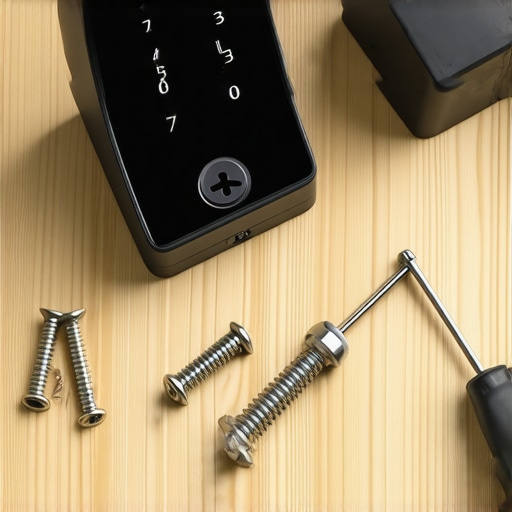
The strike plate is the most neglected component of any hardware kit. Most kits come with a small, two-screw plate. If you use the screws provided in the box, they are likely only three-quarters of an inch long. These screws only grab the thin decorative trim of your door frame. One solid kick will rip the entire assembly out. A master locksmith installation always involves a heavy-duty reinforcement plate with three-inch screws that reach past the trim and into the structural 2×4 studs of the house. This transforms the door from a flimsy panel into a structural barrier. When evaluating hardware kits, check if they include a security strike. If they do not, go to a locksmith shop and buy one separately. It is the best five dollars you will ever spend on home security. This is the difference between a ‘smart’ home and a ‘secure’ home.
“A lock is only as strong as its weakest point of contact with the frame.” – Security Manual
App-Controlled Door Locks: Security Risks and Digital Vulnerabilities
We need to talk about app-controlled door locks security risks. Beyond the physical bypass, you have the digital handshake. Many DIY kits rely on Bluetooth or Zigbee protocols. While these are generally secure, the risk often lies in the ‘convenience’ features like auto-unlock based on geofencing. If your phone’s GPS drifts while you are sitting in your living room, the lock might think you just arrived home and pull the bolt back. I have seen cases where homeowners slept through the night with their front door standing wide open because a software glitch triggered an unlock command. Also, consider the master key systems for hotels 2026 standards which are moving toward encrypted mobile credentials. For a residential DIYer, this means you are responsible for your own firmware updates. If you do not keep the lock’s software updated, you leave the door open to known exploits. This is why I often recommend ‘hybrid’ smart locks that still maintain a physical keyway with a high-security cylinder, rather than ‘keyless’ models that leave you stranded if the electronics fail.
Installation Process: The Sensory Check for a Flush Fit
When you begin the installation, do not just follow the pictures. Listen to the hardware. Start by removing the old deadbolt and checking the bore hole. Most modern kits require a 2 and 1/8 inch hole. If your door is older, the hole might be smaller, requiring you to use a jig to enlarge it. Once the bolt is in, extend it. Is it hitting the back of the dust box in the frame? If it bottomed out before fully extending, the lock will think it is jammed and send an error to your phone. You need at least a one-inch deep hole in the frame. Next, check the ‘flush fit.’ The housing of the smart lock should sit perfectly flat against the door skin. If there is a gap, moisture will get in and corrode the circuit boards. This is especially true in regions with high humidity or salt air. Use a level. A crooked lock is a failing lock. Finally, test the manual thumbturn. It should feel like butter. If there is any ‘crunch’ or ‘grind,’ something is misaligned internally. You might need to adjust the mounting plate by a hair. This is the forensic approach to installation that prevents a 3 AM call to a locksmith like me.
Beyond Residential: Lessons from Commercial and Automotive
While you are fixing your home, do not ignore your other assets. For business owners, panic bar installation and repair for commercial buildings is a completely different animal. You cannot just slap a residential smart lock on a storefront. Those require exit devices that meet fire codes. Similarly, in the automotive world, the automotive transponder keys 2026 updates show us that security is moving toward multi-factor authentication. If you lose your car keys, the automotive locksmith vs dealership for car key replacement debate is usually won by the locksmith who has the specialized programming tools to sync new transponders to your ECU without the dealership markup. All these fields—residential, commercial, and automotive—share the same core principle: the system is only as good as the technician who calibrated it. Whether you are dealing with commercial restricted keyways or a simple DIY smart kit, the attention to detail during the physical setup determines the longevity of the security. If you ever find yourself with a snapped blade in a cylinder, knowing how to extract a broken key from a lock safely involves using a dedicated spiral extractor tool, not a pair of needle-nose pliers that will just push the fragment deeper into the pin stacks. This same patience is required for smart lock setup.
The Final Verdict on DIY Kits
If you choose to go the DIY route, buy a kit that allows you to retain a high-quality mechanical cylinder. Look for kits that are compatible with high-security euro cylinder locks or American 5-pin/6-pin cylinders that can be rekeyed to a master key system if needed. Avoid any hardware that feels light or ‘hollow’ in your hand. Security involves trust, but that trust must be earned by solid metal and precise engineering, not just a pretty app. A lock’s primary job is to stay locked until the correct credential is presented. If the hardware is flimsy, the smartest software in the world will not stop a crowbar. Real security is a physics problem, and the solution is always heavy-duty hardware installed with surgical precision. Keep your hinges tight, your strike plates reinforced, and your firmware updated. That is how you actually protect a home.