
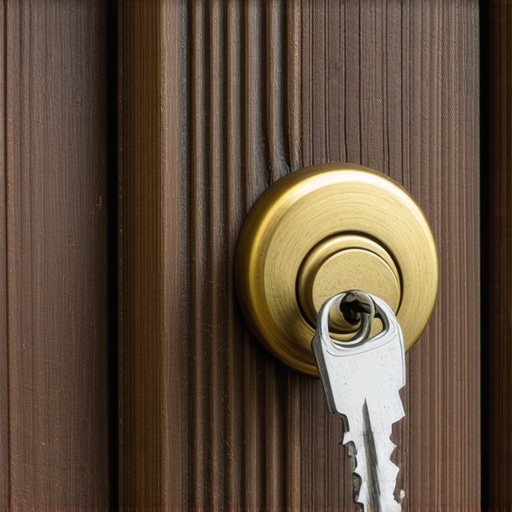
The Physics of a Failing Lock
I teach my apprentices that if you have to force the key, you’ve already lost the battle against physics. In my twenty-five years behind a locksmith bench, I have seen thousands of locks that owners swore were working fine right up until the moment they were stranded on their porch. A lock is a precision instrument, often built with tolerances thinner than a human hair. When you ignore the subtle mechanical feedback your door is giving you, you are basically waiting for a metal fatigue catastrophe. Most people treat their door hardware like a toaster, but it is actually a security gate that relies on the structural integrity of brass, steel, and sometimes, unfortunately, cheap zinc. If you are noticing a change in the way your key enters the cylinder, you are not dealing with a ghost; you are dealing with a mechanical failure in progress.
“Security is always a trade-off between convenience and protection.” – Industry Axiom
1. The Gritty Crunch in the Cylinder
When you insert your key and feel a sensation like sand is trapped inside the plug, you are feeling the first stage of a total seizure. This is often the result of internal pin erosion. Inside a standard pin-tumbler lock, you have bottom pins, top pins, and tiny springs. These components are usually made of brass. Over time, the constant friction of the key blade wears down the peaks of the pins, creating microscopic metal shavings. These shavings mix with old, dried-out factory grease to create a grinding paste. If you keep turning that key, you are forcing those pins against the shear line while they are misaligned. This is why door lock jamming fixes 2026 emphasize cleaning the internal tracks before the springs collapse. Once a spring binds because of this debris, the lock will not just be hard to turn; it will physically lock you out by preventing the pins from reaching the neutral position.
2. The Ghost Turn and Cylinder Rotation
If you put your key in and the entire circular face of the lock moves a fraction of an inch before the bolt retracts, your mounting bolts or your tailpiece are failing. This is a common precursor to a snap. In high-security euro cylinder locks, the center cam is the most vulnerable part. If the cylinder is not seated perfectly flush, every turn applies torque to the center screw hole, which is the narrowest and weakest point of the metal. We see this constantly with budget home security upgrades 2026 where the hardware is slapped on without checking the alignment of the strike plate. When the cylinder is under constant tension, the metal undergoes stress crystallization. Eventually, the tailpiece or the cylinder body itself will snap in half, usually while the bolt is still in the locked position, making a non-destructive entry nearly impossible for even a pro.
3. The Key Resistance at the 90-Degree Mark
A lock should operate with a fluid motion. If you feel a hard stop or a hitch at the 90-degree rotation mark, your bolt is likely misaligned with the frame. This is not just a nuisance; it is a death sentence for your lock’s internal linkage. When you force the key to overcome that resistance, you are putting hundreds of pounds of pressure on the drive cam. Most big-box store locks use pot metal (zinc alloy) for these internal parts. Zinc is brittle. While high-security locks for rental properties are designed to handle some lateral pressure, your standard hardware store deadbolt is not. If the door has sagged due to humidity or house settling, that bolt is hitting the strike plate instead of the hole. Every time you force it, you are bending the drive bar. Eventually, that bar will snap, and you will be left with a key that spins 360 degrees without doing a single thing.
“A lock is only as strong as its weakest point, which is usually the strike plate or the cylinder tailpiece.” – Security Standards Handbook
4. The Failure of Fingerprint and Smart Interfaces
We are seeing a massive surge in fingerprint lock reliability tests failing in the field because people forget that there is still a mechanical motor inside. Even if the sensor reads your thumbprint, if you hear a high-pitched whining sound or a repetitive clicking, the motor is struggling. This often happens with integrated home security lock bundles where the software is advanced but the motor is weak. If your solar-powered smart locks 2026 are struggling to throw the bolt, the gear teeth are likely stripping. These gears are often plastic or thin nylon. Once one tooth shears off, the rest follow in rapid succession. This is a digital-to-analog failure. You might have the most integrated smart lock hubs 2026 on the market, but if the mechanical drive snaps, the app will tell you the door is locked while it remains wide open, or vice versa.
5. Discoloration and “Metal Bleeding”
Look at your lock. If you see a dark, oily residue leaking from the keyhole or around the thumbturn, that is “metal bleeding.” It is a sign that the internal components are literally grinding themselves into dust. This is especially dangerous after an emergency lock changes after break-in if the technician used cheap, non-graded hardware. Residential door locks for safety and durability should be made of solid brass or stainless steel. When you see that black sludge, it means the protective plating on the pins has worn off, and the base metal is oxidizing. This friction increases the torque required to turn the key, which leads directly to the key snapping off inside the plug. A snapped key is a 3 AM call that will cost you three times as much as a proactive replacement. If your lock looks like it is crying oil, it is time to upgrade to something with a higher ANSI rating.
The Maintenance Verdict
Stop using WD-40. I see it every day, and it drives me crazy. WD-40 is a solvent, not a long-term lubricant. It will make your lock feel better for three days, then it will attract every piece of dust and lint in the neighborhood, creating a gunk that will seize the pins faster than rust ever could. Use a dedicated PTFE (Teflon) or silicone-based dry lubricant. Spray it into the keyhole, work the key in and out twenty times, and wipe off the excess. If the lock still feels like it is hitching or grinding, the metal has already been compromised. At that point, you aren’t looking for a fix; you are looking for a replacement. Do not wait for the snap. A proactive swap to a high-security cylinder is the only way to ensure your door remains a barrier rather than a liability.