
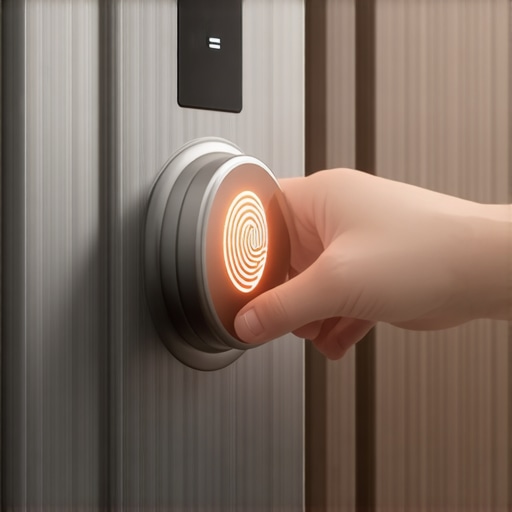
Why Most Biometric Locks Fail and How to Choose One That Actually Protects Your Home
A lady came into my shop crying because a scammer drilled her lock and charged her six hundred dollars for a twenty dollar piece of pot metal. She had called an emergency locksmith number from a sticker on a pole, and instead of a professional, she got a ‘trunk slammer’ with a cordless drill and a predatory mindset. She was terrified and wanted the ‘best’ lock money could buy, thinking a fingerprint scanner would solve all her problems. I had to sit her down and explain that biometrics are only as good as the physical metal they are attached to. If the housing is made of cheap zinc, a criminal does not care how high-tech your scanner is; they will just snap the handle off with a pipe wrench.
The Physics of Biometric Reliability and Mechanism Zooming
When we look at the internal physics of a biometric lock, we are talking about two distinct systems: the electronic authentication layer and the mechanical actuator. Most people focus on the fingerprint sensor, but the real failure point is often the motor-driven clutch. In my twenty-five years at the bench, I have seen countless units where the capacitive sensor works perfectly, but the tiny plastic gears inside the actuator have stripped because the door was slightly misaligned. Fingerprint lock reliability tests often focus on the False Rejection Rate (FRR), but they rarely test the shear strength of the internal cam. When you press your finger to a capacitive scanner, it measures the electrical charge difference between the ridges and valleys of your skin. This signal triggers a solenoid or a small motor to move a locking bar into the ‘gate’ of the drive cam. If that cam is made of cast aluminum instead of hardened steel, it will eventually fail under the stress of daily cycles.
“Security is always a trade-off between convenience and protection.” – Industry Axiom
In my shop, I tell apprentices that if the physical lock body does not meet ANSI Grade 1 standards, the electronics are just expensive window dressing. Emergency lock changes after break-in scenarios often reveal that the burglar ignored the smart features entirely and simply kicked the door. If your biometric lock is not backed by a solid brass cylinder and a one-inch throw deadbolt with a hardened steel anti-saw pin, you are not buying security; you are buying a gadget.
The Hard Truth About Weatherproofing and Outdoor Usage
I frequently see weatherproof outdoor locks reviews that are written by people who have never seen what salt air or freezing rain does to a PCB. For my customers in regions with high humidity or extreme cold, I explain that ‘weather-resistant’ and ‘weatherproof’ are not the same thing. A true outdoor biometric lock needs an IP65 rating at minimum. The rubber gaskets must be UV-resistant or they will crack within two seasons, allowing moisture to reach the battery terminals. Once corrosion starts on those contacts, the resistance increases, the voltage drops, and suddenly your fingerprint is not recognized because the sensor cannot pull enough current to process the image. Access logs for smart locks will not show a ‘mechanical failure’ or ‘low voltage ripple’; they will just stop working, leaving you locked out at 2 AM in a rainstorm.
Selecting Your Operational Lane: Residential Fortress vs. Commercial Access
If you are looking at commercial keyless entry benefits, you are moving away from simple deadbolts and into the territory of heavy-duty mortise locks or cylindrical locks with push-button locks for offices. In a commercial setting, access logs for smart locks are vital for internal theft prevention. You need to know exactly who entered the server room at 11 PM. However, for a 24/7 mobile locksmith for apartments, the priority is often bypass capability. I never install a biometric lock that does not have a physical key override. Why? Because electronics fail. Capacitors leak. Soldering joints cold-crack. When the motherboard dies, you need a physical 6-pin Schlage or Kwikset cylinder that can be picked or keyed by a professional. This is where transponder key programming guide knowledge overlaps with residential security; understanding how chips communicate with readers is essential for troubleshooting modern hardware.
“ANSI/BHMA A156.36 establishes the requirements for auxiliary locks, including cycle tests and impact resistance.” – ANSI Standards Manual
The Forensic Installation: Why The Strike Plate Matters
The best biometric lock in the world is useless if it is installed into a soft pine door frame with half-inch screws. When I perform a fortress upgrade, I replace those factory screws with three-inch hardened steel screws that bite directly into the wall stud. I look for a ‘flush fit’ where the lock body meets the door. Any gap is a leverage point for a pry bar. Automotive transponder keys 2026 updates show us that security is moving toward more complex encryption, but in the residential world, the physical strike plate remains the weakest link. If you are worried about transponder chip key cloning 2026 or high-tech hackers, you are likely overestimating the average burglar. Most are looking for the path of least resistance. A biometric lock with a heavy-duty strike plate and a reinforced box strikes sends a clear message: go somewhere else.
Expert Verdict on Modern Biometrics
Do not be fooled by the flashy apps and the promise of a ‘keyless life.’ A biometric lock is a tool, and like any tool, its quality is defined by its construction. Look for solid metal housings, check the ANSI grade, and ensure there is a physical override. Avoid the cheap plastic models sold at big-box stores that feel light in your hand. Real security has weight. Real security has friction. When you turn that thumbturn, you should feel the precision of the machining, not the wobbliness of cheap components. If you have been a victim of a break-in or a scammer, take the time to vet your hardware. Security involves trust in the physics of the lock, not just the convenience of the tech.