
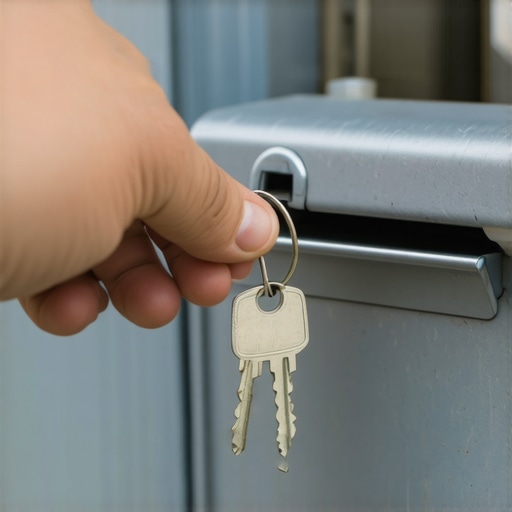
The Forensic Autopsy of a Failing Cam Lock
I teach my apprentices that if you have to force the key, you have already lost the battle against the mechanism. In my shop, I have seen thousands of these small cam locks from USPS Cluster Box Units (CBUs) and private commercial mail centers. Most people treat their mailbox lock as an afterthought until it is 5:00 PM on a Friday and they cannot get their paycheck out of the box. They start yanking, bending the key, or worse, spraying enough WD-40 inside to attract every grain of dust in the county. That gritty, crunching sound you hear when you insert the key? That is the sound of mechanical failure in progress. It is the sound of zinc oxide and road grime grinding down the delicate brass wafers that define your security.
“Security is always a trade-off between convenience and protection.” – Industry Axiom
The Anatomy of the Wafer Tumbler
To understand why your commercial mailbox lock is sticking, you have to understand the physics of the wafer tumbler system. Unlike a high-security deadbolt installation DIY vs pro scenario where you might deal with pin tumblers and spool pins, most mailbox locks use a series of five or six wafers. These are flat pieces of metal with different heights of internal cutouts. When the correct key is inserted, the cuts on the key pull these wafers into the plug so they are flush with the shear line. If even one wafer is hung up by a microscopic burr or a glob of dried grease, it stays protruded. This creates a mechanical block against the lock shell. When you force that turn, you are not just turning a lock; you are shaving metal off the wafers. Eventually, the lock will not recognize any key, not even the original one. This is why we see so many requests for transponder chip key cloning 2026 or mobile app locksmith booking 2026 in the automotive world, but in the mailbox world, it remains a purely mechanical fight against friction.
Why Material Science Matters
The vast majority of commercial mailbox locks are made of die-cast zinc or low-grade brass. In the locksmith industry, we often call this pot metal. It is cheap to manufacture but prone to oxidation. If your building is near a coastal area or a high-traffic road where salt is used in the winter, that salt enters the keyway. It reacts with the zinc, creating a white, powdery corrosion. This corrosion increases the tolerances to the point where the wafers cannot move freely on their leaf springs. While the industry is moving toward sustainable eco-friendly locks for homes and even biometric keyless entry for cars, the commercial mailbox remains stuck in a cycle of cheap hardware that fails every three to five years. In my 25 years of bench experience, I have seen that the spring tension in a standard CBU lock is barely enough to overcome a single layer of dust, let alone years of neglect.
“The strength of a lock is only as good as the material it is cast from.” – Locksmith Guild Guideline
The Forensic Diagnosis: Why It Sticks
There are three primary reasons for a sticking mailbox lock. First is the key wear. Every time you slide that key in, the brass on brass contact removes a few microns of metal. Over a decade, the key becomes a ghost of its former self. Second is the tailpiece misalignment. The cam (the metal arm at the back) must rotate into a slot. If the mailbox door is bent or the frame has shifted, the cam hits the frame before the lock completes its rotation. Third, and most common, is the contamination of the internal leaf springs. These springs are thinner than a human hair. When they get gunked up, they cannot push the wafers back into the locked position, leading to signs of tampered locks detection being falsely reported by nervous tenants. While property managers might be looking at master key systems for hotels 2026 or integrated home security lock bundles for their units, they often forget that the mailbox is the first point of entry for identity thieves.
The Proper Fix: More Than Just Lubrication
If you want to fix a sticking mailbox lock, stop reaching for the blue and yellow can of multi-purpose spray. That product is a solvent, not a long-term lubricant for tight tolerances. To do it right, you need an electronic cleaner or a dedicated lock flush to remove the old, hardened grease. Once the keyway is clear, use a dry film lubricant like PTFE or high-grade graphite. However, if the wafers are already mushroomed from being forced, no amount of spray will save it. You need a replacement. Be wary of the $29 service call scammers who show up and immediately pull out a drill. A real locksmith can often pick or shim a mailbox lock in seconds without damaging the door. We look at fingerprint lock reliability tests and budget smart lock starter kits for the front door, but for the mailbox, a simple, well-maintained mechanical cam lock is still the gold standard for reliability if you treat the metal with respect.