The Illusion of Digital Safety: A Master Locksmith’s Warning
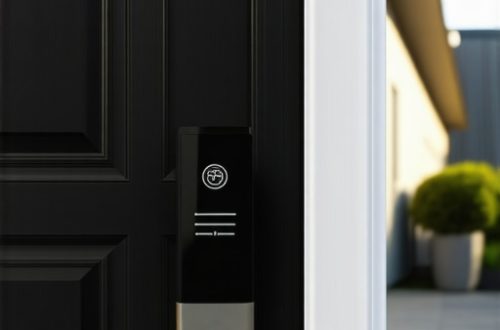
I’ve spent over 25 years at a workbench, breathing in the scent of brass shavings and TRI-FLOW lubricant. I’ve seen security evolve from basic skeleton keys to encrypted biometric scanners, but one thing never changes: security is a physics problem, not a software update. Most homeowners in 2026 treat their biometric locks like a smartphone—they think if the screen glows, the house is safe. That’s a dangerous lie. I own a real brick-and-mortar shop, and I see the aftermath of these ‘high-tech’ installs every single day. People are trading solid steel for fancy sensors, and they’re doing it wrong.
A lady came into my shop crying last Tuesday because she’d been locked out of her own home in a rainstorm. She’d spent six hundred dollars on a ‘smart’ deadbolt she bought from a big-box store. When the internal capacitor failed, a ‘trunk-slammer’ locksmith—one of those unlicensed scammers who operates out of a sedan—showed up and didn’t even know how to use a Lishi tool or a basic bypass shim. He just went straight for the drill, ruined her custom mahogany door, destroyed the lock, and then charged her another four hundred dollars for a ten-dollar zinc replacement. This is the reality of the 2026 locksmith tools market; if you don’t understand the mechanics, you’re just bait for scammers.
“Security is always a trade-off between convenience and protection.” – Industry Axiom
Mistake 1: Ignoring the Mechanical Shear Line and Manual Keyway
The first mistake is choosing a lock that prioritizes the fingerprint scanner over the physical cylinder. Many 2026 biometric models utilize high-security euro cylinder locks as a backup, but the quality of these cylinders varies wildly. When I zoom into the mechanism of a cheap biometric lock, I see ‘pot metal’—zinc alloys that crumble under the slightest torque. A real high-security lock uses nickel-silver pins and hardened steel anti-drill inserts. If your biometric lock has a cheap, five-pin tumbler backup with wide tolerances, a semi-skilled thief can rake it open in seconds, regardless of how ‘smart’ the electronics are. You need a cylinder with spool pins or mushroom pins that create false sets, confusing anyone trying to pick the lock. If the mechanical heart of the device is weak, the biometric brain is irrelevant.
Mistake 2: Mounting Tension and Solenoid Binding
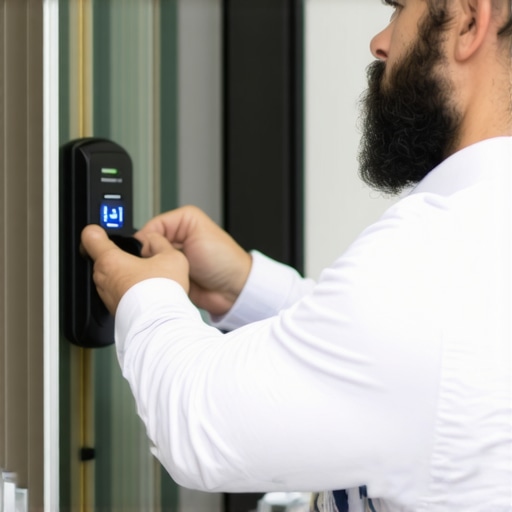
In Blueprint B of security—The Fortress Upgrade—we focus on the installation physics. Homeowners often install these locks themselves, failing to realize that a door is a living, breathing thing. In my experience, wood doors swell with humidity, and if your deadbolt isn’t perfectly aligned within 1/32 of an inch, the internal solenoid has to work overtime. The solenoid is the electromagnetic coil that pulls the plunger to engage the clutch. When the bolt rubs against the strike plate, it creates friction. This friction causes a ‘binding’ effect. In 2026 smart models, the motor will try to force the bolt, drawing excess milliamps from the battery and burning out the circuit board. I teach my apprentices that a lock should feel ‘fluid.’ If you have to push or pull on the door handle to get the biometric scanner to work, you’ve already failed the installation. The bolt should throw smoothly into the pocket without touching the metal of the strike plate.
“The strength of a lock is only as good as the frame it is mounted to.” – ANSI/BHMA Security Standards
Mistake 3: The Strike Plate Trap and ANSI Grade Confusion
IMAGE_PLACEHOLDER
Most people don’t look at the ANSI Grade. They see a shiny box and ‘2026 Tech’ branding. If your lock is ANSI Grade 3, it’s basically a toy. For residential security, I only recommend Grade 1. The weak point isn’t usually the lock itself; it’s the strike plate—the piece of metal on the door frame. Most homeowners use the half-inch screws that come in the box. One kick and the wood door jamb splinters. I always replace those with three-inch hardened steel screws that bite into the structural 2×4 studs of the house. This transforms the door from a flimsy barrier into a fortress. When comparing high security locks vs standard locks, the difference isn’t just the key; it’s the mass of the metal and the length of the reinforcement. For commercial smart access control 2026 trends, we see integrated panic bar installation and repair systems that use heavy-duty latching mechanisms; homeowners should mimic this by using reinforced strike boxes.
Mistake 4: Failing to Audit the Keyless Entry Systems Pros and Cons
The final mistake is the ‘Set and Forget’ mentality. Keyless entry systems require a maintenance schedule. Every six months, you need to check the battery terminal for oxidation. I’ve seen 24/7 emergency locksmith services called out simply because a battery leaked and ate through the ribbon cable of a fingerprint sensor. Furthermore, you must understand the difference between capacitive and optical sensors. Optical sensors take a photo of your finger; they can be fooled by a high-resolution print. Capacitive sensors measure electrical current and are much harder to bypass. If you are looking for an automotive key programming near me or a locksmith for vintage car keys, you know that specialized tech requires specialized care. The same applies to your front door. Clean the sensor with isopropyl alcohol—never use WD-40 on the electronics. In fact, never use WD-40 on the lock cylinder either; it attracts gunk. Use a dry PTFE or graphite lubricant to keep the pins moving freely without gumming up the works.
The Verdict: Physics Beats Electronics Every Time
A biometric lock is a tool, not a savior. If you buy a cheap unit and install it on a warped frame with short screws, you aren’t secure; you’re just trendy. Real security involves a high-security euro cylinder, a reinforced door jamb, and a professional installation that accounts for the ‘crunch’ and ‘click’ of precision engineering. Don’t be the person crying in my shop because a scammer drilled your ‘smart’ lock. Do it right the first time. Security involves trust, and trust is built on solid steel and proper physics.

![Dead Key Fob? Replace Your Battery in 3 Minutes [2026 Tutorial]](https://prolocksmithco.com/wp-content/uploads/2026/01/Dead-Key-Fob-Replace-Your-Battery-in-3-Minutes-2026-Tutorial-75x75.jpeg)
![5 Budget Home Security Fixes That Work in 2026 [Tested]](https://prolocksmithco.com/wp-content/uploads/2026/01/5-Budget-Home-Security-Fixes-That-Work-in-2026-Tested-75x75.jpeg)
![5 Solar-Powered Smart Locks That Won't Die in Winter [2026]](https://prolocksmithco.com/wp-content/uploads/2026/04/5-Solar-Powered-Smart-Locks-That-Wont-Die-in-Winter-2026-1-500x330.jpeg)
![5 Solar-Powered Smart Locks That Won't Die in Winter [2026]](https://prolocksmithco.com/wp-content/uploads/2026/04/5-Solar-Powered-Smart-Locks-That-Wont-Die-in-Winter-2026-500x330.jpeg)