The Scam That Cost a Homeowner Six Hundred Dollars
A lady came into my shop crying last week because a scammer drilled her lock and charged her a fortune. She was locked out of her own home in the middle of a rainstorm. Instead of using a pick or a bypass tool, this ‘trunk slammer’ took a high-speed drill to her beautiful Baldwin handleset, destroyed the internal timing of the latch, and then had the nerve to charge her for a replacement lock that was nothing but zinc pot metal. This is the state of the industry today. If a technician reaches for a drill before they’ve spent at least fifteen minutes attempting a non-destructive entry, you are being robbed. Real locksmithing is a dance with physics, not a demolition job.
The Physics of the Shear Line
To understand how 24/7 emergency locksmith services explained by a professional actually work, you have to understand what is happening inside that brass cylinder. Most residential locks are pin-tumbler systems. You have a plug that must rotate within a housing. To prevent that rotation, there are stacks of pins pushed down by springs. Only when the correct key lifts those pins to the exact height of the ‘shear line’ can the plug turn. In 2026, we are seeing tighter tolerances than ever, but the fundamental physics remain the same.
“Security is always a trade-off between convenience and protection.” – Industry Axiom
Tactic 1: Precise Pin Manipulation
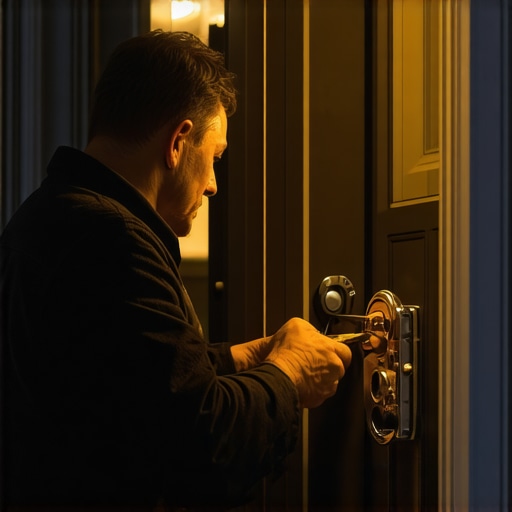
The first professional tactic for emergency residential lockout solutions is Single Pin Picking (SPP). This isn’t what you see in the movies. I use a tension wrench to apply a microscopic amount of torque to the plug. Because no lock is manufactured perfectly, one pin will always bind before the others. I feel for that ‘binding pin’ using a hook made of high-carbon steel. When I lift that pin and it hits the shear line, the plug rotates perhaps half a degree. That’s the ‘click.’ I repeat this for all five or six chambers. If the lock has spool pins or serrated pins (security pins designed to give false feedback), the tension must be pulsed to allow the pin to reset without dropping the others. This is why you pay for twenty years of bench experience.
Tactic 2: The Air Wedge and Latch Bypass
Sometimes the lock itself is not the target. Many residential doors are installed poorly. If the gap between the door and the frame is wide enough, I can use an air wedge to gently move the door stop just enough to reach the latch. I am looking for the deadlatch. A properly installed lock has a small plunger that, when depressed, prevents the main latch from being retracted by a credit card or a shim. However, if the strike plate is misaligned, that deadlatch falls into the hole, and the door is vulnerable. This bypass is fast, quiet, and 100 percent damage-free. It’s one of the best residential door locks for safety and durability tests we perform; if I can bypass it in ten seconds, your security is an illusion.
Tactic 3: Lishi Decoding Technology
In 2026, the Lishi tool is the king of the job site. Originally designed for automotive locks, residential Lishi decoders allow us to see exactly where the pins are sitting inside the keyway. It’s a grid system that lets me manipulate each pin while simultaneously reading its depth. Once I’ve picked the lock with the Lishi, I don’t just open the door; I can read the depths of the pins and cut you a brand new key on the spot. This is how to upgrade your home security on a budget because it proves your hardware works and provides you with a spare without needing to replace the whole unit.
Tactic 4: The Metallurgy of Impressioning
If picking fails due to extreme weather or debris in the keyway, I use impressioning. I take a blank key, coat the blade with a specialized marker or soot, and insert it into the lock. By binding the pins and wiggling the key, the hard steel pins leave microscopic marks on the soft brass blank. I file the blank where the marks appear. I repeat this until the key turns. You walk away with a working key and a lock that hasn’t been touched by a drill bit. This requires an understanding of metallurgy and a very steady hand.
Protecting the Modern Home
Security doesn’t end with a traditional key. We are seeing a rise in high-security euro cylinder locks that feature ‘snap-secure’ technology and magnetic pins. For those looking at neighborhood watch lock recommendations, I always suggest moving toward hardware that resists bumping and picking. Smart lock hacking prevention tips often focus on software, but the physical override is usually the weakest link. Always ensure your smart locks for pet doors or main entries have a physical cylinder that is at least ANSI Grade 1.
“The strength of a chain is only as great as its weakest link, and in home security, that link is often the strike plate screws.” – Security Manual 101
The Professional Verdict
Don’t let a scammer tell you that your lock is ‘unpickable’ and must be drilled. While some high-security cylinders are designed to be extremely difficult to manipulate, 90 percent of residential hardware can be opened by a master smith using the tactics mentioned above. If you are dealing with a home safe lockout recovery or a complex business key management software issue, the same principles of precision apply. Metal has a memory, and physics never lies. Trust the man with the shop and the grease on his hands, not the guy with the brand-new drill and a $29 service call ad. Real security is built on trust and high-quality steel.