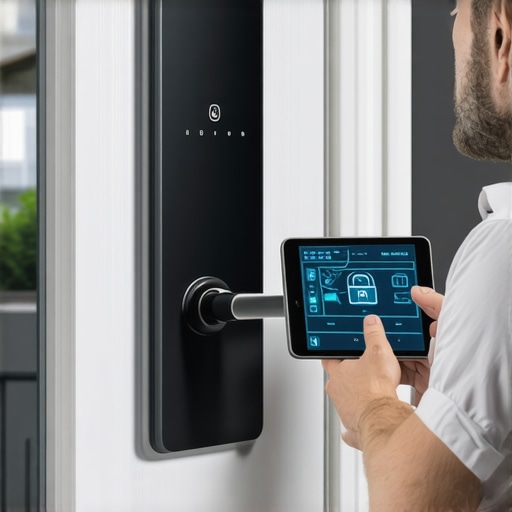
The 2026 Threat Landscape: Why Your Smart Lock is a Target
I teach my apprentices that if you have to force the key, you’ve already lost. In the world of 2026 smart security, that ‘force’ isn’t just physical; it’s digital. Last week, I had a kid in my shop—a bright apprentice—who couldn’t understand why a high-end smart deadbolt failed to throw. He kept hitting the app button, forcing the motor to whine against a misaligned strike plate. I told him: ‘Son, the app is lying to you because the physics are wrong.’ If that motor strains, it creates a gap in the bolt’s throw, and that’s exactly where a digital exploit meets a physical vulnerability. As we move into 2026, the ‘Trunk Slammer’ scammers aren’t just carrying drills; they’re carrying signal boosters. You need to understand the internal physics of your security to keep your family safe.
“Security is always a trade-off between convenience and protection.” – Industry Axiom
1. Harden the Physical Core: Moving Beyond Zinc Hardware
Most smart locks sold at big-box retailers are made of ‘pot metal’—a low-grade zinc alloy that has the structural integrity of a soda can. When you’re looking for door reinforcement for security, you need to ignore the flashy touchscreen and look at the ANSI Grade. By 2026, even the smartest locks will be bypassed by simple ‘prying’ if they aren’t Grade 1 certified. A Grade 1 deadbolt is tested to withstand ten 225-foot-pound blows. If you’re using a Grade 3 lock, a burglar with a heavy boot is already inside your house before your phone even sends the ‘Tamper Alert’ notification. Signs you need to change your door locks immediately include a ‘spongy’ feel when the bolt throws or visible discoloration on the bolt itself, which suggests the metal is fatigue-cracking. [IMAGE_PLACEHOLDER]
2. Network Isolation: The ‘Air-Gap’ Strategy for 2026
Smart lock hacking in 2026 won’t just be about picking pins; it will be about ‘Man-in-the-Middle’ attacks on your Wi-Fi. To stop this, your first fix is to move your smart locks to a dedicated VLAN. Never put your security hardware on the same network as your ‘smart’ toaster or your kids’ unpatched gaming consoles. We are seeing a massive rise in commercial smart access control 2026 trends where offices isolate their touchless entry systems for offices from the main guest network. This same logic applies to your home. Use the ‘Matter’ protocol or ‘Thread’ networks which offer better end-to-end encryption than traditional 2.4GHz Wi-Fi. If your lock is constantly dropping connection, it’s not just a nuisance—it’s a vulnerability. A lock in a ‘search’ state is more susceptible to signal hijacking.
3. The Strike Plate Deep Dive: The Physics of Resistance
I’ve seen it a thousand times: a $500 smart lock installed with the 3/4-inch screws that came in the box. Those screws only grip the soft pine of the door casing. One solid kick and the whole assembly—lock and all—is on your floor. To properly secure your home, you must replace those screws with 3-inch hardened steel screws that bite into the structural 2×4 studs of the house frame. When we talk about door reinforcement for security, we are talking about the ‘Shear Line’ of the entire door assembly. If your strike plate doesn’t have a reinforced steel box behind it, your ‘smart’ lock is just an expensive paperweight. I always check the ‘flush fit’—if the bolt doesn’t sit perfectly centered in the strike, the motor-driven actuator will eventually wear out, leading to a mechanical failure that leaves the door unlocked while the app claims it’s ‘Secure.’
4. Biometric Encryption and Firmware Hardening
We are seeing more electronic gate lock systems using biometric sensors. The fix here is simple: stop using default settings. 2026 hacking techniques involve ‘Replay Attacks’ where a recorded signal or a lifted fingerprint image is used to trick the sensor. Ensure your lock has ‘Live Tissue Detection.’ In my shop, I won’t even stock a lock that doesn’t offer 128-bit AES encryption. If you’re using mobile app locksmith booking 2026 features to manage your property, ensure the app uses Multi-Factor Authentication (MFA).
“The strength of a system is defined by its weakest point of entry, whether that point is a brass pin or a line of code.” – Security Manual 101
If you’ve recently suffered a break-in, rekeying after burglary best practices dictate that you shouldn’t just change the physical pins; you must ‘flush’ the digital authorized users list and update the firmware immediately to close any backdoors the intruder might have exploited.
5. Forensic Awareness: Signs of Tampered Locks Detection
You need to look at your lock like a crime scene investigator. Signs of tampered locks detection in 2026 include fine metallic ‘shavings’ around the keyway (indicating a manual picking attempt) or a ‘lag’ in the touchscreen response (which could indicate a hardware-level ‘shim’ is drawing power). If you have a home safe lockout recovery situation, don’t let a ‘Trunk Slammer’ drill it out. A real tech uses an oscilloscope or a specialized dialer. The same applies to your front door. If your smart lock’s exterior housing looks slightly askew, someone may have tried to ‘torque’ it to snap the mounting bolts. For businesses, implementing fire-rated panic hardware options that integrate with smart hubs is the only way to ensure safety and security co-exist. Don’t let a ‘smart’ upgrade turn into a fire hazard because the electronic strike won’t release during a power failure.


![5 Solar-Powered Smart Locks That Won't Die in Winter [2026]](https://prolocksmithco.com/wp-content/uploads/2026/04/5-Solar-Powered-Smart-Locks-That-Wont-Die-in-Winter-2026-1-500x330.jpeg)
![5 Solar-Powered Smart Locks That Won't Die in Winter [2026]](https://prolocksmithco.com/wp-content/uploads/2026/04/5-Solar-Powered-Smart-Locks-That-Wont-Die-in-Winter-2026-500x330.jpeg)
This article hits the nail on the head regarding the importance of understanding the physical and digital vulnerabilities of smart locks. I’ve always been a proponent of moving beyond reliance solely on electronic security and focusing on the physical reinforcement of door frames and strike plates. The emphasis on replacing standard ¾-inch screws with 3-inch hardened steel ones is a simple yet often overlooked step. In my own experience installing smart locks, I’ve seen many homeowners neglect this detail, leaving their homes vulnerable to basic brute-force attacks. The integration of network segmentation also seems crucial, especially as hackers advance their techniques in 2026. Do others here have experience with the latest protocols like Thread or Matter? How effective have they been in real-world scenarios for maintaining secure and stable connections? I believe awareness and proactive upgrading can significantly bolster our defenses, but staying updated is a constant challenge in this rapidly evolving landscape.