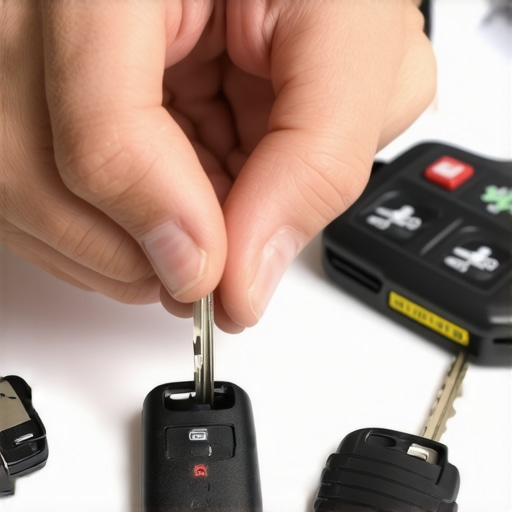
The Apprentice Lesson: A Microchip is Not a Screwdriver
I teach my apprentices that if you have to force the key, you’ve already lost. But in 2026, the lesson has shifted from the physical bitting of a brass blade to the invisible handshake of a transponder chip. Last week, I watched a young kid—an apprentice who thinks he knows it all because he can use a smartphone—try to force a cloned key into a 2026 crossover ignition. He didn’t understand that the mechanical fit is only 10% of the job. I had to pull him aside and explain that a transponder is a delicate marriage of physics and cryptography. If the induction coil in the steering column doesn’t see the exact frequency it’s looking for, that car is nothing more than a two-ton paperweight. You don’t ‘force’ a signal. You align it. This is why I tell every driver who walks into my shop: don’t let a ‘trunk slammer’ with a $20 tablet touch your ECU. You’re not just paying for a key; you’re paying for 25 years of knowing why a 128-bit encryption cycle fails when the voltage drops below 12.2 volts.
“Security is always a trade-off between convenience and protection.” – Industry Axiom
The Anatomy of a 2026 Transponder: Why Your Car is Dead
When you turn that key or push that start button, a silent conversation happens in milliseconds. This isn’t the basic RFID of the early 2000s. We are dealing with 2026 trends in automotive security that utilize Ultra-Wideband (UWB) and sophisticated rolling codes. The induction coil, a copper-wound antenna hidden behind the plastic shroud of your steering column, sends a burst of electromagnetic energy. This energy wakes up the passive transponder chip inside your key head. Once awake, the chip doesn’t just send a password; it solves a mathematical riddle sent by the Engine Control Unit (ECU). If the answer is wrong by even one bit, the fuel injectors stay shut. This is where the ‘Forensic Autopsy’ of a failed key begins. Most ‘budget’ keys use cheap Chinese clones of the PCF7935 or similar chips that have high ‘jitter’ in their frequency response. In my shop, I see these fail during temperature swings. A key that works in the cool morning will fail in the 100-degree afternoon because the internal oscillator in the chip drifted off-frequency. That’s a $250 mistake if you have to call for 24/7 emergency locksmith services because you tried to save $20 on a knock-off blank.
Cloning vs. Programming: The Secret to Saving $250
Drivers in 2026 are often quoted astronomical prices at the dealership—sometimes upwards of $400 for a single key. They tell you it requires a ‘deep system flash.’ Most of the time, that’s a lie. There is a massive difference between ‘programming’ a new key to the car and ‘cloning’ an existing key. When we program a key, we use a diagnostic tool to tell the car’s computer to accept a new ID. When we clone a key, we use a specialized tool like a Silca RW5 or a VVDI Key Tool to sniff the data from your working key and mirror it onto a ‘super chip.’ The car doesn’t even know it happened; it just thinks the original key is being used. This bypasses the need for expensive dealership software licenses. However, you must ensure the locksmith is using high-fidelity chips. Cheap chips have poor ‘coupling’ with the antenna ring. I’ve seen door lock jamming fixes in 2026 that were actually just electrical interference from a low-quality transponder chip messing with the integrated smart lock hubs in modern vehicles. If your key feels ‘sticky’ electronically, it’s a hardware failure inside the plastic, not the metal.
“The integrity of a cryptographic system lies in the secrecy of the key, not the algorithm.” – Kerckhoffs’s Principle
The Physics of Weatherproof Outdoor Locks and Automotive Remotes
Whether you’re looking at residential lock cylinder replacement or automotive fobs, the environment is the enemy. In 2026, many drivers are moving toward integrated smart lock hubs that connect their car to their home. But these systems are vulnerable to the same physics as a 1950s deadbolt: moisture and oxidation. If your transponder key is exposed to high humidity, the micro-solder joints on the PCB (Printed Circuit Board) can develop dendrites—tiny metallic whiskers that short out the signal. This is why weatherproof outdoor locks reviews often emphasize sealing. For your car key, if you’ve dropped it in a puddle, don’t just dry the outside. The mineral deposits left behind when the water evaporates will eventually kill the transponder handshake. If you find yourself in a situation of what to do when locked out of your car, the first thing is to check the spare. If the spare works but the main doesn’t, you have a chip degradation issue, not a car issue. Multi-family building lock rekeying often faces similar issues with electronic fobs—wear and tear on the chip’s internal capacitor is the silent killer.
Smart Lock Hacking Prevention and Key Control
As we move into the latter half of the decade, smart lock hacking prevention tips are becoming essential for automotive security. 2026 models are susceptible to ‘relay attacks’ where a thief uses an amplifier to pick up your key’s signal from inside your house and beam it to the car. To prevent this, your cloned key should ideally be stored in a Faraday pouch. This is the new ‘key control.’ In the old days, key control meant making sure no one took your brass key to the local hardware store to use a manual duplicator. Today, it means controlling the digital footprint of your transponder’s rolling code. The locksmith tools market outlook 2026 shows a shift toward devices that can lock down a transponder, preventing it from being cloned again without a master PIN. This is the level of security I provide at my shop. I don’t just give you a piece of metal; I give you a hardened digital asset. When you’re looking for residential lock cylinder replacement or automotive help, ask the tech if they understand ‘rolling code desynchronization.’ If they look at you like you have two heads, walk away. They are a trunk slammer, and they will leave you stranded when the car’s immobilizer goes into ‘lockdown mode’ after three failed handshakes.


![5 Modern Access Control Fixes for Co-Working Spaces [2026]](https://prolocksmithco.com/wp-content/uploads/2026/02/5-Modern-Access-Control-Fixes-for-Co-Working-Spaces-2026-75x75.jpeg)
![How to Cut 2026 EV Key Fob Replacement Costs by 50% [Data]](https://prolocksmithco.com/wp-content/uploads/2026/04/How-to-Cut-2026-EV-Key-Fob-Replacement-Costs-by-50-Data-500x330.jpeg)
Reading this post really opened my eyes to the complexities involved in modern transponder keys. I had no idea that temperature swings could cause such variability in the internal oscillator of a cheap chip, leading to failures that aren’t related to the physical key at all. It’s fascinating how much cryptography and physics influence something as seemingly simple as starting your car. From personal experience, I once had a key fail during a cold snap, and I wondered if environmental factors played a role. After reading, I realize better quality chips and weatherproofing are crucial. I’m curious, how common are these low-quality clones in the aftermarket, and what should consumers look for to avoid falling victim to unreliable or cheap transponders? Also, with so many new security measures, do DIYers have any safe options for cloning or programming keys without risking security breaches? Would love to hear thoughts from others who have navigated these modern challenges.