The Psychological Reality of the Perimeter
Most business owners view their front door as a static barrier. As someone who has spent over 25 years at the bench, I see it as a collection of mechanical tolerances and physics-based vulnerabilities. A burglar or a disgruntled ex-employee doesn’t see a ‘Lock’; they see a system with potential friction points. By the time 2026 rolls around, the average commercial access control system will be riddled with ‘Security Debt’—deferred maintenance and outdated logic that makes a brick-and-mortar shop an easy target. If you think your Grade 2 hardware from a big-box store is protecting your inventory, you’re already behind the curve. We aren’t just talking about physical picking anymore; we are talking about the intersection of mechanical fatigue and digital handshake failures.
I teach my apprentices that if you have to force the key, you’ve already lost. I remember a kid I was training last summer who tried to ‘muscle’ a jammed 7-pin Interchangeable Core (IC). He almost snapped his follower. I had to pull him aside and explain that the metal is talking to you. If there’s resistance, the shear line is compromised. The pins aren’t reaching the operating height because of brass shavings or a bent spring. In a business environment, that resistance is a signal that your security is about to fail. When you force a mechanism, you aren’t just opening a door; you are wearing down the operating wafers until the lock becomes ‘universal’ to any similar key profile. This is the technical wisdom that prevents a $500 repair from becoming a $5,000 disaster.
“Security is always a trade-off between convenience and protection.” – Industry Axiom
Gap 1: The Degradation of Fire-Rated Panic Hardware
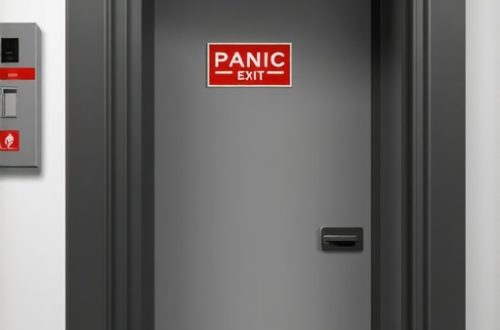
One of the most frequent failures I see during a 2026 audit involves fire-rated panic hardware options. These aren’t just exit devices; they are precision-engineered safety tools. The gap usually exists in the vertical rod alignment or the latch-bolt retraction depth. Over time, the door sag causes the latch to drag across the strike plate. This creates a friction coefficient that prevents the door from fully latching. In a fire or security event, a door that is ‘mostly’ closed is actually open. We look at the dogging mechanism—the part that keeps the bar depressed during business hours. In 2026, many of these mechanical assemblies are using inferior pot metal instead of hardened steel, leading to internal fractures that can jam the exit path entirely. A proper audit identifies these ANSI Grade 1 failures before the fire marshal does.
Gap 2: Vulnerabilities in 2026 Wireless Lock Protocols
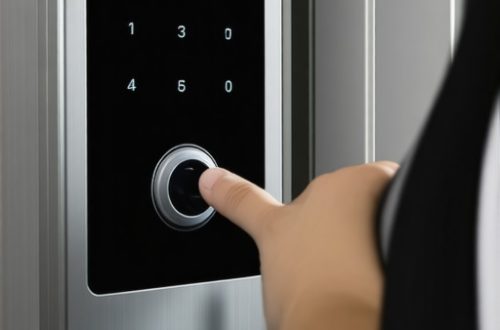
Everything is moving to wireless, but 2026 wireless lock protocols explained reveal a disturbing trend: convenience is outstripping encryption. While electronic locks for Airbnb properties have popularized remote management, using those same residential-grade protocols in a commercial setting is a recipe for a data breach. A business access control audit often finds that the ‘handshake’ between the reader and the server is using outdated rolling codes that can be intercepted by a simple $20 software-defined radio. We check for AES-256 encryption at the edge device. If your system is still running on legacy 125kHz proximity cards, you aren’t secure; those cards are cloned easier than a grocery store loyalty card. The ‘gap’ is the lack of mutual authentication between the credential and the lock body.
Gap 3: The Ghost of Terminated Employees (Credential Drift)
Physical key control is the backbone of commercial security. In my shop, I see businesses that have zero idea how many master keys are floating around. This is what I call ‘Credential Drift.’ If you aren’t using a restricted keyway where the blanks are patented and unavailable at the local hardware store, you have no security. An audit in 2026 will likely find ‘orphaned’ digital credentials or physical keys that were never collected. This is why Interchangeable Cores (IC) are vital. They allow a manager to swap the entire locking cylinder in ten seconds using a ‘Control Key.’ If your audit doesn’t include a full reconciliation of who has access to which master wafers, your perimeter is an illusion. We look for the shear line integrity; if too many master pins are used, the lock becomes easier to pick via ‘ghosting’—where multiple key heights can trigger the opening.
Gap 4: Improper Broken Key Extraction and Maintenance
I’ve read the broken key extraction tools 2026 reviews, and frankly, most of the stuff sold to the public is garbage. When a key snaps inside a high-security cylinder, the ‘trunk slammers’ come out with drills. A real locksmith uses a spiral extractor or a saw-tooth extractor to navigate the side-bar pins without Marring the plug. The ‘gap’ here is usually caused by the ‘WD-40 Myth.’ Business owners spray silicone or oil-based lubricants into their locks, which eventually turns into a sticky paste that traps grit. This grit acts like sandpaper on the nickel-silver pins. During an audit, we check the ‘plug-to-cylinder’ play. If there’s more than .005 inches of wobble, the lock is structurally compromised and needs a full rebuild, not just a squirt of lubricant.
“A lock is only as strong as the frame it is mounted in; a Grade 1 bolt in a Grade 3 frame is merely a handle.” – Security Standards Manual
Gap 5: The Automotive & Fleet Security Oversight
Many businesses overlook their fleet vehicles during a security audit. They rely on automotive locksmith vs dealership for car key replacement comparisons based solely on price, ignoring the security of the transponder chips. With automotive transponder keys 2026 updates, the encryption is now tied to the vehicle’s ECU in a way that requires specialized diagnostic tools. If your fleet keys aren’t being tracked, a thief can use a relay attack to steal a van full of tools in under 60 seconds. We also see a rise in mobile locksmith for RVs and campers serving businesses that use mobile offices. These locks are often the weakest link, using simple wafer tumblers that can be raked open by a novice. An audit must include these mobile assets, ensuring they are outfitted with automotive key programming near me that includes ‘lost key’ erasure from the system memory.
The Verdict: Physics Over Features
Security isn’t a ‘set it and forget it’ situation. It is a constant battle against entropy and the ingenuity of those who want what you have. Whether it’s finding a locksmith for smart home ecosystems to integrate your office or upgrading to fire-rated panic hardware, the focus must remain on the mechanical integrity of the door. Don’t be the business owner who calls me at 3 AM because a $10 zinc lock failed on a $10,000 door. Audit your gaps, respect the physics of the cylinder, and keep your key control tighter than your payroll. Safety isn’t found in a flashy app; it’s found in the solid ‘thunk’ of a well-fitted bolt and the precision of a perfectly cut key.

![3 Best Smart Locks with Video Integration for 2026 [Tested]](https://prolocksmithco.com/wp-content/uploads/2026/03/3-Best-Smart-Locks-with-Video-Integration-for-2026-Tested-75x75.jpeg)
![5 Toughest High-Security Locks for Rentals in 2026 [Tested]](https://prolocksmithco.com/wp-content/uploads/2026/03/5-Toughest-High-Security-Locks-for-Rentals-in-2026-Tested-75x75.jpeg)