
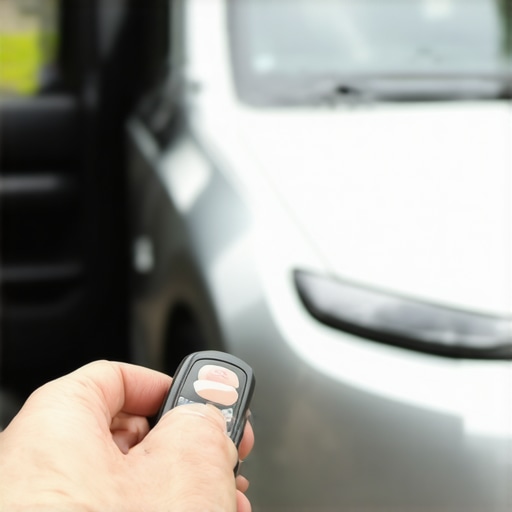
The Frustrating Silence of the Modern Key Fob
You press the unlock button and nothing happens. You press it again, harder this time, as if the physical force on the plastic housing could somehow strengthen the radio signal. Silence. This is the moment most drivers panic and start looking up the nearest dealership. But as someone who has spent over 25 years at the locksmith bench, I can tell you that the metal and silicon in your hand are usually fine. The problem is a broken handshake. Your car and your remote have stopped speaking the same language. This forensic autopsy of the automotive remote system will show you why these systems fail and how you can often fix the sync yourself without paying a service manager three hundred dollars for five minutes of work.
The Apprentice Lesson: Respect the Silicon
I teach my apprentices that if you have to force the key, you’ve already lost the battle against physics. The same applies to electronics. I remember one kid, eager to show off, who tried to pry open a Lexus fob with a flathead screwdriver like he was opening a paint can. He snapped the inductor coil right off the circuit board. I told him then, and I tell my customers now: these remotes are not just plastic toys. They are precision-tuned radio frequency (RF) transmitters. If the car stops responding, it is rarely a catastrophic hardware failure. Usually, the rolling code counter has drifted too far apart. Modern security relies on a concept called a ‘hopping code’ or ‘rolling code’ to prevent replay attacks. Every time you press the button, the remote and the car advance to the next number in a secret mathematical sequence. If you press the buttons too many times while out of range of the vehicle, the remote moves to step 500 while the car is still waiting for step 10. The sync is lost.
“Security is always a trade-off between convenience and protection.” – Industry Axiom
Diagnosing the Failure: Material Science and RF Logic
Before we jump into the transponder key programming guide steps, we have to look at the ‘why’ behind the failure. Most car remotes operate on the 315MHz or 433MHz frequency. Inside the fob, a small Printed Circuit Board (PCB) houses an EEPROM chip, a battery, and a tactile switch. When you see door lock jamming fixes 2026 trending, it is often because people mistake a dead remote for a mechanical jam. The first thing I check is the tactile switch. If the button doesn’t ‘click’ when pressed, the physical solder joint has likely failed. If it does click but the car ignores it, we are looking at a logic desynchronization. Cheap ‘big box’ replacement remotes use inferior oscillators that drift in frequency when the temperature changes. This is why I tell people to avoid the zinc-alloy garbage sold online. A real professional locksmith uses OEM or high-quality aftermarket heads that maintain frequency stability even in the dead of winter.
The Re-Sync Action: Manual Programming Sequences
Many vehicles from the early 2000s up through the mid-2020s still have On-Board Programming (OBP) capabilities. This is the secret back-door that dealerships dont want you to know about. While automotive laser-cut keys costs are rising due to the precision milling required, the software side can sometimes be handled with a specific ‘dance.’ For many domestic brands, the process involves cycling the ignition from ‘Off’ to ‘Run’ five to eight times within ten seconds. You will hear the door locks cycle—a mechanical thud that signals the Body Control Module (BCM) is now in ‘Learning Mode.’ At this point, pressing any button on the remote sends the new rolling code seed to the BCM. If you are dealing with smart locks with geofencing features in a residential setting, the logic is similar, but for cars, it is all about that ignition timing. However, be warned: if you have a vehicle that requires a ‘Proximity’ key (push-to-start), you likely cannot do this manually. Those systems require a bidirectional handshake that usually needs a professional diagnostic tool to bypass the security gateway.
The Reality of Automotive Laser-Cut Keys and Duplication in 2026
As we move into 2026, the complexity of car keys has reached a peak. We are seeing car key duplication costs 2026 hovering between $150 and $450 depending on the encryption level. The days of a two-dollar hardware store key are dead. Automotive laser-cut keys costs are higher because the machines required to cut them—high-speed CNC millers—cost thousands of dollars and must be calibrated to within 0.05mm. A ‘sidewinder’ key, as we call it in the shop, is much harder to pick than a traditional edge-cut key because the internal wafers are arranged to prevent traditional tensioning. When you combine this with a transponder chip that uses 128-bit encryption, you have a rolling fortress. But even a fortress needs a key that works. If your laser-cut key turns the ignition but the engine dies after two seconds, the transponder chip is not synced to the immobilizer. This is a security feature designed to stop ‘hotwiring.’
“The integrity of a locking system is only as strong as its most vulnerable component, which is often the electronic credential.” – Security Standards Manual
Protecting the Hardware: Beyond the Remote
While we focus on the remote, don’t ignore the physical security of the vehicle. I often recommend a lock shield installation for doors for commercial vans where the remote might be compromised. Furthermore, as fingerprint lock reliability tests become more common in the automotive sector, the traditional fob may eventually disappear. But for now, the RF remote is king. One major tip: stop using WD-40 on your keys or remotes. It is a solvent, not a lubricant, and it attracts grit that will grind down the brass wafers in your ignition. If your key is sticky, use a dry Teflon-based lubricant or high-grade graphite. If your remote buttons are sticking, open the case and clean the contact pads with 99% isopropyl alcohol and a Q-tip. This removes the skin oils and carbon buildup that prevent the electrical bridge from forming when you press the button.
The Professional Advantage vs. The Dealership
Why choose a locksmith over a dealer? The cost of hiring a professional locksmith in 2026 is typically 40% lower than dealership rates. We don’t have the overhead of a glass-walled showroom and a fleet of loaner cars. A mobile locksmith can perform transponder key programming guide procedures on-site, saving you a towing fee. We also specialize in ‘All Keys Lost’ scenarios, which many dealerships struggle with because they prefer to just replace the entire ECU for three thousand dollars rather than reflashing the memory. Whether you are looking for panic hardware for office buildings 2026 or just need your Ford F-150 remote to work again, a dedicated locksmith shop is your best bet for honest, technical expertise. We see security as a physics problem to be solved, not a sales quota to be met. Keep your remotes clean, change your batteries every two years before they leak acid, and respect the handshake between the remote and the machine.
Comments are closed.