
The Liability of the Latched Door
In the commercial security world, your panic exit device is the only thing standing between a safe building and a massive legal disaster. Most building owners think of these as simple push-bars, but as a locksmith with 25 years at the bench, I look at them as complex kinetic machines. If the internal timing of the latch retraction is off by even a fraction of a millimeter, the door binds. In 2026, the physics of these devices has shifted due to new building codes and the aggressive integration of smart lock hubs. We are moving away from simple mechanical spring tension and toward precision-engineered safety systems. A lady came into my shop crying last month because a scammer, one of those trunk-slammers with a drill and a magnetic sign, had absolutely butchered her storefront. He didn’t understand how to timing-adjust the vertical rods on her panic bar and ended up drilling through the chassis to ‘force’ it to open. He charged her twelve hundred dollars for a ruined Von Duprin and a Grade 3 knock-off that wouldn’t pass a fire inspection in a million years. This is the reality of the industry today: if you do not understand the internal metallurgy of these devices, you are putting lives at risk.
“Security is always a trade-off between convenience and protection.” – Industry Axiom
Update 1: The Transition to 300-Series Stainless Steel Components
For 2026, the industry is finally purging the last of the zinc-alloy ‘pot metal’ internals from Grade 1 devices. When you depress a panic bar, you are engaging a scissor-action mechanism. In older or cheaper models, the pivot points are made of soft alloys that wallow out over time. This creates ‘slop’ in the push-pad. You might have to push the bar two inches before the latch even begins to move. The new 2026 standards require 300-series stainless steel for all load-bearing internal pivots. This ensures that even after a million cycles, the tolerances remain tight. When we talk about how to extract a broken key from a lock safely, it usually starts with the realization that the hardware was so poorly made that the user had to exert five times the necessary torque just to get the mechanism to fire. High-quality steel prevents that mechanical fatigue from the start.
Update 2: Integrated Smart Lock Hubs 2026
The biggest shift is the move toward integrated smart lock hubs 2026. We are seeing a massive push for panic devices that communicate via the Matter protocol. This means your exit device is no longer an island. It talks to the security cameras and the HVAC system. If a fire alarm triggers, the integrated hub ensures the electric latch retraction (ELR) activates immediately, but keeps the exterior trim locked to prevent unauthorized entry during the chaos. This is not just a software update; it involves a redesigned solenoid in the push-bar that can handle constant power without overheating. These solenoids now use a dual-coil design: one high-current coil to pull the latch back and a low-current coil to hold it there. This prevents the ‘buzzing’ sound common in older commercial panic exit devices 2026 and increases the lifespan of the electronics.
Update 3: Fingerprint Scanners on Exterior Trim
We are seeing more smart deadbolts with fingerprint scanners being used as the exterior control for these exit devices. In apartment complexes, a 24/7 mobile locksmith for apartments is often called because someone lost their fob. By 2026, the exterior trim for panic bars will frequently include capacitive biometric sensors. These are not the cheap optical sensors that fail when it gets cold. These are silicon-based sensors that read the sub-dermal layer of the skin. This provides a higher level of security after a break-in, as physical keys can be copied, but a biometric signature is much harder to spoof. When performing emergency lock changes after break-in, I always recommend moving to a biometric trim if the budget allows, especially for high-traffic employee entrances.
Update 4: Smart Locks with Video Integration
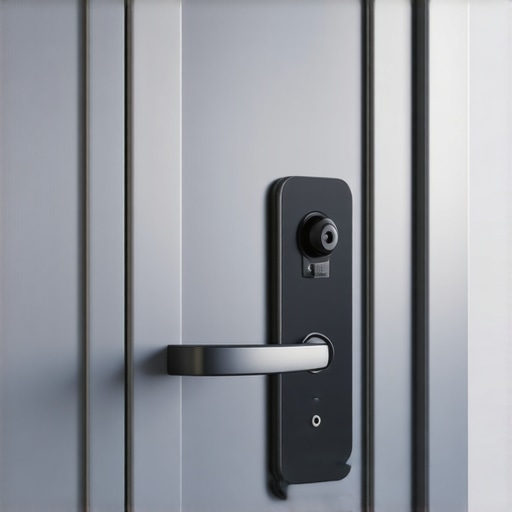
The 2026 hardware revision includes smart locks with video integration built directly into the exterior pull-plate. This is critical for ‘lost wallet key replacement fast’ scenarios. If a manager loses their keys, they can use a remote app to see who is at the door and grant access via an encrypted one-time token. The camera is hidden behind a one-way polycarbonate shield that is impact-rated. This eliminates the need for a separate doorbell camera that can be easily ripped off the wall. The physics here are impressive: the lens is angled to capture a full 180-degree field of view even when the door is being opened.
Update 5: Delayed Egress Physics and Timing
Delayed egress is a lifesaver in retail, preventing shoplifting while still meeting fire codes. In 2026, the sensors have become much more sophisticated. Instead of a simple mechanical switch, they use hall-effect sensors to detect the slightest movement of the push-pad. If someone tries to push the bar, a 15-second timer starts, and an alarm sounds. The 2026 update mandates that these devices must have a visual countdown display on the bar itself so that in an actual emergency, people do not panic thinking the door is jammed. This requires a much larger internal battery backup located within the rail of the device.
Update 6: Antimicrobial Coating and Material Longevity
Post-pandemic standards have finally been codified into the ANSI/BHMA A156.3 requirements for 2026. High-traffic doors must now feature permanent antimicrobial silver-ion coatings that are baked into the powder coat or the stainless steel finish. This isn’t just a spray-on chemical; it is part of the material science of the bar. From a locksmith’s perspective, this means we have to be very careful with what lubricants we use. Using the wrong solvent can strip this coating. I always tell my guys to stick to high-grade synthetic PTFE sprays and avoid the ‘blue-can’ stuff that attracts dust and ruins the finish.
“Life safety is the primary goal of any exit device; security is secondary.” – NFPA 101 Life Safety Code
Update 7: Lock Maintenance Tips for Winter 2026
As we head into the colder months, lock maintenance tips for winter 2026 are focused on ‘thermal bridge’ prevention. Commercial doors are made of aluminum or steel, which conduct cold directly into the latch mechanism. If there is any moisture inside the device, it will freeze the grease and the bar will fail to latch. This is a massive security risk. I recommend a full ‘dry-lube’ service every October. We take the cover off, clean out the old gunk, and apply a graphite-free synthetic lubricant that is rated down to -40 degrees. This ensures that when the metal contracts in the cold, the tolerances are still wide enough for the latch bolt to clear the strike plate. If you find yourself needing a locksmith in the dead of winter, it is usually because this basic maintenance was ignored.
The Bottom Line on 2026 Security
Securing a commercial property is about understanding the cumulative effect of small mechanical failures. Whether you are dealing with a broken key extraction or a full-scale access control overhaul, the quality of the hardware determines your long-term success. Don’t trust your building to a scammer with a drill. Look for a technician who understands the difference between a rim device, a surface-mounted vertical rod, and a concealed vertical rod system. In 2026, the complexity of these systems means that ‘good enough’ is a recipe for disaster. Keep your hardware clean, keep your hubs updated, and never settle for Grade 3 hardware on a Grade 1 door.
Comments are closed.