
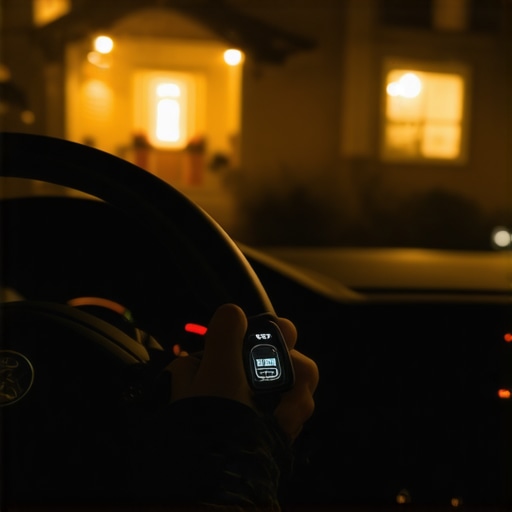
The Forensic Breakdown of Keyless Failures
A lady came into my shop crying because a scammer drilled her lock and charged her eight hundred dollars for a simple keyless ignition failure that required nothing more than a five dollar battery and a bit of technical knowledge. This is the reality of the 2026 locksmith industry where trunk slammers exploit the complexity of modern automotive electronics. When your keyless ignition fails, it is rarely a mechanical catastrophe; it is a breakdown in the communication between the proximity fob and the vehicle’s Immobilizer System (IMMO). This system operates on a complex handshake involving low-frequency wake-up signals and high-frequency authentication codes. If the Body Control Module (BCM) does not receive the correct rolling code from your transponder, the fuel pump stays dead and the starter motor remains silent. This is not magic; it is physics and data encryption.
“Security is always a trade-off between convenience and protection.” – Industry Axiom
Mechanism Zooming: The Inductive Loop and The Handshake
To understand why your car won’t start, you must understand the internal physics of the proximity key. Inside that plastic shell is a Printed Circuit Board (PCB) with a copper coil antenna. This antenna is designed for passive induction. When you press the start button, the vehicle sends out a 125kHz Low-Frequency (LF) signal. This signal is intended to ‘wake up’ the key fob. Once awake, the fob transmits a 315MHz or 433MHz Radio Frequency (RF) burst containing the encrypted security token. In 2026 trends in automotive security, we are seeing a shift toward Ultra-Wideband (UWB) which measures the ‘time of flight’ of the signal to prevent relay attacks. If your fob battery is dead, the RF burst fails. However, the passive induction coil inside the fob can still be powered by the electromagnetic field generated by the car’s transceiver ring if it is held in close enough proximity. This is the first bypass method: physical coupling.
Diagnosing the Crunch: Why the Mechanical Backup is Your Lifeline
Most drivers do not even realize their high-tech fob contains a physical piece of brass. Every keyless system has a mechanical override. If you are locked out of your car because the battery is flat, you must locate the hidden release on the fob. This releases a physical key blade. On many modern door handles, the lock cylinder is hidden behind a plastic cap that must be popped off using the key itself. Once inside, the forensic autopsy of the failure continues. If the engine won’t turn over, it’s often due to capacitor failure on the fob’s PCB or a cracked solder joint on the battery terminals. In my 25 years at the bench, I have seen thousands of these units fail because they are made of cheap pot metal and thin plastics rather than the robust materials used for locksmith for vintage car keys. If you have to force the key into the emergency slot, you have already lost the battle against physics. The mechanical bypass should be smooth; if it is not, the wafers inside the cylinder are likely seized from lack of use.
The 2026 Shift: Smart Locks and Automotive Integration
We are moving toward integrated home security lock bundles where your car and your house share the same digital ecosystem. While this sounds convenient, it creates a single point of failure. If your phone battery dies and your car fob is malfunctioning, you are effectively a ghost in your own life. This is why 2026 smart lock trends for homes still emphasize the importance of a physical override. When I perform a lock shield installation for doors in a residential setting, I am applying the same hardening principles we use in automotive security. We are reinforcing the strike plate and ensuring the shear line of the cylinder is protected against physical attacks like bumping or picking. The cost of hiring a professional locksmith in 2026 has risen due to the specialized diagnostic tools required to interface with these encrypted systems. A real professional uses a Lishi tool to decode a lock rather than a drill. A scammer will always reach for the power tools first because they lack the technical skill to manipulate the internal pins and springs of a high-security cylinder.
“An automobile’s anti-theft system is only as secure as the weakest bit in its encryption protocol.” – 2026 Automotive Security Manual
[IMAGE_PLACEHOLDER]
Emergency Procedures: How to Extract a Broken Key and Bypass the System
If you have managed to break your emergency mechanical key inside the door, do not panic. How to extract a broken key from a lock safely involves using a specialized spiral extractor or a thin-gauge saw-tooth tool. You must not use glue; glue will migrate into the pin chambers and weld the springs to the driver pins, turning a fifty dollar extraction into a five hundred dollar replacement. Once the key is out and you are inside, locate the designated ’emergency start’ spot. This is often a slot in the center console or a specific area on the steering column marked with a key icon. By placing the fob directly against this spot, you are placing the fob’s induction coil directly into the vehicle’s transceiver field. This bypasses the need for the fob’s internal battery. This is the same logic used by a mobile locksmith for RVs and campers when dealing with remote ignition failures in the wilderness. The signal is weak, so the distance must be near zero. This is a physics-based bypass designed by engineers for this exact failure scenario.
The Professional Verdict on Modern Security
Whether you are dealing with a keyless ignition or looking for a locksmith for vintage car keys, the principles remain the same: precision and patience. The 2026 trends in automotive security make it harder for the average person to perform DIY repairs, but the basic failsafes remain consistent across most manufacturers. Avoid the ‘trunk slammers’ who quote you twenty-nine dollars on the phone only to demand a thousand at the roadside. A legitimate shop will explain the physics of the failure and offer a solution that preserves the integrity of your hardware. Security involves trust and metal, not just digital convenience. Proper maintenance, like occasional lubrication of your emergency mechanical locks with a high-quality synthetic spray, will ensure that when the electronics fail, the physics of the mechanical bypass will still save your night.