
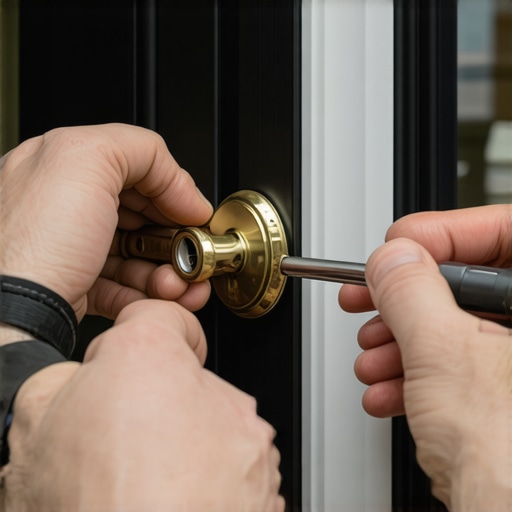
The Brutal Reality of a Home Lockout
You find yourself standing on your own porch, staring through the glass at your keys sitting on the kitchen counter. Your first instinct is panic, followed closely by frustration. Then comes the bad idea: kicking the door, throwing a rock through a window pane, or grabbing a heavy screwdriver from the garage to pry the frame. As a master locksmith with over twenty-five years of bench experience, I am here to tell you that these brute-force impulses will cost you ten times more than a professional resolution. Your door frame, the jamb, and the lock housing are delicate physical systems. When you attack them with raw force, you do not just bypass the lock; you destroy the structural integrity of your entryway.
I teach my apprentices that if you have to force the key, you have already lost. The same logic applies to a lockout. A lock is a mechanical puzzle designed to control physical forces. If you do not understand the physics of the shear line, the tension of the springs, and the exact tolerances of your cylinder, any attempt to bypass the lock will likely end in expensive collateral damage. This guide will walk you through the precise, non-destructive methodologies for handling a residential lockout safely, how to spot the difference between a real craftsman and a predatory scammer, and how modern security technology is shifting the landscape.
The Apprentice Lesson: A Lesson in Tolerance
When I train new techs in my shop, I start them on a brass pin-tumbler cylinder clamped in a bench vise. I hand them a tension wrench and a standard hook pick, and I tell them to feel the binding pin. The lesson is always the same: security is a game of thousandths of an inch. If an apprentice applies too much tension, the brass pins bind so tightly against the cylinder wall that they cannot move. They get frustrated, press harder, and snap the pick inside the keyway. That is the moment I tap them on the shoulder and say, ‘You are trying to bully the metal. Talk to it instead.’
Understanding this mechanical dialogue is crucial when you are locked out. A standard residential lock relies on a series of small, two-part pins (key pins and driver pins) pushed down by tiny coil springs. When the correct key is inserted, the cuts on the blade align the gap between these pins precisely with the shear line, allowing the plug to rotate. If you do not have that key, any attempt to bypass the system requires replicating that alignment through precise tactile feedback or utilizing alternative bypass points that do not destroy the lock hardware.
“Security is always a trade-off between convenience and protection.” – Industry Axiom
The Blueprint: The Emergency Service Guide
If you find yourself locked out, you are vulnerable. This vulnerability makes you the perfect target for predatory “Trunk Slammers” who advertise insanely low prices online only to destroy your hardware and extort you for hundreds of dollars. Let us look at how a legitimate lock professional approaches a residential lockout versus how an untrained scammer operates.
The Tools of a Master vs. The Hammer of a Scammer
When a professional arrives at your home, they do not immediately reach for a drill. They analyze the lock face, the door gap, and the type of installation. A real locksmith uses specialized bypass tools like a Lishi pick, which decodes the lock pins individually without causing a single scratch, or an air wedge to gently create a temporary gap in the weatherstripping to access an interior latch. These methods preserve your lock, your door, and your frame.
A low-rate scammer, often operating under a fake local listing claiming a ‘$29 service call,’ will arrive with nothing but an electric drill and a hammer. They will tell you your lock is high-security (even if it is a cheap, $15 big-box store deadbolt) and claim that drilling the cylinder out is the only option. Once they drill it, they will replace your ruined lock with an even cheaper, zinc-alloy pot-metal lock and demand $400 or more. Knowing the signs you need to change your door locks immediately is helpful, but you should never let an unqualified person force that decision on you by destroying a perfectly functional lock.
How to Properly Vet an Emergency Locksmith
Before you let anyone touch your door, ask these critical questions:
- Do you have a physical shop address? Legitimate locksmiths have a storefront where they cut keys, pin cylinders, and service safes. If they only operate out of a generic call center, hang up.
- Will you attempt non-destructive entry first? A professional will always try picking, bumping, or bypassing before discussing drilling.
- What is the total estimated cost, including service call fees and labor? Get a clear, binding estimate before work begins.
“The lock is only as strong as the door frame, and the frame is only as strong as the screws holding the strike plate.” – Manual of Physical Security
Mechanical Diagnostics: What Went Wrong?
Sometimes a lockout is not caused by a forgotten key, but by a sudden mechanical failure within the lock cylinder or latch assembly. Let us examine the physics of lock failure. Inside a standard deadbolt, the turnpiece rotates a tailpiece, which retracts the bolt. Over years of use, the internal cast-zinc cams can wear down, or the heavy spring inside the latch bolt can snap. When this happens, inserting your key and turning it might result in a loose, spinning sensation, or a harsh grinding sound.
If your lock is jamming or refusing to turn even with the correct key, do not force it. Applying excessive torque can twist the brass key blade, snapping it off inside the keyway. This turns a simple cylinder lubrication or alignment issue into a complex extraction job. If you notice signs of resistance when turning your key, it is a warning that you need to service your hardware immediately before you are locked out permanently.
The Technological Evolution: 2026 Standards
Physical security is rapidly merging with digital convenience. We are seeing a significant rise in smart locks with geofencing features, which automatically unlock your door as your smartphone approaches the perimeter. These systems eliminate the risk of traditional lockouts by relying on encrypted Bluetooth and Wi-Fi protocols rather than physical brass keys.
Furthermore, locksmith response times 2026 averages have dropped significantly due to advanced dispatch systems and AI-powered locksmith services 2026, which optimize routing and diagnostic accuracy. While these modern conveniences make lockouts less common, they introduce new vulnerabilities, such as battery failures and electronic glitches. A smart homeowner always maintains a physical, high-security mechanical override lock on at least one secondary entryway to ensure access during power outages or system errors.