
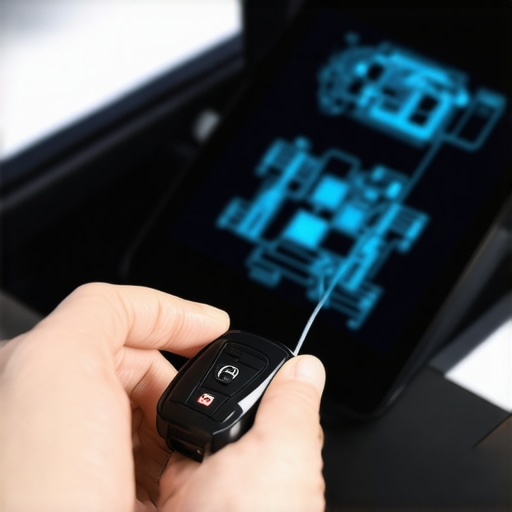
The Master Bench Perspective on Modern Automotive Security
I teach my apprentices that if you have to force the key, you have already lost. That lesson was easier in 1998 when we were dealing with brass wafers and heavy springs. Today, that wisdom translates to digital signatures and EEPROM data. I have spent 25 years at my bench, and I have seen the transition from simple metal blades to the complex encrypted proximity fobs used in Electric Vehicles (EVs). When a customer walks into my shop holding a dead fob for a 2024 or 2025 model, they are usually shaking. They have already called the dealership, and they were quoted $600 for a part and another $200 for ‘labor.’ That is a racket. The truth is that automotive transponder keys 2026 updates are making these systems more complex, but not impossible for a technician with the right hardware. You do not need the dealership; you need someone who understands the physics of the signal.
“Security is always a trade-off between convenience and protection.” – Industry Axiom
The Forensic Autopsy of a Failed EV Fob
Before we talk about reprogramming, we have to look at why these units fail. Most people think it is just a battery. In my shop, I see ‘silent failures.’ This is where the physical PCB (Printed Circuit Board) has suffered from micro-fractures in the solder joints. An EV key fob is not just a remote; it is a low-frequency radio station. Inside, you will find a transponder chip—usually a PCF series or a newer NXP hitag. These chips house a unique identifier that the vehicle’s BCM (Body Control Module) recognizes. When you press the start button on an EV, the car sends out a ‘challenge’ signal. The fob must receive this, calculate a cryptographic response using its stored secret key, and broadcast it back. If the internal crystal oscillator is off by even a few kilohertz due to a drop, the handshake fails. This is often the root cause behind EV keyless entry troubleshooting calls. The car is not ‘broken,’ and the key is not ‘dead’; they are just no longer speaking the same language.
The Scam of the ‘Dealer-Only’ Lock
Dealerships love to tell you that their proprietary software is the only way to access the vehicle’s ECU. That is nonsense. What they are actually doing is using an OBD-II interface to command the car to enter ‘Learning Mode.’ As a locksmith, I use the same protocols, but I do not have the overhead of a glass showroom. For those dealing with a lost wallet key replacement fast, the priority is speed. If you are stuck, you do not want to wait three days for a dealership to ‘order’ a key that is actually sitting in a warehouse twenty miles away. We use high-speed programmers that can pull the 4-digit or 6-digit PIN directly from the vehicle’s EEPROM. This is a delicate process of material science and data. We are talking about reading voltages at the millivolt level to ensure we do not ‘brick’ the module. It is the same precision required for commercial mailbox lock repairs, just applied to silicon instead of zinc alloy.
The Step-by-Step Logic of Reprogramming
If you are attempting this yourself, you need to understand the ‘Manual Sequence’ versus the ‘OBD-II Sequence.’ Many EVs have a ‘hidden’ pocket or a specific spot on the steering column where a dead fob can be placed. This uses inductive coupling to power the chip even if the fob battery is flat. 1. You must ensure the vehicle battery is at a stable voltage. A drop in voltage during a write-cycle can corrupt the BCM. 2. You need a blank fob that matches the FCC ID and frequency (usually 315MHz or 433MHz). 3. You enter the vehicle’s programming mode. In older cars, this was a dance of turning the ignition and pressing brake pedals. In 2026 models, it almost always requires an external handshake tool. This is where keyless ignition repair services come into play. We are not just cutting metal; we are syncing rolling code algorithms like KeeLoq. These codes change every time you press the button, which prevents ‘replay attacks’ where a thief records your signal. If the fob and the car get out of sync, the rolling code window ‘desynchronizes,’ and the car ignores the fob. Reprogramming is essentially resetting that window to zero.
“Locks are the first line of defense; electronics are the second.” – Master Locksmith Society
Integrated Systems and the Future of Access
We are seeing a massive shift toward integrated home security lock bundles where your car key and your house key live on the same encrypted platform. While this is convenient, it creates a single point of failure. This is why business key management software is becoming a necessity for even small fleets. If you lose one fob, you are not just locked out of your car; you might be locked out of your entire life. In the shop, I am already preparing for solar-powered smart locks 2026 tech which will likely integrate with these same EV platforms. We are also seeing electronic gate lock systems that use the vehicle’s MAC address as a secondary authentication factor. It is a beautiful, complex web of security, but it requires a technician who knows how to navigate it without charging you a month’s mortgage.
Why Material Quality Matters
I refuse to use the cheap fobs you find on auction sites for $15. Those are made of ‘pot metal’ and low-grade plastics that interfere with signal propagation. A real OEM-quality fob uses high-grade copper for its antenna coil and a reinforced casing. This is the same reason I tell people to avoid fire-rated panic hardware options that feel light in the hand. If it is light, it is cheap. If it is cheap, it will fail when you need it most. When we talk about automotive transponder keys 2026 updates, we are talking about hardware that can withstand the extreme heat of a dashboard in July without the internal clock drifting. If you buy a cheap knock-off, you will be calling me for EV keyless entry troubleshooting within six months. Do it right the first time.
Lubrication and Maintenance: The Locksmith’s Secret
Even though we are talking about digital fobs, there is still physical hardware involved. Most EV fobs have an emergency ’emergency blade’ tucked inside. People forget these exist until their car battery dies and they cannot use the electronic handle. I see these blades seized all the time because they have never been used. Do not use WD-40. Use a high-quality PTFE or dry graphite lubricant. This ensures that when the electronics fail—and they will eventually—the physics of the lock will still save you. Security is about layers. If the digital layer fails, you fall back to the mechanical layer. That is how you stay protected.