
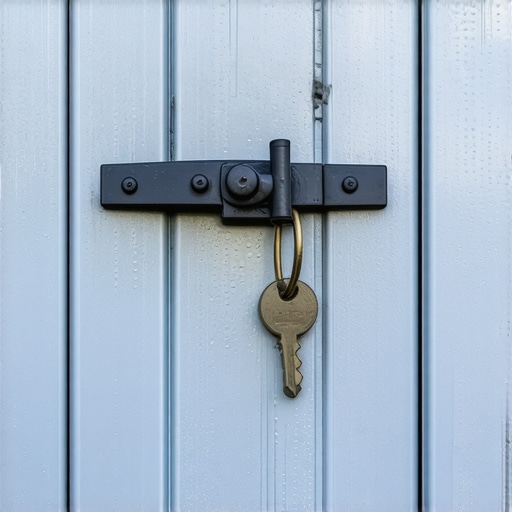
You hear it before you see it. That gritty, sandpaper-like crunch when you slide your key into the gate. It is the sound of metal-on-metal friction exacerbated by oxidation. As a locksmith with twenty-five years at the bench, I can tell you that a gate lock is the most abused piece of hardware on any property. It sits in the rain, bakes in the sun, and handles the vibrations of a slamming gate frame. Most people wait until they are standing in a downpour with a snapped key before they care about weatherproofing. By then, you are calling for emergency residential lockout solutions and paying a premium for my time.
The Apprentice Lesson: Force is a Failure of Understanding
I teach my apprentices that if you have to force the key, you have already lost. I remember a kid I had under my wing a decade ago. He thought he could muscle a frozen gate cylinder open with a pair of pliers. He did not just break the key; he sheared the tailpiece right off the back of the plug. I told him then what I will tell you now: a lock is a precision instrument, even if it is bolted to a rusty iron fence. If the internal tolerances are jammed with iron oxide, force only turns a simple lubrication job into a complex key extraction for deadbolts or gate cylinders. You have to understand the physics of the mechanism to save it.
“Security is always a trade-off between convenience and protection.” – Industry Axiom
The Forensic Autopsy: Why Gate Locks Fail
When I pull apart a failed outdoor lock, the diagnosis is usually the same: galvanic corrosion. This happens when two dissimilar metals, like a brass plug and a zinc-alloy housing, sit in an electrolyte (rainwater). The weaker metal literally dissolves over time. Most big-box store locks are made of pot metal or cheap zinc castings. They look shiny on the shelf, but they are porous. Once moisture gets into those pores, it expands during a freeze and cracks the internal chambers that hold your pins and springs.
A truly waterproof lock does not just block water; it manages it. We look for IP (Ingress Protection) ratings. If you are looking at solar-powered smart locks 2026 models, you want to see at least an IP65 rating. This means the electronics are sealed against dust and low-pressure water jets. Without that seal, the circuit boards in those integrated smart lock hubs 2026 will corrode faster than a cheap padlock at the beach.
Mechanism Zooming: Inside the Cylinder
Let us look at the pin stack. In a standard indoor deadbolt, you have brass pins and steel springs. In a gate lock exposed to the elements, those steel springs are the first to go. They rust, lose their tension, and fail to push the driver pins back across the shear line. Now your lock is permanently stuck in the ‘open’ or ‘locked’ position. High-quality outdoor hardware uses stainless steel springs and phosphor bronze pins. These materials resist the electrochemical breakdown that kills cheaper units.
Furthermore, consider the strike plate and the latch. On a gate, the movement of the post due to soil moisture changes means the latch rarely stays aligned. If the lock is not waterproof, the constant friction of a misaligned latch wearing through the plating exposes the raw steel underneath. Rust starts there and migrates into the internal bolt works. For commercial applications, using commercial panic exit devices 2026 rated for exterior use is mandatory to prevent the hardware from seizing during a fire or emergency evacuation.
The Scam Buster: Professional Service vs. The Drill
I see it all the time in the 2026 locksmith insurance claims guide: homeowners getting fleeced by ‘trunk slammers.’ These are unlicensed guys who show up in an unmarked car and immediately tell you the lock must be drilled. A real professional uses tools like a Lishi pick or an air wedge. We understand high-tech lock bumping prevention and how to bypass a weather-seized lock without destroying the gate. 24/7 emergency locksmith services explained properly means having the specialized tools to save the hardware, not just replace it with more junk. If someone pulls out a drill before they pull out a pick set, send them away.
“The quality is remembered long after the price is forgotten.” – Sir Henry Royce
The Fortress Upgrade: Selecting the Right Hardware
If you are managing a multi-family building lock rekeying project or looking for a mobile locksmith for RVs and campers, hardware grade matters. ANSI Grade 1 is the gold standard. For a gate, you want a deadbolt with a shrouded shackle or a gate box that is fully welded. This prevents moisture from pooling around the cylinder. If you are moving toward high-tech solutions, the integrated smart lock hubs 2026 are becoming more resilient, but they still require a physical key override that is protected by a weather sliding cover.
Check the finish. A ‘Lifetime Finish’ usually means a PVD (Physical Vapor Deposition) coating. This is a process where the finish is bonded to the metal at a molecular level. It will not flake off like the cheap lacquer on a ten-dollar deadbolt. If the finish stays intact, the metal underneath stays dry. If the metal stays dry, the lock does not rust. It is basic physics.
The Maintenance Protocol: No More WD-40
Stop using WD-40 in your locks. It is a solvent, not a long-term lubricant. It attracts dust and turns into a sticky goo that jams the pins. Instead, use a dry Teflon or silicone-based spray. For gate locks, I recommend a marine-grade grease on the latch bolt and a puff of graphite or specialized lock lube inside the keyway once every six months. If you live in a coastal area, do it every three months. This prevents the salt air from initiating the corrosion cycle. If you follow these steps, you will never have to worry about whether your gate lock is truly waterproof; you will have made it weather-resistant through proper engineering and care.