
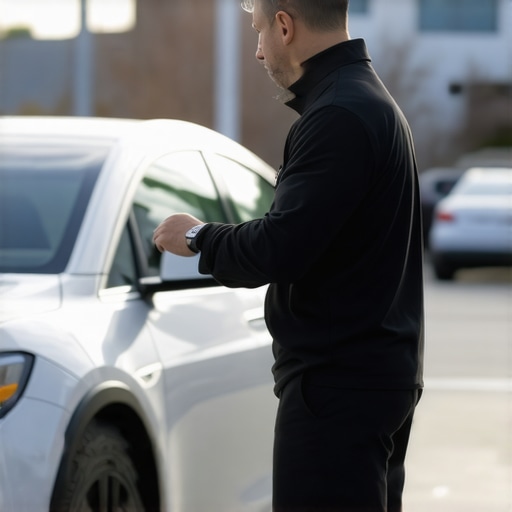
The Digital Deadbolt: Why Your Tesla Ignores Your Phone
I teach my apprentices that if you have to force the key, you’ve already lost. This technical wisdom is doubly true for a Tesla. In my 25 years at the bench, I have seen the transition from skeleton keys to transponders, but the modern EV presents a unique physics problem. When you are standing in a parking garage with no cellular signal or if the Tesla servers go dark, your phone app is useless. You are not just facing an auto lockout: you are facing a localized network failure. I have seen owners get frantic, tapping their screens until their fingers ache, but the car is effectively deaf to those commands without a handshake through the cloud. This is where the hardware knowledge of a master locksmith becomes your only way in.
“Security is always a trade-off between convenience and protection.” – Industry Axiom
Method 1: The NFC Card and the Physics of Induction
The primary fallback for any Tesla owner is the NFC (Near Field Communication) key card. Unlike a traditional transponder that broadcasts a signal, the NFC card is a passive device. It operates at a frequency of 13.56 MHz. When you place that card against the B-pillar, the car sends out a tiny burst of electromagnetic energy. This energy creates an induction field that powers the internal chip in your card just long enough for it to shout back its encrypted identity. If you are dealing with lock maintenance tips for winter 2026, you must know that ice buildup on the B-pillar can interfere with this induction. A layer of frozen road salt acts as a barrier. You need a clean contact point. If the card is bent or the internal antenna coil is cracked, the handshake will fail. Always carry two cards in separate locations, because a cracked card is a dead card.
Method 2: The Bluetooth Low Energy (BLE) Key Fob
Many owners have moved to the optional key fob. This is not your standard 315MHz or 433MHz remote. It uses Bluetooth Low Energy (BLE) to communicate with multiple sensors around the vehicle. The car uses triangulation to determine exactly where the fob is. This is a high-tech lock bumping prevention measure: the car will not open if the fob is inside the house five feet away from the garage. However, the fob relies on a CR2032 or similar lithium coin cell. My key fob battery replacement guide is simple: change it every 12 months, regardless of use. By the time the car warns you the battery is low, the voltage has already dropped below the reliable threshold for a cold-start handshake. In the freezing winters of 2026, those coin cells lose their chemical potential rapidly. If the fob fails, try holding it directly against the B-pillar, similar to the NFC card, as there is often a passive backup coil inside the fob for exactly this scenario.
Method 3: The 12V Jump-Start and Manual Override
Sometimes the lockout isn’t a software issue: it is a dead 12V battery. If the low-voltage battery dies, the computer that runs the NFC reader and the BLE sensors is off. The car is effectively a brick. To get in, you have to access the 12V jump posts. This usually involves popping a small circular cover on the front bumper and pulling out two wires. You then apply an external 12V power source to these wires to pop the frunk. Once inside the frunk, you have to remove the plastic maintenance shields to find the actual 12V battery. Hooking up a portable jump pack here will wake the car’s gateway. Once the gateway is awake, your phone or card will work again. This is a deep dive into the mechanical science of the vehicle, and it is something a trunk-slammer locksmith won’t understand. They will try to use an air wedge and a long-reach tool, which is a disaster for frameless glass. You risk shattering the window or destroying the weather stripping.
“The most secure system is the one the user understands how to bypass in an emergency.” – Security Manual 101
Keyless Entry Systems Pros and Cons
We are seeing emergency locksmith growth trends 2026 moving toward these digital solutions, but they come with risks. Smart locks with geofencing features are great until the GPS on your phone drifts and the car unlocks while you are still inside a store. For residential security, rekeying after burglary best practices still favor physical high-security cylinders, but for automotive, we are tethered to the ECU. Smart lock hacking prevention tips always start with one thing: disable passive entry if you are in a high-theft area. Thieves use relay attacks to pick up the BLE signal from your house and bounce it to the car in the driveway. A Master Locksmith knows that security is about layers. If you rely solely on your phone, you have a single point of failure. Always have a physical NFC card in your wallet as the ultimate backup. This is the difference between a minor delay and a $500 emergency safe cracking services call for your automotive computer. Keep your hardware clean, your batteries fresh, and never trust a cloud connection to do a mechanical job.