
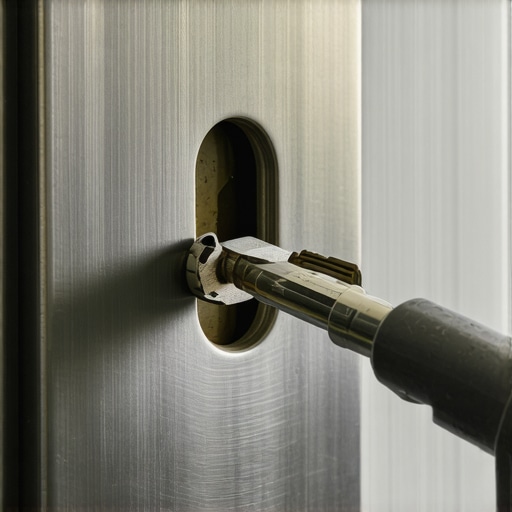
The Sound of a Mechanical Failure
That sharp, metallic snap is a sound that haunts homeowners and commercial property managers alike. You are standing at the threshold, the sun is setting, and half of your key is trapped inside the keyway while the bow remains uselessly in your hand. In my shop, I have seen thousands of these cases. Most people react with panic, followed by an aggressive attempt to dig the fragment out with a screwdriver or, heaven forbid, a pair of tweezers that only push the debris deeper into the guts of the cylinder. This is not a moment for brute force; it is a diagnostic puzzle involving metallurgy and frictional physics.
The Apprentice Lesson
“I teach my apprentices that if you have to force the key, you’ve already lost. A lock is a precision instrument, not a stubborn bolt that needs a hammer.” – The Master’s Rule
I remember teaching my first apprentice back in the late nineties. He was trying to muscle a stuck rim cylinder on a heavy oak door. He thought he could just pry it. I stopped him and explained that the moment you apply lateral pressure to a snapped blade, you are likely binding the pins against the remaining key fragment. If you have to force the key, the mechanical alignment is already compromised. The secret to extraction is understanding that the key fragment is currently held by nothing more than the spring tension of the driver pins and the friction of the warding. If you understand the physics of the shear line, you can coax the metal out without a single scratch on the plug.
The Forensic Autopsy of a Snapped Key
Why do keys break? It is rarely a single event. Most keys are made of brass or nickel silver. Over years of use, the metal undergoes stress crystallization, especially at the deepest cut of the key where the blade is thinnest. Every time you turn a key in a door that has dropped on its hinges, you are applying torque to a weakened point. Eventually, the material reaches its fatigue limit. When I look at a snapped key under a loupe, I can see the grain of the metal. If the break is jagged, it was likely a torque failure. If it is clean, there might have been a manufacturing defect in the blank.
The Internal Physics: Mechanism Zooming
Inside the cylinder, you have a plug and a shell. Between them is the shear line. When the key is snapped, the fragment is usually sitting across several pin chambers. The bottom pins are resting on the cuts of the broken key, and the driver pins are pushing down from the shell. To get that piece out, you must ensure the plug is in the neutral vertical position. If the plug is even one degree out of alignment, the driver pins will bind the fragment against the side of the chamber, making extraction impossible. You are fighting against the frictional coefficient of the brass. This is why professional extractors are designed with microscopic hooks. We are not grabbing the key; we are catching the serrations of the bitting to pull it out along the path of least resistance.
The Tools of the Trade vs. The Scam Artist
A legitimate locksmith uses a spiral extractor or a saw-tooth extractor. These are incredibly thin, tempered steel wires with tiny barbs. We slide them into the gap between the key and the warding, hook one of the key’s teeth, and gently pull. A “Trunk Slammer” or a scammer will walk up to your door and immediately tell you the lock is “unpickable” or “unrepairable” and that they need to drill it out. They charge you $300 for a $20 zinc-alloy deadbolt they bought at a big box store. A real technician values the integrity of the cylinder. Whether it is a high-security Medeco or a standard Schlage, the goal is always non-destructive entry and repair.
Transitioning to Smart Home Ecosystems
Many of my customers, after dealing with a snapped key, ask if it is time to move to a locksmith for smart home ecosystems. It is a valid question. Modern smart locks with geofencing features eliminate the physical key stress entirely. When your phone approaches the door, the 2026 wireless lock protocols explained by manufacturers allow the deadbolt to retract without you ever touching a piece of brass. However, even these systems require a mechanical backup. For electronic locks for Airbnb properties, I always recommend a high-quality physical override because batteries die and circuits fail. If you are using business key management software for a commercial site, you know that tracking who has a physical key is much harder than managing a digital credential.
The Danger of DIY Lubrication
The biggest mistake people make before calling me is spraying WD-40 into the lock. Stop doing that. WD-40 is a solvent, not a long-term lubricant. It attracts dust and eventually turns into a sticky gunk that gums up the springs. I have seen weatherproof outdoor locks reviews that claim certain products never need oil, but that is a myth. Use a dry PTFE spray or high-grade graphite. This reduces the friction on the pins and prevents the key from sticking in the first place, which is the primary cause of snapping.
Commercial Standards and 2026 Compliance
For my business clients, we have to look at panic bar code compliance 2026. If your exit device is sticking and causing employees to pull harder on their keys, you aren’t just risking a snapped key; you are risking a fire marshal fine. There are massive commercial master key system advantages for businesses, but they require precise biometric locks installation guide 2026 adherence to stay secure. A master wafer in a cylinder makes the lock easier to pick but also more prone to mechanical wear. If you see signs of tampered locks detection, such as scratch marks around the keyway, your master key system might be compromised.
Final Professional Verdict
“Security is always a trade-off between convenience and protection.” – Industry Axiom
If you have a snapped key, do not reach for the super glue. I have had people try to glue the bow back onto the fragment while it is still in the lock. All they did was glue the pins to the plug, turning a $50 extraction into a $300 replacement job. Trust the physics of the tool, or trust the hands of a Master Locksmith who has spent decades feeling the click of a pin reaching the shear line. Keep your hinges aligned, use the right lubricant, and your keys will stay in one piece.