
The Anatomy of a Fracture: Why Physics Just Ruined Your Day
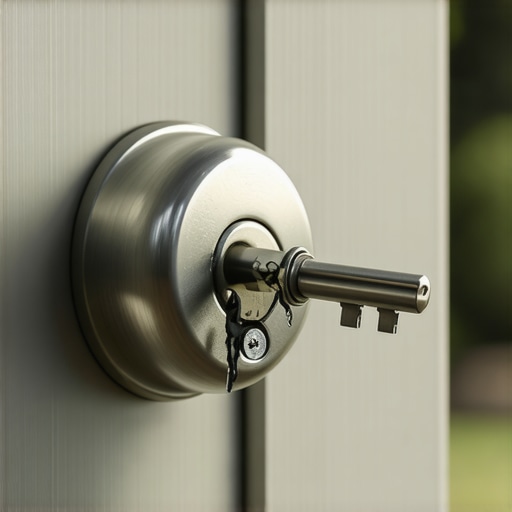
That sickening ‘tink’ sound followed by a sudden lack of resistance is a noise I have heard too many times in my twenty-five years at the bench. You were in a hurry, the door was sticking because of the humidity, and you applied just a few inch-pounds of torque too many. Now, you are staring at a brass bow in your hand while the blade of the key is buried deep inside the plug of your deadbolt. I teach my apprentices that if you have to force the key, you have already lost. This is a technical wisdom born from thousands of service calls. When you force a key, you are fighting the physics of the shear line. If a single pin is not reaching its required height because of debris or a worn spring, the plug cannot rotate. Forcing it does not fix the alignment; it simply stresses the narrowest point of the key blade until the metal reaches its yield point and shears off. [image_placeholder_1]
The Forensic Autopsy of a Broken Key
To understand why this happened, we have to look at the material science of your hardware. Most residential keys are made of brass or nickel silver. Brass is a relatively soft alloy, chosen because it is easy to cut and easy on the hardened steel pins inside the lock. However, brass work-hardens over time. Every time you turn that key, you are microscopicly fatiguing the metal. Eventually, a crack forms at the bottom of a deep cut, usually near the shoulder where the blade meets the bow. Big box stores often sell keys made of ‘pot metal’ or cheap zinc alloys that have the structural integrity of a soda can. When these keys meet a high-quality deadbolt with tight tolerances, the key is the weakest link every single time.
“Security is always a trade-off between convenience and protection.” – Industry Axiom
The Mechanical Failure: It Is Not Just the Key
Often, the key is not the primary culprit; it is the messenger of a deeper mechanical failure. Inside your deadbolt, there is a series of pin stacks. Each stack consists of a spring, a driver pin, and a key pin. For the plug to turn, the gap between the driver pin and the key pin must align perfectly with the shear line, the boundary between the plug and the housing. If your door is misaligned, the bolt is putting pressure on the plug, which in turn binds the pins. This friction makes it harder for the pins to move freely. If you are also dealing with a commercial master key system, the complexity increases. Commercial master key system advantages for businesses include granular access control, but they also introduce master wafers. These tiny brass discs create multiple shear lines. If the lock is poorly maintained, these wafers can tilt or ‘cock’ inside the chamber, leading to a jammed plug that invites a key snap.
How to Extract a Broken Key Without Destructive Entry
If you find yourself in this situation, do not reach for the drill. A trunk-slammer scammer will tell you the lock is ‘unpickable’ and needs to be drilled and replaced for three hundred dollars. That is a lie. As a master locksmith, I use a set of spiral extractors or thin-gauge saw-tooth extractors. The goal is to bypass the pin stacks and hook the serrations of the key blade.
“A lock is only as strong as its weakest component, which is frequently the user’s patience.” – Security Manual 101
First, ensure the plug is in the neutral vertical position. If the key snapped while turning, you must use a tension wrench or a flathead screwdriver to rotate the plug back to the 12 o’clock position. If the plug is turned even a fraction of a degree, the pins will trap the broken blade, and no amount of pulling will get it out. Once aligned, slide the extractor tool along the side of the key blade, hook one of the bittings, and pull with a steady, firm motion. It is a surgical process that requires a steady hand and a deep understanding of the internal chamber dimensions.
Upgrading Your Security: Beyond the Physical Key
Once the blade is out, you have a choice: rekeying vs replacing locks which is better? If the cylinder is high quality, such as an ANSI Grade 1 deadbolt, rekeying is the way to go. I can swap the internal pins and issue you a new, fresh key made of nickel silver for a fraction of the cost of a new lock. However, if you are tired of the physical key altogether, it might be time to look at smart deadbolts with fingerprint scanners. These units eliminate the mechanical ‘snap’ risk and provide access logs for smart locks, allowing you to see exactly when someone entered your home. For my commercial clients, I often recommend push-button locks for offices to reduce the liability of lost keys and the constant need for rekeying when employees move on. If you do go the digital route, remember these smart lock hacking prevention tips: always use two-factor authentication for the app and never use a default manufacturer code.
Automotive Considerations and Emergency Scenarios
Keys do not just snap in houses; they snap in ignitions too. Keyless ignition repair services are becoming more common as older fobs fail. If you are dealing with an auto lockout because your only key is now in two pieces, do not panic. We can perform a lost wallet key replacement fast by pulling the key code from your VIN or decoding the remaining wafers in the door lock. Modern automotive keys involve transponder chips and rolling codes, meaning a simple mechanical cut is not enough. We have to program the ECU to recognize the new chip, a process far more complex than the simple pin-tumbler systems of decades past.
Maintenance: The Secret to Longevity
To prevent this from happening again, stop using WD-40 in your locks. WD-40 is a solvent, not a long-term lubricant; it eventually attracts dust and turns into a sticky goo that jams pins. Use a high-quality PTFE-based or dry graphite lubricant. Apply it once a year, or more often if you live in a coastal area where salt air can corrode the brass internals. Check your strike plate alignment. If you have to push or pull on the door to get the bolt to throw, your lock is under constant stress. Moving the strike plate a sixteenth of an inch can save you a two-hundred-dollar emergency call-out in the middle of a storm. Security is not a product you buy and forget; it is a system of physics that requires respect and occasional maintenance.