
The 3 AM Lesson in Electronic Neglect
I once had a customer call me at 3 AM because they were stranded in a supermarket parking lot during a freezing rainstorm. Their 2024 SUV wouldn’t recognize the proximity key, and the alarm was screaming because they had to use the hidden emergency blade to get in. They thought the immobilizer had fried or the ECU was bricked. After I drove across the county, fighting the locksmith response times 2026 averages that most mobile techs struggle with, I checked the voltage on their fob. It was sitting at 2.6 volts. A standard CR2032 lithium coin cell should be at 3.0 or 3.2 volts to function reliably. That tiny drop of 0.4 volts was the difference between a running engine and a cold night in the rain. This is the reality of modern automotive security. We have moved from simple brass blades to complex radio frequency emitters, but we are still at the mercy of a five dollar piece of lithium and manganese dioxide.
“Security is always a trade-off between convenience and protection.” – Industry Axiom
The Forensic Autopsy of a Failing Fob
When a key fob starts to die, it does not just quit. It sends out warning signals that most drivers ignore until they are looking for keyless ignition repair services. You might notice the range shrinking from fifty feet to five feet. You might find yourself clicking the ‘unlock’ button three times instead of one. Internally, the physics of this failure are fascinating. The fob contains a printed circuit board (PCB) with a crystal oscillator that generates a specific frequency, usually 315MHz or 433MHz. As the battery voltage sags, the oscillator’s stability fluctuates. The Integrated Circuit (IC) needs a steady current to perform the rolling code calculation. Modern vehicles use sophisticated rolling codes to prevent relay attacks. Every time you press the button, the fob and the car sync to a new pseudo-random number. If the battery is too weak to complete this handshake, the car ignores the signal to prevent a security breach. This is a core part of 2026 trends in automotive security where the encryption layers are becoming so thick that even a minor power dip causes a total communication blackout.
Why Cheap Batteries Are a Security Risk
I see it every day in my shop. People go to the dollar store and buy a multi-pack of off-brand batteries. These are often manufactured with thinner casings and inconsistent chemical mixtures. In the world of high-end locksmithing, we call this ‘pot metal’ logic applied to electronics. A cheap battery can leak electrolyte onto the PCB, corroding the copper traces and shorting out the tactile switches. If you are managing electronic access control systems for small businesses or even multi-family building lock rekeying projects, you know that hardware reliability is everything. The same applies to your car. A leaked battery ruins the remote, turning a twenty dollar maintenance task into a five hundred dollar replacement and programming job. I tell my apprentices that using a bad battery is like putting 85 octane fuel in a Ferrari. You are asking for a breakdown.
The Anatomy of the Replacement Process
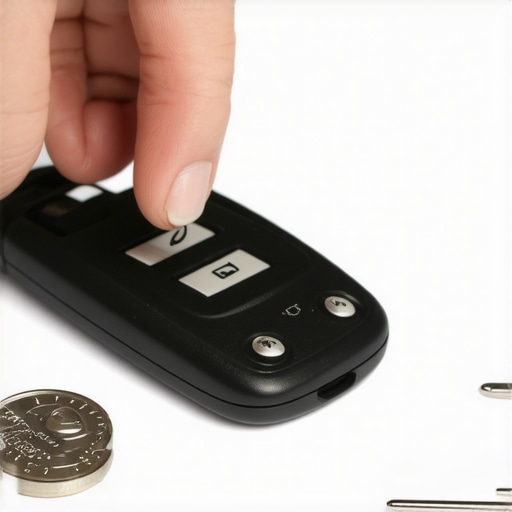
To replace the battery correctly, you must treat the fob like a surgical patient. Most fobs are held together by plastic tension clips. If you use a flathead screwdriver and just twist, you will mar the plastic and potentially snap the retention tabs. I use a non-marring nylon spudger. Once you split the case, you’ll see the battery held in place by a nickel-plated spring contact. Do not touch the surface of the new battery with your bare fingers. The oils from your skin can create a high-resistance film that leads to premature failure. Use a glove or a piece of plastic. Check the contact points for oxidation. If they look dull, a tiny bit of electrical contact cleaner on a swab can restore the connection. This attention to detail is how you avoid needing lost wallet key replacement fast because your backup fob is also dead and forgotten in a drawer.
“The strength of any security system is defined by its weakest component, which is frequently the power source.” – Security Manual 101
Beyond the Battery: The Future of Vehicle Access
We are seeing a shift toward integrated smart lock hubs 2026 where your vehicle, home, and office all live on the same digital keychain. This sounds great until your phone dies or your app glitches. This is why professional locksmiths still emphasize physical backups and robust hardware. Even as we move toward mobile app locksmith booking 2026 and biometrics, the fundamental physics of the strike plate and the shear line remain. If you want to know how to upgrade your home security on a budget, start by ensuring your existing hardware is maintained. Don’t just throw a ‘smart’ lock over a door that doesn’t latch properly. The same logic applies to your car. A fresh fob battery is the cheapest insurance policy you can buy. Also, keep an eye on your access logs for smart locks if you have them integrated with your car’s security system. Any ‘failed’ entry attempts in the log could indicate someone trying to jam your signal or a battery that is starting to pulse irregularly.
Proper Maintenance and The WD-40 Myth
I need to clear something up. If your physical emergency key is stuck in the door lock because you haven’t used it in five years, do not spray WD-40 into the keyway. WD-40 is a solvent, not a long-term lubricant. It will eventually attract dust and turn into a sticky paste that pins the tumblers in place. Use a high-quality PTFE or graphite-based lubricant. Every six months, take that emergency blade out of your fob and exercise the door lock. If you don’t, the internal wafers will seize due to road salt and grime. This is especially true in humid environments where the metal components undergo galvanic corrosion. Whether you are dealing with keyless ignition repair services or just a standard rekey, moving parts need to move. Don’t wait for a crisis to find out your backup plan is frozen shut. Keep your batteries fresh, keep your mechanical locks lubricated, and stop trusting the cheapest hardware you can find at the big box stores. Security is an investment in your own peace of mind, not a place to cut corners. “,