
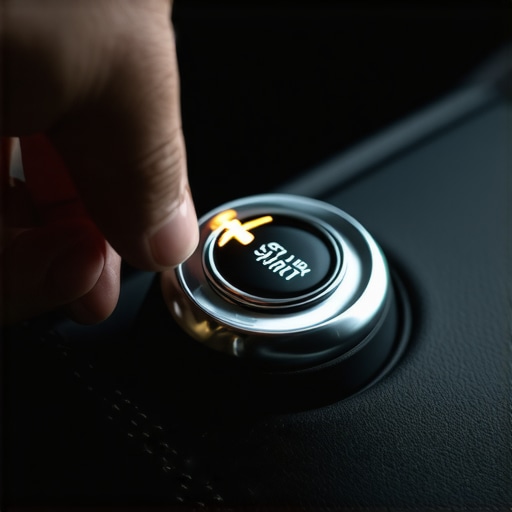
The 3 AM Call and the Ghost in the Dashboard
I once had a customer call me at 3 AM because he was stranded in a grocery store parking lot during a sleet storm. His high-end SUV sat there like a two-ton paperweight. He kept pressing the start button, and the dashboard just blinked back a cold, mocking message: No Key Detected. He had already spent an hour on the phone with his dealership, and they told him to tow it fifty miles to their lot so they could replace the Entire Engine Control Module for three thousand dollars. I showed up with a frequency tester and a kit of CR2032 batteries. Within five minutes, I realized it wasn’t the car at all. It was a cheap, generic battery he had bought from a gas station that couldn’t handle the cold-crank amperage required to wake up the immobilizer. This is the reality of modern automotive security. It is not just about metal teeth anymore; it is about invisible handshakes between silicon and copper.
“Security is always a trade-off between convenience and protection.” – Industry Axiom
The Forensic Autopsy of a Silent Keyless System
When your keyless ignition fails, you are dealing with a breakdown in the Passive Entry Passive Start (PEPS) architecture. This system relies on a dual-frequency conversation. Most fobs use a Low-Frequency (LF) signal, typically 125kHz, for the wake-up call and a Radio Frequency (RF) signal, usually 315MHz or 433MHz, to transmit the rolling code data. If your car is not starting, we have to perform a forensic autopsy on the communication loop. Is the fob failing to shout, or is the car failing to listen? Most trunk slammers will tell you to just buy a new fob because they do not understand the physics of the antenna array. A real master locksmith knows that the car usually has three to five antennas hidden in the center console, the rear deck, and the door handles.
The Fob Side: More Than Just a Battery
Let us talk about the hardware. A key fob is a Printed Circuit Board (PCB) encased in plastic. Over time, the micro-switches for the buttons can become de-soldered from the board due to repetitive stress. However, if the proximity start is failing, the culprit is often the transponder coil. This is a tiny copper-wound component that handles the inductive coupling. If you drop your keys often, you can fracture the ferrite core of this coil. This is why a key fob battery replacement guide is often the first step, but not the final solution. You need to ensure you are using high-drain lithium cells, not the zinc-carbon junk found in discount bins. When we talk about automotive locksmith vs dealership for car key replacement, the difference is that I actually test the PCB for frequency drift while the dealer just wants to sell you a new plastic shell for five hundred bucks.
The Antenna Side: The Car’s Nervous System
If the fob tests fine, we look at the car’s antennas. These are often flat, rectangular modules hidden behind interior panels. In many vehicles, if you have a mobile locksmith for RVs and campers look at your setup, you will find that metal shielding or even certain aftermarket solar controllers can create electromagnetic interference (EMI) that drowns out the 125kHz wake-up signal. I have seen cases where a simple phone charger plugged into the 12V socket generated enough RF noise to kill the keyless ignition system entirely. The car’s antenna is trying to hear a whisper in a hurricane.
“Locks are but a physical manifestation of a mathematical secret.” – Security Manual
The Inductive Loop: The Emergency Lifeline
Every keyless car has a backup plan. If your fob battery is truly dead, there is a specific spot (the inductive slot) where you can hold the fob to start the car. This uses a physical principle called near-field induction. The car’s antenna emits a magnetic field that actually powers the chip in your fob momentarily, even without a battery. If your car starts when the fob is touched to the button but not when it is in your pocket, your antenna array is likely the issue, or your fob’s RF transmitter is weak. This is a classic diagnostic split that saves my customers hundreds in unnecessary parts.
Expanding the Security Perimeter: Commercial and Future Tech
While I spend my days digging into car dashes, the same logic applies to commercial security. The transition to biometric keyless entry for cars and biometric locks installation guide 2026 standards shows we are moving toward a world where your thumbprint is the rolling code. For my business clients, a commercial master key system advantages for businesses still relies on the same physics of tolerances, whether it is a physical wafer or a digital bit. We are even seeing solar-powered smart locks 2026 models that use ambient light to maintain the capacitor charge for touchless entry systems for offices. Even in large-scale settings, like installing panic hardware for office buildings 2026, the integration of electronic strikes with keyless fobs means the troubleshooting steps remain the same: check the power, check the frequency, check the interference.
The Repair Path: Rekeying the Digital Soul
If you find that the antenna is the failure point, it is rarely a broken wire. It is usually a fouled connector or a module that has lost its sync. In the locksmith world, we use specialized tablets to perform a hard reset on the Immobilizer (IMMO) system. We clear the old keys and perform a fresh handshake. This is why a biometric locks installation guide 2026 or a car key sync requires more than just a screwdriver. It requires an understanding of the CAN-bus network that connects every electronic component in the vehicle. Do not let a scammer drill your ignition because they do not know how to read a data stream. A real technician understands that the problem is often a software glitch or a five-cent battery contact that needs a little tension. Keep your fobs away from magnets, keep your batteries fresh, and if the car stops talking to the key, stop and listen for the electronics before you start throwing parts at it.