
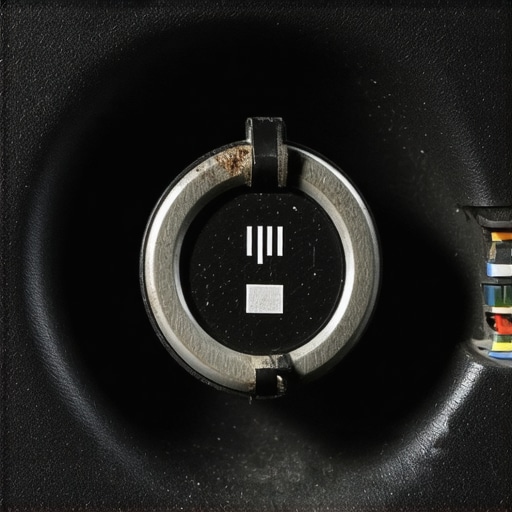
The Silence of a Dead Button: A Forensic Look at Modern Ignition Systems
You sit in the driver’s seat, press the brake, and thumb that plastic button. Nothing happens. No engine roar, no dashboard lights, just a cold, expensive piece of metal sitting in your driveway. Most people assume the battery is dead, but as someone who has spent over 25 years at the bench, I can tell you that the physics of failure are rarely that simple. A push-to-start system is not a switch; it is a complex, high-frequency handshake between your vehicle’s Engine Control Unit (ECU) and a transponder chip that is constantly fighting for signal clarity.
The Apprentice Lesson: Invisible Handshakes
I teach my apprentices that if you have to force a mechanical key, you’ve already lost the battle against the hardware. However, with modern proximity systems, the ‘key’ is an invisible conversation. I remember telling a young kid in my shop last week that a push-to-start button is essentially a request for permission. When you press that button, the car sends out a Low Frequency (LF) wake-up signal, usually around 125 kHz. The key fob hears this, wakes up from its sleep mode, and broadcasts an Ultra High Frequency (UHF) response, typically at 315 MHz or 433 MHz, containing a rolling code. If the timing is off by even a few milliseconds, or if the code is out of sync, the car stays dead. It is a physics problem involving signal attenuation and cryptographic timing.
“Security is always a trade-off between convenience and protection.” – Industry Axiom
Diagnosing the Forensic Failure: Why the Connection Breaks
When a customer brings me a vehicle that won’t start, I perform a forensic autopsy on the system. The failure usually falls into three categories: signal interference, component fatigue, or protocol desynchronization. In 2026 wireless lock protocols explained to my clients, I emphasize that we are moving toward Ultra-Wideband (UWB) technology which measures the ‘time of flight’ of the signal. This prevents relay attacks where scammers use antennas to bridge the gap between your fob on the kitchen counter and your car in the driveway. If your button fails, the UWB sensors might be failing to calculate the distance correctly, thinking the fob is outside the cabin when it is in your pocket.
The Key Fob Battery Replacement Guide
Most ‘failures’ start with the power source. If you are experiencing intermittent starts, check the voltage. A standard CR2032 battery starts at 3.2V. Once it hits 2.8V, the UHF transmitter begins to lose its ‘shout,’ and the car’s antennas can’t pick up the rolling code. To replace it: 1. Slide the release catch to remove the mechanical emergency blade. 2. Use the tip of that blade to gently pry the two halves of the fob housing apart. 3. Avoid touching the green circuit board with your bare fingers, as skin oils can cause traces to oxidize over time. 4. Seat the new battery firmly, ensuring the positive (+) side faces the correct direction. 5. Snap the housing back together and test the proximity lock function before trying the button.
[IMAGE_PLACEHOLDER]
Beyond the Battery: The Brake Light Switch and RF Interference
Sometimes the button is fine, the fob is fine, but the car is stupid. The ECU will not allow the start sequence unless it sees a ‘closed’ circuit from the brake light switch. I’ve seen dozens of cases where a $15 plastic switch under the brake pedal crumbled, and the car simply didn’t know the driver was pressing the brake. Furthermore, high-security locks for rental properties and commercial zones often use heavy-duty RF shielding that can create ‘dead zones’ for car fobs. If you’re parked near a cell tower or a massive server room, your fob’s signal might be drowned out by electromagnetic noise. In these cases, you must hold the fob directly against the start button. There is a hidden induction coil behind that plastic that will power the transponder chip via magnetic resonance, even if the fob battery is completely missing.
The Sticking Mechanism: Physical Wear in a Digital World
People ask me how to fix a sticking door lock mechanism or a sticky ignition button. The answer is never WD-40. That stuff is a solvent, not a lubricant; it attracts grit and turns into a grinding paste. For the physical button itself, it is usually a matter of the silicone membrane underneath wearing out or becoming gummed up by spilled coffee. If the button feels ‘mushy,’ the tactile dome switch on the PCB is failing. As a professional locksmith, I often have to pull the dash trim and replace the entire switch assembly because manufacturers no longer build these components to be serviced.
“The strength of a system is defined by its weakest link, which is often the interface between the digital and the physical.” – Security Manual 101
The 2026 Landscape: Smart Locks and Office Security
The tech in your car is bleeding into your home and office. We are seeing more app-controlled door locks security risks where the same rolling code vulnerabilities found in cars are appearing in residential hardware. While searching for the best smart locks compatible with Alexa 2026, you must ensure they use AES-256 encryption. For my commercial clients, I still recommend panic hardware for office buildings 2026 that relies on mechanical fail-safes. You don’t want a software glitch preventing an exit during a fire. Whether it is locksmith services for vacation homes or home safe lockout recovery, the lesson is the same: always have a mechanical backup. If your push-to-start fails and you don’t know where your emergency key blade is, you are at the mercy of a tow truck and a dealership that will charge you triple what a real locksmith would.
Weather and Regional Realities
In regions with high humidity or extreme salt air, the copper traces inside your key fob and the button assembly corrode faster than you’d think. I’ve seen fobs from coastal areas where the internal antennas were completely green with oxidation. This is why I tell people to keep their fobs in a dry place and avoid leaving them in the car overnight where temperature fluctuations cause condensation. Your car is a fortress, but it is a fortress controlled by a very small, very fragile computer. Treat it like one.