
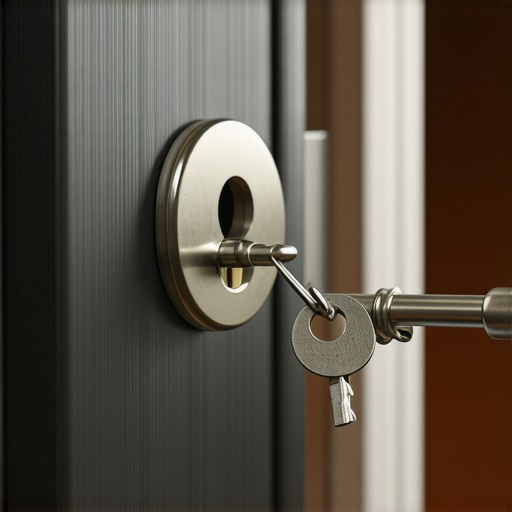
The Wisdom of the Bench: An Apprentice Lesson in Patience
I teach my apprentices that if you have to force the key, you have already lost. That lesson usually comes after a young tech snaps a high-security blade inside a cylinder because they thought muscle could overcome physics. I remember one kid, bright-eyed but impatient, trying to manhandle a stubborn deadbolt on a humid July afternoon. He put enough torque on that brass key to twist the bow right off the blade, leaving the business end buried deep inside the plug. I made him sit there for two hours with a set of dental picks and a magnifying glass. I told him he wasn’t allowed to drill it. You see, a lock is a mechanical puzzle of incredible precision, and when a key breaks, it is a signal that the system has failed, usually due to lack of maintenance or poor material quality. Learning the delicate art of the probe extraction is what separates a true locksmith from a trunk-slammer with a cordless drill.
“Security is always a trade-off between convenience and protection.” – Industry Axiom
The Forensic Autopsy of a Snapped Key
Why do keys break? It is rarely a sudden event. It is a slow death by a thousand cycles. Most residential hardware uses keys made of nickel silver or brass. While these materials are great for resisting corrosion, they are susceptible to work hardening. Every time you turn that key against a misaligned strike plate, the metal molecules compress and shift. Eventually, a hairline fracture develops at the deepest cut of the key, usually near the bow where the torque is highest. When that fracture finally gives way, you are left with a piece of metal stuck behind a series of spring-loaded pins. To understand the extraction, you must visualize the internal physics. Inside the cylinder, there are five or six pin stacks. Each stack consists of a bottom pin, a top pin (or driver pin), and a spring. When the key fragment is inside, those bottom pins are resting on the peaks and valleys of the broken blade. If the fragment is pushed too far back, it might actually be trapped by the last pin, which drops down into the void where the rest of the key should be, effectively locking the fragment in place.
The Tool of the Trade: The Thin Probe
When we talk about a thin probe, we are usually referring to a spiral extractor or a modified surgical-grade stainless steel pick. In the current locksmith tools market outlook 2026, we see a shift toward even thinner, high-tensile alloys designed to bypass the tight tolerances of modern high-security cylinders. The probe must be thin enough to slide into the paracentric keyway, which is the zig-zag shape of the hole, alongside the broken fragment. You are looking for a gap, usually at the top of the keyway or along the side warding. The goal is to reach past the first or second pin stack and find a ‘bite’ on one of the key’s teeth. By applying a slight outward pressure and a rhythmic ‘jiggling’ motion, you can walk the fragment forward. This requires a tactile sensitivity that no machine can replicate. You have to feel the spring tension of the pins and ensure you aren’t accidentally pushing the fragment further into the depths of the plug.
Automotive Complications and Laser-Cut Realities
In the world of vehicles, things get even more complex. If you are dealing with automotive laser-cut keys costs, you know that a broken car key is a financial headache. These keys are side-milled, meaning the ‘teeth’ are actually a path cut into the face of the metal. If one of these snaps, the extraction is a nightmare because there are no traditional serrations for a probe to grab. Often, this happens in the ignition, where the steering column lock adds extra pressure. In these cases, we have to use specialized lubricants to reduce the friction coefficient between the brass and the zinc-alloy housing. Speaking of vehicle maintenance, many people forget that a simple key fob battery replacement guide could save them from over-working their physical keys. If your remote fails, you start using the manual door lock, which hasn’t been turned in years and is likely seized with road salt and grime. This is a recipe for a snapped key and a call to a professional.
“Standardized testing ensures that lock cylinders meet a minimum threshold of cycles before mechanical fatigue sets in.” – ANSI/BHMA A156.5 Security Standards
Beyond the Metal: The Rise of Electronic Access Control
While I love the mechanical side of things, I also recognize that we are moving toward a digital future. Many of my commercial clients are moving toward electronic access control systems for small businesses. These systems eliminate the physical key entirely, using fobs, cards, or biometric scanners. The beauty of these setups is the ability to review access logs for smart locks. If a door is forced or a code is used at 2 AM, the system records it. We are also seeing a surge in electronic gate lock systems for gated communities and private estates. These systems use heavy-duty solenoids or magnetic locks that provide much higher holding force than a standard deadbolt. However, even these high-tech solutions require physical door reinforcement for security. A smart lock is useless if the door frame is made of soft pine that can be kicked in with a single blow. We always recommend installing extended strike plates with three-inch screws that anchor directly into the wall studs.
Emergency Response and Security Upgrades
When I am called for emergency lock changes after break-in, I often see the same mistakes. People rely on the hardware that came with their house, which is usually Grade 3 pot metal. After we extract a broken key or repair a kicked-in door, we talk about the future. For those worried about car key duplication costs 2026, the best advice is to get a spare made now. The price of transponder chips and laser-cutting equipment is only going up. For homeowners, learning how to prevent future house lockouts is about more than just hiding a key under a fake rock. It is about routine maintenance. Use a dry PTFE-based lubricant in your locks twice a year. Never use WD-40, as it attracts dust and turns into a sticky sludge that actually accelerates key wear. If your key feels ‘crunchy’ when you turn it, that is the lock screaming for help. Don’t wait until it snaps to call a professional who knows how to handle a thin probe with the grace of a surgeon.