
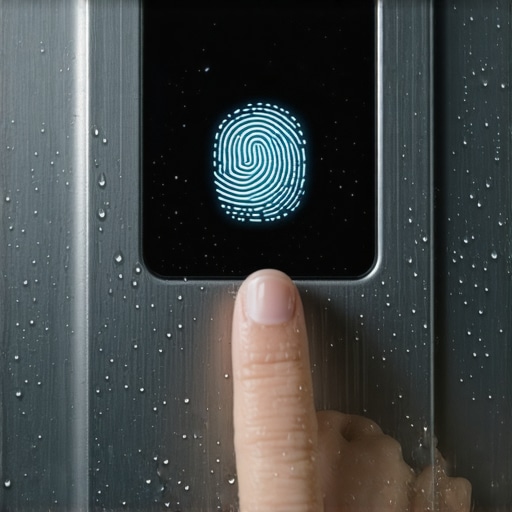
I teach my apprentices that if you have to force the key, you’ve already lost. With biometrics, the lesson is even harder: if the sensor can’t see the ridge because of a drop of water, the smartest lock in the world is just a paperweight. I have seen guys spend twenty minutes in the rain trying to get their own front door to recognize them, looking like they are trying to start a fire with their thumb. This is the reality of the hardware game. Security is a physics problem, and water changes the physics of your skin. If you are looking for a lock that does not fail when your hands are wet from the pool or the rain, you have to understand the circuitry, not the marketing brochure.
The Physics of the Fingerprint Failure
To understand why your smart lock hates your wet hands, you have to look at how it sees you. Most cheap consumer-grade locks use optical sensors. Think of an optical sensor as a tiny camera with a light source. When you place your finger on the glass, the ridges of your fingerprint touch the surface while the valleys do not. The sensor captures the contrast between the light reflected from the ridges and the dark areas of the valleys. When your hands are wet, water fills those valleys. Because water has a refractive index similar to glass, the sensor no longer sees ridges and valleys. It sees one big, blurry blob of gray. The software can’t find the minutiae points, the bifurcations, or the ridge endings. It treats you like an intruder because the math doesn’t add up.
“Security is always a trade-off between convenience and protection.” – Industry Axiom
Then we have capacitive scanners, which are what you usually find on mid-range units and integrated home security lock bundles. These work by using tiny electrical capacitors to measure the voltage difference between your skin and the sensor. Your skin is conductive, and the air in the valleys of your fingerprint is not. Water, especially if it has any salt or minerals from sweat, is incredibly conductive. It shorts out the sensor’s ability to distinguish between the ridge and the valley. This is why these units often give you a false rejection or a ‘sensor dirty’ error the moment the humidity spikes. If you are dealing with an auto lockout because your car’s touch-entry system is failing in a thunderstorm, you are seeing this same electrical interference in action.
Mechanical Integrity vs. Digital Convenience
I often tell my customers that while they are worried about fingerprint lock reliability tests, they are ignoring the basic physics of the door. A lock is only as good as the bolt and the strike plate. Many of the smart locks sold at big-box stores are built with zinc alloy internals that a toddler could snap with a pry bar. When I perform fingerprint lock reliability tests in my shop, I am not just looking at the scanner. I am looking at the motor torque and the clutch mechanism. If the biometric part works but the motor is too weak to pull the bolt through a slightly swollen wooden door frame, you are still stuck outside. In my neighborhood, the humidity swells wood doors every summer. If your smart lock doesn’t have the torque to handle that friction, the electronics are irrelevant.
If you are seeing signs you need to change your door locks immediately, such as a grinding sound when the bolt extends or a loose cylinder, do not just slap a smart lock over the problem. A biometric scanner won’t fix a misaligned door. In fact, it will probably fail faster because the electronic motor will burn out trying to force a bolt into a misaligned strike plate. I always recommend upgrading to anti-pick locks for front doors 2026 standards, which often combine a high-security mechanical cylinder with the biometric interface. This gives you a physical override that actually works when the technology decides to quit.
The Ultrasonic Solution
If you absolutely must have a lock that works with wet hands, you have to move into ultrasonic technology. Instead of light or electricity, ultrasonic sensors use sound waves. They send out a pulse that bounces off your finger and returns to the sensor. Because sound travels through water differently than it reflects off skin, the sensor can see ‘through’ the moisture to the actual 3D structure of your fingerprint ridges. This is the same tech used in high-end smartphones, but it is only just now trickling into the residential lock market. These units are more expensive, but they are the only ones I trust for a pool house or a front door in a rainy climate.
“The strength of a biometric system is only as good as its fallback mechanism.” – Security Manual
When you look at the car key duplication costs 2026, you see that automotive manufacturers have spent billions on this. They use rolling codes and multi-layered encryption because the stakes are higher. For your home, you should look for smart lock hacking prevention tips that include disabling the ‘auto-unlock’ feature based on Bluetooth proximity alone. You want a lock that requires the biometric or a pin, and you want a unit that has been hardened against ‘replay attacks.’ If the lock’s brain is on the outside of the door, a thief doesn’t need your fingerprint, they just need a screwdriver and a jumper wire.
Maintenance and the Real World
I get calls all the time from people who think their lock is broken, but the sensor is just coated in skin oils and dust. You need a key fob battery replacement guide for your car, and you need a maintenance schedule for your smart lock. Clean the sensor with a microfiber cloth and a tiny bit of rubbing alcohol once a month. If the coating on the sensor is scratched, its ability to read through moisture is gone. This is why I tell people to avoid ‘smart locks for pet doors’ that use cheap plastic sensors. The first time a dog scratches at that sensor, the biometric function is dead.
For those interested in the DIY route, car remote programming tutorials often show how complex modern encryption is. That same complexity is inside a high-quality biometric lock. If you buy a $50 scanner from an unknown brand, you are asking for trouble. Those units often have no encryption between the scanner and the bolt motor. A simple magnet or a small electrical pulse can bypass them entirely. Always look for ANSI Grade 1 or Grade 2 ratings on the hardware itself, regardless of how cool the fingerprint scanner looks. Metal beats plastic every day of the week.
“,”image”:{“imagePrompt”:”A close-up, high-detail macro shot of a weathered, professional locksmith’s hand pressing a wet thumb onto a glowing blue ultrasonic biometric fingerprint scanner on a heavy-duty matte black door handle. Water droplets are visible on the skin and the scanner surface, with a blurred background of a brick-and-mortar locksmith shop.”,”imageTitle”:”Professional Biometric Scanner Testing”,”imageAlt”:”A wet thumb being scanned by a high-security biometric door lock in a locksmith shop environment.”},”categoryId”:0,”postTime”:””} Ready to post.