
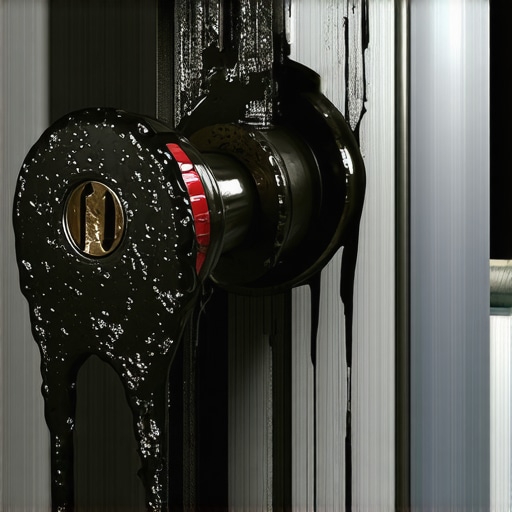
The Sound of Impending Hardware Failure
Every morning in my shop, I hear the same story. A customer walks in with a handful of brass shards or a cylinder that looks like it was marinated in crude oil. It always starts with a faint crunching sound or a key that requires a bit of a wiggle. Then comes the fatal error: they reach for the blue and yellow can. I teach my apprentices that if you have to force the key, you’ve already lost the battle against physics. When you feel that mechanical resistance, your lock is telling you that the tolerances between the pin stacks and the plug have been compromised. Forcing it just shears off the delicate warding or bends a driver spring. But spraying a multi-purpose solvent like WD-40 into the keyway is the equivalent of trying to fix a watch with a sledgehammer. It might work for ten minutes, but you are effectively signing the death warrant for that hardware. This is especially true for the high-security euro cylinder locks that are becoming standard in modern residential builds. These units use tight tolerances where even a micron of debris can seize the entire mechanism.
“Security is always a trade-off between convenience and protection.” – Industry Axiom
The Forensic Autopsy of a Lubricant Mistake
To understand why WD-40 is a locksmith’s nightmare, you have to look at the material science. Most residential locks are made of brass, zinc, or nickel-silver components. WD-40 is a Water Displacement formula. It is a solvent, not a long-term lubricant. When you spray it into a lock cylinder, it washes away whatever factory grease was remaining and replaces it with a thin, oily film. This film is hygroscopic and tacky. It acts as a magnet for pocket lint, dust, and microscopic metallic debris. Within weeks, this mixture creates a grinding paste. In the context of lock maintenance tips for winter 2026, this becomes a critical failure point. As temperatures drop, that slurry of oil and grit thickens. If you are using integrated home security lock bundles, the mechanical resistance from this gunk can actually burn out the small servo motors that drive the locking bolt. I have seen countless smart locks compatible with Alexa 2026 fail not because of a software glitch, but because the physical cylinder was choked with dried solvent residue.
The Mechanics of the Shear Line
Inside your lock, there is a plug and a shell. Between them is the shear line. For the lock to turn, the gaps between the key pins and the driver pins must align perfectly at this line. When you introduce a sticky, dust-attracting substance, the pins start to hang. Instead of the springs pushing the driver pins back down into the plug, they stay stuck in the up position. This is how you end up with a lock that spins freely without engaging or a key that gets trapped. If you find yourself in this situation, do not yank the key. Knowing how to extract a broken key from a lock safely is a skill every homeowner should have, but prevention is better. For those managing panic hardware for office buildings 2026, the stakes are higher. A gummed-up crash bar isn’t just a nuisance; it is a fire code violation that can lead to massive liability. Weatherproof outdoor locks reviews often point toward specialized dry lubricants for a reason: they do not provide a medium for ice or dirt to bond to the internal springs.
“The strength of a lock is inversely proportional to the amount of debris inside its cylinder.” – The Master Locksmith Manual
Corrective Action and Maintenance Protocols
If your lock is sticking, the first step is a proper cleaning, not more oil. Use a dedicated electronic cleaner or a high-pressure air blast to clear out the existing debris. For lubrication, I only recommend dry PTFE (Teflon) or high-grade graphite, though graphite can be messy if over-applied. If you are dealing with automotive issues, the complexity increases. Modern automotive laser-cut keys costs have skyrocketed because they involve precision milling that leaves little room for error. When these keys get sticky, it is often due to the transponder chip key cloning 2026 process where the physical blade wasn’t deburred correctly, or the ignition wafers are worn. In these cases, car key duplication costs 2026 are a small price to pay compared to replacing an entire ignition column because you tried to lubricate it with a household degreaser. For residential users, if the lock is over ten years old and made of cheap zinc or “pot metal,” replacement is often more cost-effective than repair. Moving to a high-security cylinder with hardened steel inserts provides better protection against drilling and picking while offering smoother mechanical action. Stop treating your security hardware like a squeaky door hinge. Use the right tools, or you will be calling me at 3 AM for an emergency extraction that will cost five times the price of a bottle of proper lock lubricant.