
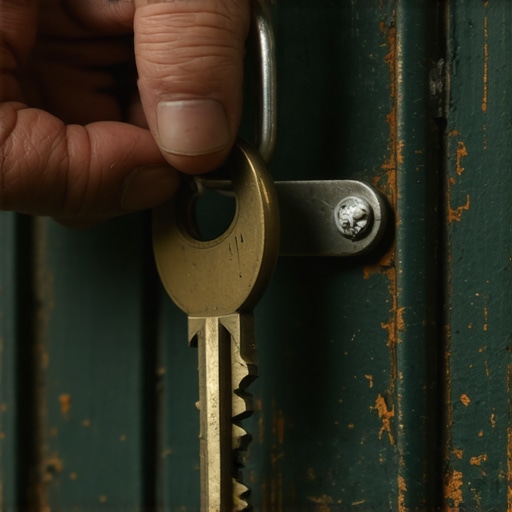
The Warning Signs of Mechanical Fatigue
That subtle resistance you feel when you slide your key into the cylinder is not a quirk; it is a mechanical distress signal. In my 25 years behind the bench, I have seen thousands of homeowners ignore a sticky lock until they are standing in the rain with a snapped piece of nickel silver in their hand. A lady came into my shop crying last week because a scammer she found online drilled her high-security lock and charged her six hundred dollars for a twenty dollar deadbolt replacement after she could not get her key to turn. If she had addressed the initial resistance, a simple ten minute service call would have saved her five hundred dollars. When a lock begins to fight you, the internal physics are already working against the hardware.
“The lock is the sentinel of the threshold, and its failure is the failure of the boundary itself.” – Modern Security Manual
The Forensic Autopsy: Why Pin Tumblers Fail
To understand why your key is sticking, you have to look at the mechanism zooming level. A standard pin tumbler lock relies on five to six pin stacks. Each stack consists of a bottom pin (key pin), a top pin (driver pin), and a coil spring. These components are housed within a plug and a shell. When you insert the correct key, the bittings on the blade lift the pins to the shear line, the precise point where the top and bottom pins separate, allowing the plug to rotate. In many residential settings, especially in locksmith services for vacation homes where salt air or humidity can corrode internal components, this shear line becomes compromised. Brass is a self-lubricating metal, but it is soft. Over thousands of cycles, the pins develop flat spots or burrs. When these burrs catch on the edge of the plug chamber, you feel that notchiness. If the plug itself is made of cheap pot metal or zinc instead of solid brass, the cylinder walls can warp, creating a binding condition that no amount of force will overcome.
Material Science: The War Between Brass and Zinc
In the trade, we distinguish between builders-grade hardware and professional-grade security. Big box stores often sell Grade 3 deadbolts that look impressive but use thin springs and hollow plugs. If your key feels mushy, the springs are likely collapsing. When a spring loses its tension, the driver pin does not stay seated against the key pin, causing it to dance around the shear line. This is especially prevalent in master key systems for hotels 2026, where high-frequency use demands Grade 1 hardware with heavy-duty phosphor bronze springs. If you are managing a commercial property, investing in commercial restricted keyways is the only way to ensure the metal holds up to the physical stress of daily operation. Restricted keyways use harder alloys that resist the wearing effect of the key blade, maintaining 0.003-inch tolerances for years longer than standard hardware.
“Security is always a trade-off between convenience and protection.” – Industry Axiom
Diagnosing the Crunch: Friction and Binding
When you feel a crunching sensation, it is often a sign of debris or catastrophic spring failure. If a coil spring breaks, a piece of wire can become lodged in the shear line, effectively jamming the lock permanently. This is when people reach for pliers to force the key, which is a mistake. Forcing a stuck key leads to metal fatigue. If the key snaps, you will be looking at broken key extraction tools 2026 reviews to find a way to pull the remains out. Professional extraction requires a spiral or hooked extractor to bypass the pin stacks and grab the bittings. In modern vehicles, specifically when providing car lockout services for Tesla models or other high-end EVs, the mechanical backup locks are rarely used and often seize up due to lack of motion. This atmospheric seizing is a common failure point that requires specialized penetrants to resolve without damaging the finish.
The Digital Transition: From Pins to Biometrics
Many homeowners are tired of mechanical failures and are looking toward the best smart locks compatible with Alexa 2026. These systems replace the physical pin stack with a motor-driven bolt. While this eliminates the issue of a hard-to-turn key, it introduces new failure points like battery drain or motorized jams. For those seeking a more robust solution, affordable biometric door hardware has become a reliable alternative. These systems use capacitive or optical sensors to verify identity, removing the need for a physical keyway that can wear out. For larger estates, electronic gate lock systems offer a way to manage access from a distance, but they still require a solid mechanical foundation to be secure. When setting up these units, a voice-activated locks setup tutorial can help integrate the hardware into a smart home ecosystem, allowing you to check access logs for smart locks to see exactly who entered and when.
Corrective Action: Rekeying versus Replacement
If your lock is starting to fail, you must decide whether to rekey or replace. Rekeying involves removing the cylinder plug, discarding the old pins, and installing a new pin set that matches a new key. This is effective if the housing and plug are still in good condition. However, if the plug has significant lateral play or the housing is cracked, replacement is the only safe option. I always recommend moving to a higher ANSI grade when replacing hardware. A Grade 1 deadbolt with a reinforced strike plate and three-inch screws will withstand significantly more force than a standard Grade 3 unit. This is the difference between a door that stands firm and one that yields to a single kick.
Maintenance: The Lubrication Myth
The biggest mistake I see is people spraying WD-40 into their locks. WD-40 is a solvent, not a long-term lubricant. It will make the lock feel better for three days, then it will attract dust and grime, turning into a sticky paste that cements the pins in place. Never use oil-based products. Instead, use a dry film lubricant or a high-quality PTFE spray. Graphite is acceptable but can be messy and, if over-applied, can actually clog the small tolerances of a high-security cylinder. Apply a small amount of dry lubricant to the key, slide it in and out of the lock ten times, and then wipe the key clean. This distributes the lubricant across the pin stacks without gunking up the springs. Proper maintenance ensures that your security stays functional, because a lock that you cannot open is not security; it is a barricade against yourself.