
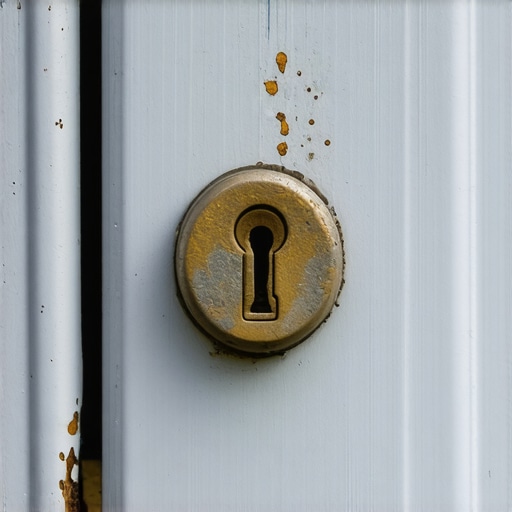
The Anatomy of a Failing Cylinder: Why Your Key is Fighting You
I teach my apprentices that if you have to force the key, you’ve already lost the battle against the mechanism. I recall a young kid I had in my shop three years ago. He was trying to muscle a brass key into a frozen Schlage deadbolt, turning it with a pair of pliers. I stopped him before the inevitable snap. That gritty, sandpaper sensation you feel when sliding your key into the plug is not just an inconvenience; it is the death rattle of your home security. When a lock starts to feel like there is gravel inside the keyway, you are looking at a material science failure that usually traces back to cheap manufacturing or environmental degradation of the internal components.
“Security is always a trade-off between convenience and protection.” – Industry Axiom
The Forensic Autopsy of the Gritty Lock
To understand the grit, you have to look at the shear line. Inside your lock cylinder sits a series of pin stacks. Each stack consists of a bottom pin, a driver pin, and a compressed coil spring. In high-quality locks, these pins are machined from hardened brass or nickel-silver with tolerances measured in the thousandths of an inch. When you insert your key, the bittings lift those pins to the exact height where the break between the top and bottom pins aligns with the edge of the plug. This is the shear line. If it is smooth, the plug rotates. If it is gritty, something has compromised the physics of that rotation.
Most of the time, that grit is galling. This occurs when the metal of the pins rub against the chamber walls of the cylinder. In lower-end hardware found at big-box retailers, manufacturers often use zinc-based alloys or thin-walled brass that lacks the structural integrity of ANSI Grade 1 hardware. As these softer metals wear down, they create tiny flakes of metal known as swarf. This swarf mixes with old, dried-up factory grease to create a grinding paste. Every time you turn the key, you are effectively sanding down the very pins that keep your house safe. This is why a high security locks vs standard locks comparison is vital; professional-grade hardware uses superior metallurgy that resists this type of internal erosion for decades rather than months.
Sustainable Security: Why Quality is Eco-Friendly
We often talk about sustainable eco-friendly locks for homes in the context of materials, but the most sustainable lock is the one you do not have to throw in a landfill every three years. A high-quality mechanical lock can be rebuilt, re-pinned, and serviced for a lifetime. When a cheap lock starts feeling gritty, it is usually because the pot metal housing has warped or the springs have lost their tension. You cannot effectively repair a lock built with planned obsolescence in mind. By investing in robust hardware, you are reducing the waste stream and ensuring that your emergency safe cracking services or residential locksmith does not have to drill out a failed unit that should have lasted fifty years.
The Evolution of Entry: From Mechanical Pins to 2026 Tech
As we look toward best smart locks compatible with Alexa 2026, the mechanical core still remains the primary point of failure. A smart lock is just a motorized thumbturn sitting on top of a standard deadbolt. If the underlying mechanical cylinder is gritty and failing, the small motor inside the smart lock will burn out trying to overcome the friction. Even in the world of locksmith services for electric vehicles 2026 and lost key replacement for hybrids 2026, the physical interaction between a key (or emergency blade) and the lock cylinder must be fluid. In 2026, we are seeing more touchless entry systems for offices that bypass the cylinder entirely, but for the average homeowner, that mechanical backup must work in a power outage. If your lock is gritty now, it will fail when you need it most.
“The strength of a lock is only as great as its weakest component’s resistance to physical force and wear.” – Security Standards Manual
The Lubrication Myth: Why WD-40 is the Enemy
I see it every week: a customer brings in a lock dripping with WD-40, complaining it is still sticking. Here is the reality: WD-40 is a solvent, not a long-term lubricant for fine mechanisms. It attracts dust and hair like a magnet. When you spray it into a gritty lock, it might feel better for forty-eight hours, but it is actually creating a sticky sludge that will eventually seize the master wafers and pins entirely. If you want to maintain your locks, use a dry film lubricant like Houdini or a high-quality PTFE-based spray. These do not attract grime and will actually help the pins glide across the shear line. If the lubrication does not fix the grit, the metal itself is failing, and you need a replacement before you are stuck with a transponder key programming guide and no way to turn the ignition.
When to Call the Pros: Automotive and Commercial Needs
The stakes are higher when we move beyond the front door. For business owners, touchless entry systems for offices are becoming the norm to prevent the wear and tear of physical keys. In the automotive sector, comparing an automotive locksmith vs dealership for car key replacement often comes down to who understands the mechanical wear of the door locks better. A dealer will just replace the whole unit at a massive markup. A real smith can often decode the wear on your current key and cut a code-compliant key that accounts for the grit in the cylinder. Whether you are using a mobile app locksmith booking 2026 or walking into a shop like mine, the goal is the same: smooth operation. If your lock feels like it is chewing on sand, do not wait for the day the key refuses to turn. Replace it with hardware that respects the physics of security.