
The Reality of Modern Office Security
I have spent over twenty-five years behind a locksmith bench, surrounded by the smell of triflow and the sound of brass shavings hitting the floor. I own a real shop with a real sign, not a magnetic one on a white van. Last month, a lady came into my shop crying because a scammer drilled her high-security deadbolt and charged her six hundred dollars for a twenty-dollar zinc piece from a big-box store. This is the world we live in, where marketing outpaces mechanics. But when we talk about the shift toward biometrics in private offices, we are moving beyond the physical blade and into the realm of data-driven physical security. This transition is not just about replacing a key; it is about changing the physics of the entry point.
“Security is always a trade-off between convenience and protection.” – Industry Axiom
The Anatomy of a Biometric Interface
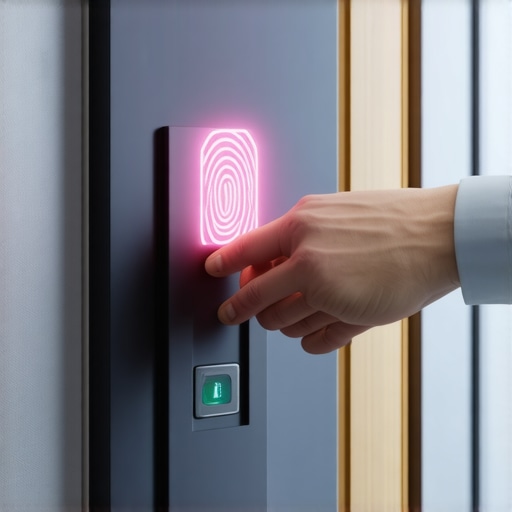
When you look at push-button locks for offices or high-end biometric scanners, you are seeing the evolution of the shear line. In a standard deadbolt, security relies on the alignment of bottom pins and driver pins at a specific height to allow the plug to rotate. With biometrics, the physical shear line is replaced by a digital handshake. Most modern office scanners use capacitive sensing. This involves a grid of tiny capacitors that measure the voltage difference between the ridges of your finger and the valleys. Your fingerprint does not just sit there; it acts as a capacitor plate. If the sensor is cheap, the resolution is low, and the false rejection rate climbs. This is why I tell business owners that a two hundred dollar lock from a discount site is a liability, not an asset. A true commercial-grade biometric system uses high-resolution mapping that can distinguish between a real finger and a silicone mold. It is about the resistance and the capacitance of the skin itself.
The Commercial Master Key System Advantages for Businesses
Many clients ask me if biometrics replace the need for traditional systems. Not entirely. The commercial master key system advantages for businesses remain relevant because you always need a mechanical override. However, biometrics allow for granular control that a master wafer simply cannot provide. In a traditional master key system, every master wafer you add to a pin stack creates a new shear line, which technically increases the number of ways to pick the lock. With biometric integration, you can maintain a clean, high-security cylinder for emergency residential lockout solutions or commercial bypass while using digital credentials for daily traffic. This reduces the wear and tear on the internal springs and pins, extending the life of the hardware. We are seeing a huge trend toward master key systems for hotels 2026 where the mechanical key is the fail-safe, but the biometric or RFID credential is the primary driver.
Hardware Durability and ANSI Standards
If you are installing hardware in a high-traffic office building, you cannot use residential-grade junk. I only install ANSI Grade 1 hardware. The difference between Grade 1 and Grade 3 is hundreds of thousands of cycles. A Grade 1 lever must withstand 800,000 cycles and heavy strikes. When we integrate panic hardware for office buildings 2026, we are looking at the internal cam and the solenoid. A biometric reader is only as good as the actuator it triggers. If the solenoid is made of cheap pot metal, it will bind the moment the building settles or the humidity causes the door frame to swell. I have seen countless office managers locked out because they bought a flashy smart lock but ignored the fact that their door was sagging. Security starts with the hinge and the strike plate. If the door is not hung true, no amount of fingerprint technology will keep it secure.
“The strength of a lock is inversely proportional to the number of people who have a key.” – Locksmith Manual Vol. 4
The Integration of Panic Hardware and Exit Devices
Commercial panic exit devices 2026 are incorporating biometrics to ensure that while anyone can get out in an emergency, only authorized personnel can enter from the exterior without a physical key. This is critical for private offices that house sensitive data. The physics of a panic bar involve a latch bolt that must retract with minimal pressure. When you add a biometric trim to this assembly, the motor must be powerful enough to overcome the friction of the latch. This is where many DIY installations fail. They do not account for the lateral pressure on the bolt. A professional install ensures that the biometric reader and the panic bar work in a synchronized mechanical dance. For those concerned with the environment, we are even seeing sustainable eco-friendly locks for homes and offices that use kinetic energy harvesting to power the biometric sensor, reducing the need for constant battery replacements.
The Digital Frontier: Smart Locks and Fast Solutions
As we move toward a more connected world, we see smart locks for pet doors and residential units using the same encrypted tech as our offices. But the problem remains the same: what happens when it fails? Lost wallet key replacement fast services are now evolving into digital credential recovery. If you lose your phone or your biometric profile is corrupted, you need a locksmith who understands the software as well as the steel. In my shop, I teach my apprentices that if you have to force the tool, you have already lost. Whether it is using a Lishi tool to decode a high-security cylinder or using a diagnostic tablet to reset a biometric controller, the goal is non-destructive entry. We want to preserve the integrity of the door and the hardware. Biometrics are changing the way we secure our offices by making the human body the credential, but the fundamentals of locksmithing—alignment, friction, and material strength—remain the same.