
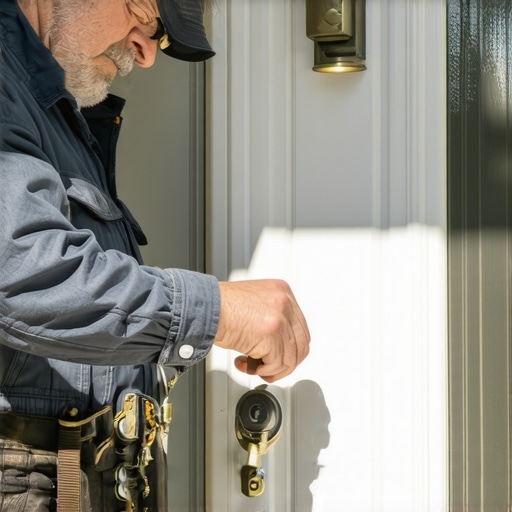
The Realities of Residential Defense
You just signed the papers and got the keys. You feel like the king of the castle. But as someone who has spent twenty-five years staring into the guts of thousands of locking mechanisms, I am here to tell you that your castle is likely held together by wishful thinking and quarter-inch screws. Most developers throw in the cheapest builder-grade hardware they can find to save a buck. I call it pot metal because that is exactly what it is: zinc die-cast junk that a teenager with a heavy boot can bypass in three seconds flat.
A lady came into my shop crying because a scammer drilled her lock and charged her six hundred dollars for a ten-minute job. This guy told her that her standard residential deadbolt was a high-security vault lock that required a diamond-tipped drill bit to bypass. In reality, it was a five-pin tumbler lock that any competent locksmith could have picked in under two minutes with a standard hook and tension wrench. He destroyed her hardware, charged her five times the market rate, and left her door weaker than he found it. This happens every single day because homeowners do not understand the physics of their own front door. Security is not a product you buy at a big-box store; it is a series of physics problems you have to solve.
“Security is always a trade-off between convenience and protection.” – Industry Axiom
The Anatomy of a Failed Door Frame
When a burglar decides to enter your home, they are not usually picking locks like a character in a movie. They are using kinetic force. They are kicking the door. The failure point is almost never the lock itself; it is the wood of the door frame. Most strike plates are secured with half-inch screws that only grab into the soft pine of the door jamb. When force is applied, the wood splits along the grain, and the door flies open. To fix this, you need to address the king stud. This is the heavy framing timber behind the decorative jamb. By replacing those tiny screws with three-inch hardened steel screws, you anchor the strike plate directly into the skeleton of the house. Now, instead of pushing against a thin piece of pine, the intruder has to move the entire wall of your home.
Mechanism Zooming: Inside the Cylinder
Let us talk about why your keys feel gritty or why they stick. Inside that brass cylinder is a series of chambers. Each chamber contains a spring, a driver pin, and a key pin. When you insert your key, the bitting (the cuts on the blade) lifts these pins to a specific height. If the tops of the key pins align perfectly with the shear line, the plug can rotate. In cheap locks, the tolerances are sloppy. You might have a 0.005-inch gap that allows the lock to function even with a poorly cut key, but that same sloppiness makes it easy to rake or bump. High-security cylinders use spool pins or mushroom pins. These are top pins with a narrow waist. If someone tries to pick the lock, the narrow part of the pin catches on the shear line, giving a false set that fools the picker into thinking they have succeeded when they are actually stuck. If you are looking for emergency residential lockout solutions, understand that a pro will look for these features before they ever touch a tool to your door.
The Smart Lock Debate
I get asked about smart deadbolts with fingerprint scanners constantly. New homeowners love the tech. But remember, a smart lock is just a computer motor glued to a mechanical deadbolt. If the mechanical parts are Grade 3 junk, the fingerprint scanner does not make you safer; it just makes you a more high-tech victim. If you want a smart lock, look for one that carries an ANSI Grade 1 rating. This means it has been tested to withstand 250,000 cycles and ten hammer blows of 75 foot-pounds. Many of the gadgets marketed to new homeowners are essentially toys that fail during the first freeze or when the humidity causes the door to swell. In urban areas, where locksmith costs in urban areas 2026 are expected to rise due to specialized tool requirements, investing in a robust mechanical backup is non-negotiable.
“The strength of a chain is its weakest link, but the strength of a door is its strike plate.” – Master Locksmith Manual
Low-Cost Tactical Upgrades
One of the best neighborhood watch lock recommendations I give is to audit your secondary entries. Sliding glass doors are a joke. The factory latches are basically just hooks that can be lifted off the track with a screwdriver. A simple wooden dowel in the track is a start, but a double-bolt locking system that anchors the top and bottom of the slider is a proper fix. For those with vintage cars in the garage, remember that a locksmith for vintage car keys often has to deal with worn ignitions; the same applies to your house. If you have to jiggle the key, the pins are worn or the springs are fatigued. Do not wait for a lockout. Rekeying a lock is significantly cheaper than replacing the entire unit. When I rekey a lock, I am not just changing the pins; I am cleaning the chambers and ensuring the plug rotates without friction. It is a mechanical tune-up for your security.
Electronic Gates and Access Control
If you have a larger property, electronic gate lock systems are becoming more common. These require a different level of maintenance. You are dealing with solenoids and magnetic locks (mag-locks). A mag-lock uses an electromagnetic field to hold a plate in place. They are great for traffic control but remember they are fail-safe, meaning if the power goes out, the door opens. For true security, you need a fail-secure system or a mechanical override. For small business owners or those working from home, business access control audits 2026 will likely focus on the integration of these gates with smart locks for pet doors and other IoT devices. The goal is to create layers of defense that do not rely on a single point of failure.
The Maintenance Myth
Stop putting WD-40 in your locks. It is a solvent, not a long-term lubricant. It will feel good for a week, then it will attract dust and grime, turning into a sticky paste that freezes your pins. Use a dry PTFE or silicone-based spray. If you use graphite, use it sparingly. Too much graphite will clump up and cause the springs to bind. A well-maintained lock should allow the key to slide in as if it were coated in silk. If you feel resistance, there is a mechanical misalignment or a burr on the pin. Address it now, or you will be contributing to the locksmith response times 2026 averages when you are stuck outside in a rainstorm at midnight. True security is a boring, repetitive process of checking screws, lubricating springs, and knowing exactly who has a copy of your key.