
The Hard Truth About Key Control in Shared Spaces
I teach my apprentices that if you have to force the key, you’ve already lost. That bit of technical wisdom usually refers to a stubborn pin tumbler lock, but in the modern world of co-working management, it applies to the entire business model. When a co-working owner relies on physical keys, they are forcing a legacy solution onto a dynamic problem. In my twenty-five years behind the bench, I have seen hundreds of property managers bleed cash because they refused to move away from the traditional deadbolt. In a high-turnover environment, physical metal is a financial anchor.
“Security is always a trade-off between convenience and protection.” – Security Industry Axiom
Consider the physics of a standard commercial cylinder. You have a plug, a shell, and a series of spring-loaded pins. When a key is inserted, it aligns those pins at the shear line. It is a beautiful piece of mechanical engineering, but it is static. When a member leaves your co-working space and fails to return their key, that mechanical security is compromised. You are then faced with two choices: ignore the risk or call someone like me to rekey the entire suite. If you have a master key system involving interchangeable cores (IC), you might be able to swap the core yourself, but you still have the cost of the new core and the time spent tracking keys. Cloud-based access control eliminates this entire labor-intensive cycle.
The Mechanism of Digital Savings
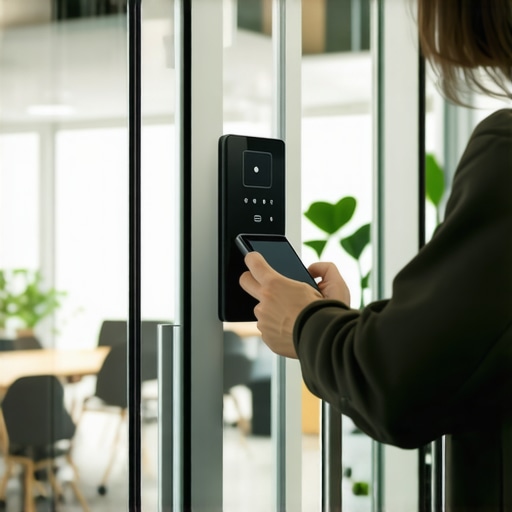
Cloud-based systems operate on a different physical principle. Instead of moving metal pins, we are dealing with encrypted data handshakes and electromagnetic relays. When a member approaches a door, their smartphone or a high-frequency RFID card communicates with the reader. The reader sends a signal to a controller, which then instructs an electric strike or a magnetic lock to release. [IMAGE_PLACEHOLDER] This setup allows for granular control that a deadbolt simply cannot match. If a member’s contract ends at midnight, their access is revoked at 12:01 AM automatically. There is no drive to the office, no locksmith fee, and no hardware waste.
The Hidden Costs of Traditional Hardware
Many owners look at the price of a commercial-grade smart lock or an integrated access system and balk, comparing it to the price of a basic ANSI Grade 2 deadbolt from a big-box store. This is a mistake in material science and economics. Standard residential-grade hardware is made of zinc or pot metal, which shears under the stress of 50-plus openings a day. For commercial buildings, panic bar installation and repair is a significant expense. A traditional panic bar requires a physical cylinder. If that cylinder is part of a master key system, the complexity of the wafers inside increases the likelihood of a mechanical jam. By integrating cloud access with high-quality panic hardware, you reduce the physical friction on the lock body itself, extending the life of the hardware by years.
“The strongest lock is useless if the key management protocol fails.” – Master Locksmith Association Handbook
We are seeing a shift toward integrated home security lock bundles and smart home security integration 2026 trends that are now hitting the commercial sector. Business owners are realizing that the labor involved in key extraction for deadbolts and the liability of unauthorized copies are costs that never end. With a cloud system, your ‘key’ is a digital token. It cannot be duplicated at a hardware store kiosk. This level of key control is the difference between a profitable square foot and one that is eaten up by maintenance overhead.
Security Logic: DIY vs. Professional Installation
I often hear from owners asking about deadbolt installation DIY vs pro. For a single door in a low-traffic area, a DIY approach might save you a hundred bucks today. But for a co-working space, the alignment must be perfect. If a door is off by even a fraction of an inch, the electric strike will bind. This puts load on the transformer and eventually fries the circuitry. A professional locksmith ensures a ‘flush fit,’ where the latch sits perfectly in the throat of the strike without rubbing. This is especially true when dealing with specialized needs like smart locks for pet doors in pet-friendly offices or car lockout services for Tesla models that members might require. Everything needs to work within a cohesive ecosystem.
Future-Proofing Your Investment
Looking at 2026 smart lock trends for homes and offices, the focus is on interoperability. A cloud-based system isn’t just about opening a door; it is about data. It tells you which rooms are being used most often, allowing you to optimize your HVAC and lighting. This is where the real money is saved. You aren’t just buying a lock; you are buying an operational management tool. Neighborhood watch lock recommendations are even starting to suggest these systems for community gates because the audit trail provides a level of accountability that metal keys never could. When you stop thinking about security as a piece of hardware and start thinking about it as a cloud-managed service, your profit margins will reflect the change.