
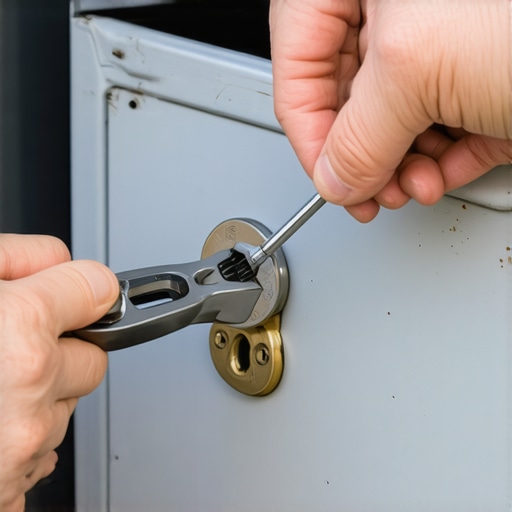
The Spinning Key Syndrome: A Forensic Autopsy of Mailbox Failure
You turn the key, you feel a slight resistance, and then a sickening pop. Now the key spins 360 degrees without engaging the latch. Most people immediately panic and think they need to wait six weeks for a USPS contractor to show up and charge a small fortune. I am here to tell you that as a master locksmith with over 25 years at the bench, this is a physics problem you can solve yourself with about twelve dollars in parts and twenty minutes of your time. I see this every week at my shop. A lady came into my shop crying because a scammer drilled her lock and charged her one hundred and fifty dollars for a twelve dollar mailbox lock. It is a classic trunk-slammer move. They see a simple residential lock cylinder replacement and turn it into a high-priced emergency residential lockout solution by destroying the hardware. Don’t be that victim. When a mailbox lock fails, it is almost always the cam, also known as the tailpiece, or the nut holding that cam in place. The internal physics are simple: a series of five or six wafers sit inside a plug. When the correct key is inserted, the wafers align with the shear line of the cylinder shell, allowing the plug to rotate. That rotation is transferred to a metal arm (the cam) that swings behind the frame of the mailbox. If that cam bends, rounds out, or falls off, you are staying out. Let’s look at why these things fail before we fix them.
“Security is always a trade-off between convenience and protection.” – Industry Axiom
The Material Science of Why Mailbox Locks Fail
The vast majority of mailbox locks, whether they are for a cluster box unit (CBU) or a wall-mounted unit, are made from zinc die-cast alloys, often disparagingly called pot metal in the trade. While your front door might feature the best residential door locks for safety and durability made of solid brass, your mailbox is usually cheap. Over time, the square or D-shaped hole in the cam begins to wallow out. This happens especially in regions where the humidity is high or during lock maintenance tips for winter 2026 scenarios where ice build-up causes the cam to bind against the frame. When you force the key against that resistance, the harder steel or brass of the lock plug eats away at the softer zinc cam. Eventually, the hole becomes a circle, and the plug spins while the cam stays still. This is why I tell my apprentices that if you have to force the key, you have already lost the battle. You are not just fighting the lock; you are fighting the metallurgy of the hardware itself. If you are dealing with a commercial property, this is where business key management software becomes vital to track which units have been upgraded to heavy-duty steel cams instead of the stock zinc ones.
Diagnosing the Cam Orientation
Before you go buying parts, you need to understand the throw. Mailbox locks are not universal. There are three main factors: the length of the cylinder, the shape of the cam, and the rotation direction. Most use a 90-degree or 180-degree turn. If you install a 180-degree cam on a 90-degree prep, your key will get stuck in the open position. It is a common mistake I see when homeowners try to DIY their residential lock cylinder replacement. You need to identify if your lock is a National, Hudson, or CompX style. Look at the face of the lock. Does it have a small dust shutter? Is the keyway vertical or horizontal when locked? These details matter because the cam must be clocked correctly on the back of the plug. If the cam is offset (bent either toward or away from the door), you must ensure the new one matches that exact offset. A millimeter of difference is the difference between a secure box and a door that rattles open in a stiff breeze.
“Standardized hardware is the illusion of safety when the installation is neglected.” – Security Manual
The Step-by-Step Recovery Process
If the lock is already open, the repair is easy. Use a 7/16-inch wrench to remove the nut on the back of the cylinder. If it is a clip-style lock, use a pair of needle-nose pliers to slide the large horseshoe clip off. Once the cam is free, inspect the tail of the plug. If the threads are stripped, the whole cylinder needs a residential lock cylinder replacement. If the threads are fine, simply swap the cam. If the mailbox is locked and you cannot get in, you might need to use a thin shim to try and depress the latch, but usually, a mailbox lock is simple enough that a basic wafer pick or a Lishi tool can get you in without damage. Unlike automotive transponder keys 2026 updates or complex automotive key programming near me, mailbox locks do not have electronics. They are pure mechanical interface. Once inside, replace the hardware and use a drop of blue thread locker on the nut. This prevents the vibration of the mail carrier slamming the big master door from loosening your hardware over time. For those looking at biometric keyless entry for cars or high-tech solutions, remember that sometimes the simplest mechanical fix is the most reliable.
Long-Term Maintenance and Weather Resistance
As we head into the colder months, lock maintenance tips for winter 2026 are crucial. Never use WD-40 in a lock. It is a solvent, not a long-term lubricant. It attracts dust and eventually turns into a sticky gum that freezes the wafers in place. Use a dry PTFE-based spray or high-grade graphite. This is especially true for mailbox locks that are exposed to the elements. If you are a business owner managing multiple units, ensure your panic bar code compliance 2026 checks include an audit of all external locks. Whether you are dealing with rekeying vs replacing locks which is better, the answer for mailboxes is almost always replacement because the cost of the hardware is so low compared to the labor of rekeying a cheap wafer lock. Keep your hardware clean, keep the cam nut tight, and you will never have to wait on the government to get your own mail.