
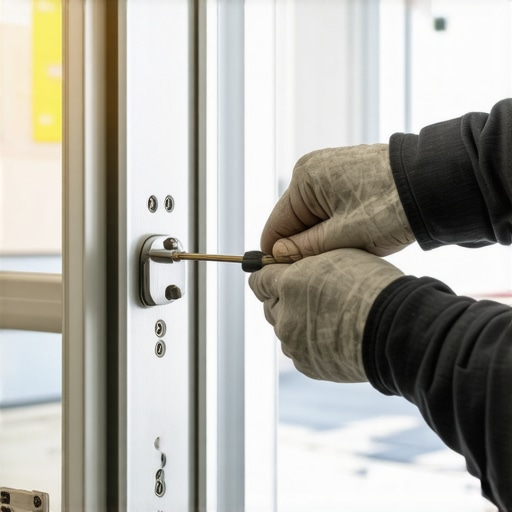
The Sound of a Failing Egress: The Forensic Autopsy
When you walk up to a commercial door and press that touch-bar, you expect a crisp, mechanical click. Instead, you get a mushy resistance or a metallic grind. That sound is the death knell of a poorly maintained exit device. As someone who has spent two and a half decades behind a workbench, I can tell you that a jammed panic bar is not just an inconvenience; it is a liability nightmare waiting for a fire marshal to find it. I once had a lady come into my shop crying because a scammer drilled her Grade 1 Von Duprin lock and charged her nearly a thousand dollars, only to leave the door unable to latch properly. He told her the whole chassis was shot. It wasn’t. It just needed a three-dollar spring and a technician who actually understood the physics of the internal cam. This is why I tell people to avoid those trunk-slammers who show up with a drill and a ‘one size fits all’ attitude. They do not understand the mechanical harmony required for life safety.
“Exit devices shall be designed such that a horizontal force of 15 pounds will release the latch and allow the door to open.” – ANSI/BHMA A156.3 Standard
Identifying the Mechanism Failure: Material Science at Work
To fix a jammed panic bar, you have to understand what is happening inside that aluminum or stainless steel housing. Most failures occur because of ‘pot metal’ fatigue in cheap, off-brand hardware. High security locks vs standard locks comparison often comes down to the internal components. A standard Grade 3 device uses zinc alloys that shear under the constant pressure of a heavy commercial door. When you compare high-security locks vs standard locks, you are looking at the difference between cast iron or stainless steel and cheap poured metals that crumble after ten thousand cycles. If your bar is stuck, the first thing I check is the vertical rod alignment. In a Surface Vertical Rod (SVR) system, the top and bottom latches must move in perfect synchronicity. If the bottom bolt is dragging on the floor because the building settled, the entire touch-bar will feel jammed. It is a simple physics problem: the force you apply to the bar cannot translate into vertical movement if the rod is physically blocked. This is a common issue I see in locksmith services for vacation homes or high-security locks for rental properties where the doors are neglected for months at a time.
The Technical Fix: Rekeying vs. Replacing the Chassis
If the bar is physically stuck down, you likely have a broken dogging assembly. Dogging is the mechanism that keeps the bar depressed during business hours. Many budget smart lock starter kits for residential use do not even have a concept for this, but in the commercial world, it is vital. If the hex key or the cylinder dogging unit fails, the internal sliding plate can wedge itself against the chassis. To fix this, you must remove the end cap and slide the housing off. Inspect the compression springs. If they are snapped, do not try to ‘stretch’ them back. Replace them with the specific tension-rated springs designed for that model. People often ask me about how to choose a reliable locksmith near me, and my answer is always the same: ask them if they stock Grade 1 parts. If they tell you they have to ‘rig it,’ show them the door. Neighborhood watch lock recommendations often overlook the technicality of commercial egress, but the same rules apply: quality metal saves lives. We are even seeing 2026 trends in automotive security, like car lockout services for Tesla models, influencing how we think about digital access control on these bars. Smart deadbolts with fingerprint scanners are starting to integrate with panic hardware, but the mechanical failsafe must always be the priority.
“Security is always a trade-off between convenience and protection.” – Industry Axiom
Lubrication and Final Alignment
Do not reach for the WD-40. That is the quickest way to turn your lock into a magnet for dust and grit, which creates a grinding paste that destroys the shear lines. Use a PTFE-based lubricant or a dry graphite spray. Spray the pivot points of the touch-bar and the latch bolt itself. If you are dealing with weatherproof outdoor locks reviews, you will see that silicon-based lubricants are better for extreme cold, but for most commercial interiors, a dry lubricant is king. Check the strike plate. If the latch is hitting the strike off-center, the friction will prevent the bar from retracting. This is why the ‘flush fit’ is the most important part of any installation. For those looking into high-security locks for rental properties, ensuring the door closer is properly adjusted is just as important as the lock itself. If the door slams, it jars the internal wafers and can cause a premature jam. While we wait for the 2026 trends in automotive security to trickle down further into commercial hardware, we must rely on these tried-and-true mechanical principles. A panic bar is a machine, and like any machine, it requires precision. If you have to force the bar, you have already lost the battle against physics. Proper maintenance prevents the need for emergency car lockout services or expensive commercial repairs later. Keep the rods straight, the springs tight, and the scammers away from your hardware.