
The Evolution of the Mechanical Handshake
I teach my apprentices that if you have to force the key, you have already lost. For twenty-five years, I have watched the evolution of automotive security from the simple double-sided bitted brass key to the complex transponders we see today. The physics of a traditional lock is a matter of alignment and shear lines. Inside a standard ignition or door cylinder, you have a series of wafers or pins. When the correct bitting on the blade enters the keyway, it pushes these wafers against small springs to a specific depth. If every wafer reaches the exact height where it no longer obstructs the rotation of the cylinder, the lock turns. It is a mechanical logic gate. But metal on metal creates friction. Brass wears down, wafers get gummed up with road grime, and eventually, the mechanical handshake fails. This is why fingerprint entry is not just a gadget; it is the logical successor to the physical key.
“Security is always a trade-off between convenience and protection.” – Industry Axiom
The Physics of Biometric Authentication
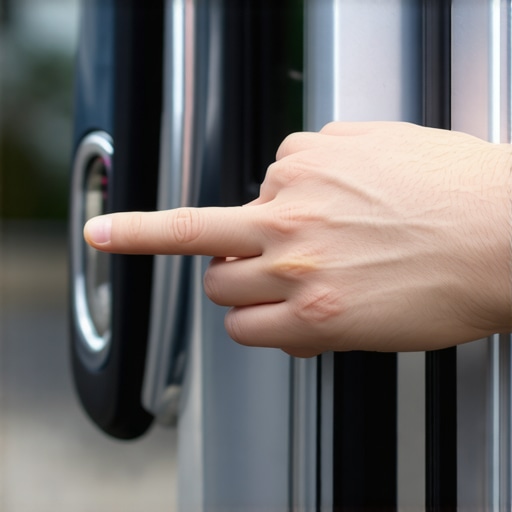
When we talk about fingerprint entry in vehicles, we are moving from mechanical logic to digital encryption. Most modern systems utilize capacitive sensors. Unlike an optical scanner that just takes a picture of your thumb, a capacitive sensor uses the electrical charge of your skin to map the ridges and valleys of your print. These sensors consist of tiny capacitor plates. When your finger touches the sensor, it changes the charge at the points of contact. The software then creates a digital map, a mathematical representation of your biometric data. This data is never stored as an image; it is an encrypted hash. When you touch the handle of a car equipped with this tech, the sensor sends a signal to the Electronic Control Unit (ECU). The ECU compares the live hash to the stored one. If they match, it sends a rolling code command to the door actuator and the immobilizer system. This removes the physical vulnerability of a lock cylinder that can be picked with a Lishi tool or forced with a screwdriver.
Why Traditional Hardware is Failing the Modern Driver
The traditional car key is a liability in a world of high-speed theft. A physical key can be duplicated in seconds if someone gets their hands on it for a moment. Furthermore, the ignition housing is often the weakest point of a vehicle. In my shop, I often see ignition cylinders that have been shredded by thieves using slide hammers. By moving to fingerprint entry, manufacturers are removing the physical interface entirely. There is no hole to stick a tool into. This is a massive shift in the automotive operational lane. Just as access control for co-working spaces has moved toward biometric and mobile credentials, the automotive industry is realizing that physical metal is the bottleneck. The same logic applies to push-button locks for offices; removing the physical keyway removes the primary point of failure for both wear and attack.
Weather Resilience and Winter 2026 Maintenance
One of the biggest concerns my customers have is how these systems handle the elements. As we look toward lock maintenance tips for winter 2026, we have to consider the conductivity of the sensor. In extreme cold, the moisture on your skin or the frost on the handle can interfere with the capacitive reading. A master locksmith knows that electronics hate moisture. High-end systems now include heater elements behind the sensor glass to melt ice. For those still using traditional locks, the old-school advice was often a squirt of WD-40, which is a mistake I see daily. WD-40 attracts dust and turns into a sticky paste. I always recommend a dry PTFE lubricant for mechanical parts, but for biometric sensors, the maintenance is purely external. Keep the sensor clean with an isopropyl wipe to ensure the capacitive plates can read the skin’s electrical discharge clearly. If you are dealing with a high-security euro cylinder locks at home, you care about drill resistance; in your car, you now care about sensor clarity.
“Standardization of biometric data ensures that security protocols remain robust against brute force digital attacks.” – ANSI/BHMA Security Manual
The Forensic Reality of Lost Access
What happens when the system fails? People ask me about lost wallet key replacement fast scenarios. In the old days, I would cut a key by code and program the transponder chip. With fingerprint systems, there is usually a secondary encrypted backup, often via a smartphone app or a physical emergency key hidden in the fob. If the car battery dies, the fingerprint sensor will not function. This is where the physical world meets the digital. Most biometric door handles have a concealed mechanical override. I tell people that even with the best smart locks with video integration or fingerprint car doors, you must know where your mechanical override is located. A locksmith is no longer just a guy with a file; we are mobile computer technicians who understand the rolling code architecture of the vehicle’s CAN bus system.
Biometrics vs. Traditional Residential Security
There is a lot of talk about the best residential door locks for safety and durability. While cars are going full biometric, homes are a bit slower. This is because a house stays still and is subject to different forces, like door frame warping or settling. A deadbolt installation DIY vs pro debate often comes down to the alignment of the strike plate. If a biometric deadbolt is misaligned by even a millimeter, the motor will burn out trying to throw the bolt. On a car, the latches are much more precise. The fingerprint tech works better in automotive because the tolerances are tighter. However, for those looking at how to extract a broken key from a lock safely, the ultimate answer in 2026 will be: don’t use a key at all. If there is no key, there is nothing to break off in the cylinder. We are seeing a move toward high-security euro cylinder locks that utilize hybrid tech: a physical key with an embedded RFID or biometric trigger.
The Scam Buster: Avoiding the $29 Locksmith Trap
Whether you are locked out of your fingerprint-enabled car or your house, the scammers are the same. They promise a $15 or $29 service call and then show up with a drill. A real locksmith has invested thousands in diagnostic tools like the Autel IM608 or specialized Lishi picks. If a technician arrives at your modern vehicle and immediately suggests drilling the lock or breaking a window because the ‘electronics are too complex,’ send them away. A master technician understands how to bypass the security module or use an EEPROM programmer to add a new biometric profile to the car’s memory. Security involves trust, not just metal. Whether it is access control for co-working spaces or your personal truck, the person touching your security system needs to know the physics of the bypass, not just how to destroy the hardware.