
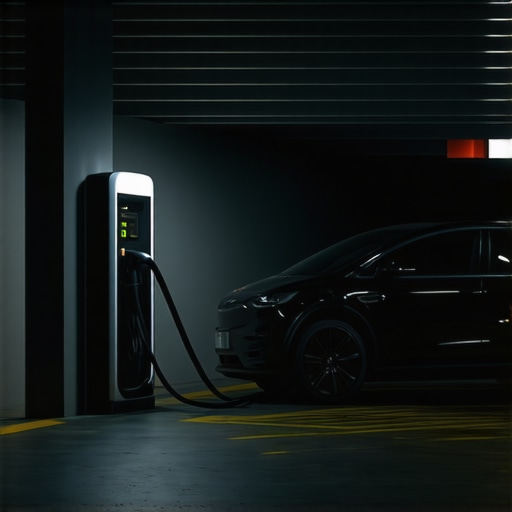
Walk up to almost any modern public Electric Vehicle (EV) charging station and you will find a multi-thousand-dollar piece of infrastructure secured by a lock that wouldn’t keep an honest toddler out. While municipal planners focus on high-speed cables, payment processors, and power grid integration, physical security remains a critical blind spot. As a locksmith with over twenty-five years at the workbench, I see these vulnerabilities daily. We are building a massive national network of high-voltage devices secured by wafer locks that can be bypassed in under three seconds with a bent piece of spring steel. This is not just a nuisance; it is an open invitation to vandalism, copper theft, and grid disruption.
“Physical security is the foundational layer of all logical security; without it, electronic protocols are merely decorative.” – Modern Security Axioms Handbook
I teach my apprentices that if you have to force a key, you have already lost. The same philosophy applies to physical cabinet design. When manufacturers rush products to market, they treat the mechanical lock as an afterthought. They buy off-the-shelf utility locks made of cheap cast zinc. This material has no tensile strength and shears easily under minimal torque. When an EV station’s maintenance panel is compromised, thieves do not just steal a few copper wires; they expose critical communication buses, power distribution blocks, and digital controllers that manage high-voltage electricity.
The Anatomy of a Low-Security Lock Cabinet
To understand the vulnerability, we have to look inside the lock cylinder. Most commercial EV charging stations use basic five-disc wafer locks or low-tier pin-tumbler systems. Inside these locks, thin metal wafers rely on a weak sidebar mechanism. A professional lockpicker, or even an amateur using basic rakes, can align these wafers with zero resistance because the tolerances within the cheap cast plug are massive. Once the cylinder turns, the cam arm swings free of the frame keeper. There are no hardened steel plates, no spool pins to prevent picking, and no protective shrouds.
This lack of physical protection is particularly glaring when compared to other high-value outdoor machines. Parking meters and ATMs use heavy-duty, drill-resistant tubular locks or high-security rotating disc-detainer systems. In contrast, EV infrastructure is left exposed. In dense urban centers, where locksmith costs in urban areas 2026 reflect the high demand for security upgrades, fixing these vulnerable stations after a breach is far more expensive than installing proper hardware from the start.
Why Electronic Security is Not Enough
Many EV network operators believe their digital firewalls and mobile app locksmith booking 2026 systems protect the chargers. They assume that if a cabinet is opened, an internal sensor will send an alert. However, by the time an alert reaches a central dispatch board, the physical damage is already done. A vandal with a simple pry bar can bypass the weak latching points, slice through the charging cables for their copper content, or destroy the main circuit board. Physical barriers must delay an attacker long enough to make the attempt not worth their time.
We must look at how we secure other commercial assets. For example, master key systems for hotels 2026 utilize physical restrictions, patent-protected keyways, and strict key-control policies to prevent unauthorized duplication. The EV charging industry needs a similar paradigm shift. We must move away from cheap utility locks and embrace robust mechanical security standards.
Upgrading the Physical Perimeter
Securing these high-voltage systems requires a multi-layered mechanical defense. First, the cabinet doors must be constructed of heavy-gauge steel or reinforced aluminum, eliminating pry points. Second, the standard wafer lock must be replaced with an Interchangeable Core (IC) cylinder that can be integrated into a secure grand master key system. These cylinders should feature hardened steel drill pins inside the shell and plug to ruin high-speed drill bits.
Adding physical deterrents like a lock shield installation for doors can prevent direct tool access to the lock face. Just as businesses rely on commercial panic exit devices 2026 to secure escape routes, or specialized commercial mailbox lock repairs to protect sensitive mail, EV charging stations need physical barriers designed for rugged, unsupervised environments. When we treat physical security as a fundamental engineering requirement rather than a compliance checklist, we protect not only the hardware but the stability of our transport network.
“Security is always a trade-off between convenience and protection.” – Industry Axiom
We cannot build the future of transportation on a foundation of weak zinc locks. It is time for municipal planners and hardware manufacturers to step up, consult with professional locksmiths, and build charging stations that can actually withstand the physical realities of the street.