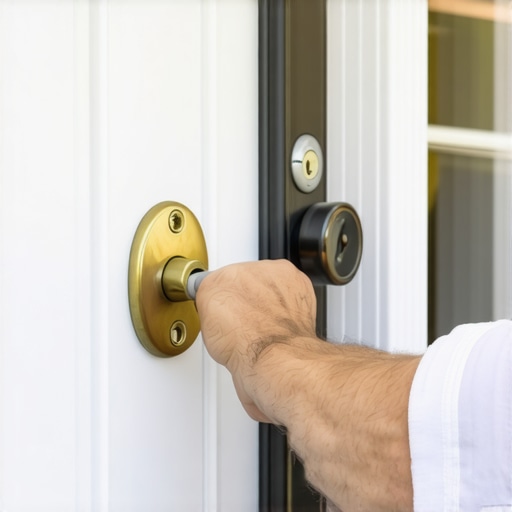
The Cost of ‘Close Enough’ in Home Security
I teach my apprentices that if you have to force the key, you’ve already lost. In my 25 years behind the bench at my shop, I’ve seen enough mangled brass and warped strike plates to know that a deadbolt isn’t just a piece of hardware; it’s a physics equation. When you buy a lock from a big-box retailer and try to slap it on your door with a cordless drill and a prayer, you aren’t just risking a lockout—you’re basically handing a burglar an invitation. By 2026, with the rise of smart home ecosystems and more complex high-security euro cylinder locks, the margin for error has shrunk to nearly zero. Most homeowners think they’ve secured their house when they hear that ‘click,’ but if the internal physics are misaligned, that click is actually the sound of a failure waiting to happen.
“Security is always a trade-off between convenience and protection.” – Industry Axiom
1. The Strike Plate Shallows: The Kick-In Invitation
The biggest failure I see in 2026 isn’t the lock itself; it’s how it anchors to the world. Most DIYers use the flimsy 1-inch screws that come in the box. Those screws only grip the soft wood of the door jamb. When a 220-pound intruder puts a shoulder to the door, that wood splinters instantly. A master locksmith knows that the strike plate is the most critical component of the assembly. If you aren’t using 3-inch hardened steel screws that penetrate the actual wall stud behind the jamb, you don’t have a deadbolt; you have a decorative paperweight. We look at the physics of the ‘throw.’ A deadbolt must extend fully into the pocket to engage its internal deadlatched position. If the hole in the jamb is too shallow, the bolt never fully ‘deadlocks,’ meaning a simple credit card or a shim can retract it. This is why residential keypad locks reviews often complain about ‘battery drain’—the motor is constantly struggling to push a bolt into a misaligned hole, killing the electronics before their time.
2. Tailpiece Timing and the ‘Crunch’ of Death
Inside every deadbolt is a tailpiece—a flat metal bar that connects the cylinder to the bolt mechanism. If you install this even a few degrees out of timing, you create ‘side-loading’ on the pin tumblers. I’ve performed countless key extraction for deadbolts where the key snapped off simply because the owner had to torque it too hard to overcome a poorly aligned tailpiece. When you rotate the key, the plug turns, lifting the bottom pins to the shear line. If the tailpiece is binding, the driver pins and springs are subjected to lateral pressure they weren’t designed to handle. This wears down the brass of the plug and creates ‘mushy’ feedback. In 2026, as we integrate best smart locks compatible with Alexa 2026, this mechanical friction becomes even more deadly. A smart motor doesn’t have the ‘feel’ of a human hand; it will simply force the mechanism until the plastic gears inside the smart lock ecosystem strip out entirely.
“High-security cylinders must resist not only physical force but also sophisticated surreptitious entry through tighter tolerances.” – ANSI/BHMA Security Standard
3. Material Science: The Zinc vs. Steel Trap
The third failure is choosing ‘Grade 3’ hardware for a ‘Grade 1’ world. Most retail deadbolts are made of pot metal or zinc alloys with a thin brass plating. If you take a saw to a cheap deadbolt, you’ll see it’s porous inside. A high-security euro cylinder lock or an ANSI Grade 1 deadbolt uses hardened steel inserts and solid brass components. When DIYers install cheap hardware, they ignore the ‘bypass’ vulnerabilities. A thief doesn’t need to pick your lock if they can just use a pipe wrench to snap the cylinder collar because the metal is brittle. Furthermore, many people ignore their secondary entries, like using a locksmith for commercial mailbox lock repairs or neglecting the side garage door. If you are building a master key system for hotels 2026 or even a large residential estate, every point of entry must have uniform material strength. Preventing bike lockouts with smart tech is great, but it’s useless if your front door can be defeated with a hammer because you saved $20 on a zinc deadbolt at the hardware store.
The 2026 Reality of Smart Home Security
As we move further into the era of affordable biometric door hardware, the physical installation becomes even more precise. If your door isn’t hung perfectly square, the biometric sensor might authorize access, but the bolt will fail to retract. I’ve seen homeowners get locked out of their own ‘smart homes’ because the wood door swelled in the summer humidity, and their DIY installation didn’t account for the 1/8th inch of play required for the bolt to move freely. Whether you are looking for automotive key programming near me for your car or trying to harden your home, remember that metal doesn’t lie. If the mechanism feels tight, something is wrong. Don’t wait until you’re staring at a broken key or a kicked-in door to realize that security is a trade of precision, not just a weekend project.


![5 Toughest Front Door Locks for 2026 Home Security [Tested]](https://prolocksmithco.com/wp-content/uploads/2026/03/5-Toughest-Front-Door-Locks-for-2026-Home-Security-Tested-500x330.jpeg)