The Anatomy of a Jammed Lock: A Master Locksmith’s Guide to 2026 Hardware
You feel it before you hear it. That gritty, granular resistance when you slide your key into the plug. You apply a fraction more torque, and instead of the satisfying thud of the bolt retracting, you get a sickening ‘crunch’ or, worse, a spongy lack of feedback. As a locksmith with over 25 years on the bench, I see this daily. Most people respond by forcing the key. That is the moment you transform a thirty dollar maintenance issue into a five hundred dollar emergency extraction. I teach my apprentices that if you have to force the key, you have already lost the battle against physics. A lock is a precision instrument, a series of sub-millimeter tolerances where brass pins must align perfectly at the shear line. When it jams, the mechanism is telling you that the internal geometry has failed. In 2026, with the rise of thinner, cheaper zinc-alloy components in big-box hardware, these failures are happening faster than ever. This guide is a forensic autopsy of why your lock is sticking and the four professional-grade fixes you need to implement before your key becomes a permanent, snapped-off resident of your cylinder.
“Security is always a trade-off between convenience and protection.” – Industry Axiom
The Mechanics of Failure: Why Your Lock Is Fighting You
To understand how to fix a sticking door lock mechanism, you must understand what is happening inside the Bible of the lock. Inside a standard pin-tumbler lock, you have a series of stacks. Each stack consists of a bottom pin (which touches your key), a top pin (the driver), and a compressed spring. When the correct key is inserted, the gap between the bottom pin and the driver pin aligns perfectly with the edge of the plug. This is the shear line. If a single pin is off by the width of a human hair, the driver pin stays bridged across the plug and the shell, preventing rotation. Jams usually occur because of three physical realities: debris accumulation, metal fatigue, or structural misalignment. Over time, microscopic shavings of brass from your key accumulate inside the chambers. These shavings mix with moisture and cheap oils to create a ‘sludge’ that prevents the springs from fully resetting the pins. In 2026 smart lock trends for homes, we are seeing a new culprit: motorized torque failure. If your smart lock is struggling to throw the bolt because the door is misaligned, the motor gears will eventually strip or the software will throw a false ‘jammed’ error, even if the mechanical pins are fine. This is why a biometric locks installation guide 2026 must always prioritize the physical strike plate alignment before the electronic setup.
Fix 1: The Chemical Cleanse (Avoiding the WD-40 Trap)
The biggest mistake I see in my shop is a lock dripping with WD-40. Stop doing that. WD-40 is a solvent, not a long-term lubricant for precision pins. It might provide a temporary slickness, but it eventually dries into a sticky film that attracts dust like a magnet, creating a grinding paste that destroys your pins. If you want to fix a sticking door lock mechanism properly, you use dry PTFE (Teflon) spray or high-grade graphite. However, before lubricating, you must flush the gunk out. Use a dedicated electronic cleaner or a high-pressure air burst to clear the chambers. Insert your key and ‘rake’ it in and out rapidly without turning. This movement breaks up the solidified sludge. Once the movement feels smoother, apply a single puff of graphite or a quick shot of PTFE. This maintains the integrity of the shear line without attracting the grit that leads to a 3 AM call for 24/7 emergency locksmith services explained by a total mechanical failure.
Fix 2: Striking the Balance (Physical Door Alignment)
Often, the lock isn’t the problem; the house is. Wood expands and contracts with the seasons. If your door has sagged by even two millimeters, the deadbolt will no longer hit the center of the strike plate hole. It will rub against the metal, creating friction that feels like a jammed cylinder. To diagnose this, look for wear marks on the strike plate. If you see shiny metal where the paint has worn off at the top or bottom of the hole, your door is misaligned. The fix isn’t more force; it is a longer screw. Remove one of the screws from the top hinge of your door and replace it with a three-inch hardened steel screw. Drive it all the way into the wall stud. This pulls the entire door frame back into square, lifting the lock side and aligning the bolt perfectly with the hole. This is a foundational step in any biometric locks installation guide 2026 because electronic motors have zero tolerance for friction. If the motor has to fight a misaligned strike plate, it will drain your batteries in a week and eventually burn out the solenoid.
Fix 3: Upgrading to Commercial Restricted Keyways
If your lock continues to jam despite cleaning and alignment, you are likely dealing with ‘pot metal’ fatigue. The internal cams and tailpieces of cheap residential locks are often made of zinc alloys that warp under stress. I recommend homeowners look toward commercial restricted keyways. These systems, once reserved for hospitals and banks, are becoming common in residential settings for 2026. A restricted keyway means the keys cannot be duplicated at a kiosk or a hardware store; only a verified locksmith with the specific contract can cut them. More importantly, the hardware is built to ANSI Grade 1 standards. This means the internal pins are made of hardened nickel-silver rather than soft brass, and the springs are stainless steel. When you use business key management software to track who has access to your home, you combine digital oversight with mechanical 18-wheeler durability. This prevents the ‘mushy’ feeling of a failing residential cylinder and provides a level of pick resistance that standard locks simply cannot match.
“The strength of a lock is only as good as the frame it is anchored to.” – Security Manual 101
Fix 4: The 2026 Digital Transition (Smart Locks and Pet Doors)
Sometimes the best fix for a jamming mechanical lock is to remove the mechanical dependency altogether. 2026 smart lock trends for homes are moving toward ‘frictionless’ entry. This includes smart locks for pet doors that sync with your main entry system. If your mechanical cylinder is shot, consider a voice-activated locks setup tutorial or a biometric system. Modern biometric locks use capacitive sensors that work even with wet or aged fingerprints. By switching to a smart system, you often replace the traditional ‘tailpiece’ with a direct-drive motor. However, ensure the system has an emergency override. In my experience, even the most advanced biometric locks need a mechanical backup. For those who manage multiple properties, business key management software can integrate with these locks to provide temporary codes, eliminating the need for physical keys that can snap or jam. If you are going this route, make sure to follow a transponder key programming guide if your system integrates with your vehicle, as modern ‘Whole Life’ security ecosystems are becoming the norm.
When the Fix Fails: Recognizing a Total Seizure
There comes a point where no amount of PTFE or hinge-tightening will save the lock. If you turn the key and hear a ‘click-click-click’ without the bolt moving, the actuator or the tailpiece has snapped. At this stage, do not keep turning. You risk locking yourself into a situation where even a locksmith cannot pick the lock and must resort to more invasive measures. This is where emergency safe cracking services techniques come into play; sometimes we have to drill the ‘hard plate’ of a high-security lock to manually trip the fence. To avoid this, vet your local technician before the crisis. Many ‘trunk slammers’ will claim they need to drill your lock immediately just to sell you a marked-up replacement. A real pro will try a Lishi pick or an air wedge first. Security involves trust, not just metal, and knowing when your hardware has reached its end of life is the mark of a smart homeowner. If your lock is over ten years old and starting to stick, don’t wait for 2027; replace it now with a high-quality ANSI Grade 1 or 2 deadbolt and enjoy the peace of mind that comes with a smooth, reliable throw. “,
“image”: {
“imagePrompt”: “A high-detail, technical macro photograph of the internal components of a disassembled brass door lock cylinder. The image should show the pins, springs, and the shear line with microscopic metal shavings visible, illustrating the friction points. The lighting should be dramatic, highlighting the metallic textures and the precision of the locksmith’s bench environment.”,
“imageTitle”: “Internal Mechanics of a Jammed Pin Tumbler Lock”,
“imageAlt”: “Macro view of brass lock pins and springs showing wear and debris accumulation inside the cylinder.”
},
“categoryId”: 0,
“postTime”: “”
}


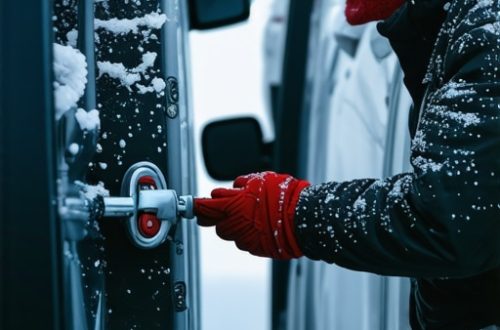
![How to Fix a Sticking Door Lock Mechanism Without a Pro [2026]](https://prolocksmithco.com/wp-content/uploads/2026/03/How-to-Fix-a-Sticking-Door-Lock-Mechanism-Without-a-Pro-2026-500x330.jpeg)